Amazon Web Services Expands Serverless Capabilities With Native GPU Support for Lambda Managed Instances

Amazon Web Services (AWS) has announced the official general availability of Graphics Processing Unit (GPU) support for Amazon EC2 G-series instances operating within AWS Lambda Managed Instances (LMI). This development introduces serverless operational simplicity to compute-intensive, GPU-accelerated workloads such as machine learning inference, real-time media processing, high-performance scientific computing, and computer graphics rendering.
For years, developers seeking to harness the parallel processing power of GPUs faced a steep operational overhead. Deploying machine learning models traditionally required manually selecting underlying cloud infrastructure, manually installing and updating intricate GPU drivers and CUDA libraries, provisioning multi-node clusters, writing complex auto-scaling logic, and hand-crafting event integration pipelines. Furthermore, because standard GPUs are costly and workloads frequently experience sporadic utilization patterns, organizations often paid for idle silicon while small inference jobs failed to saturate available hardware.
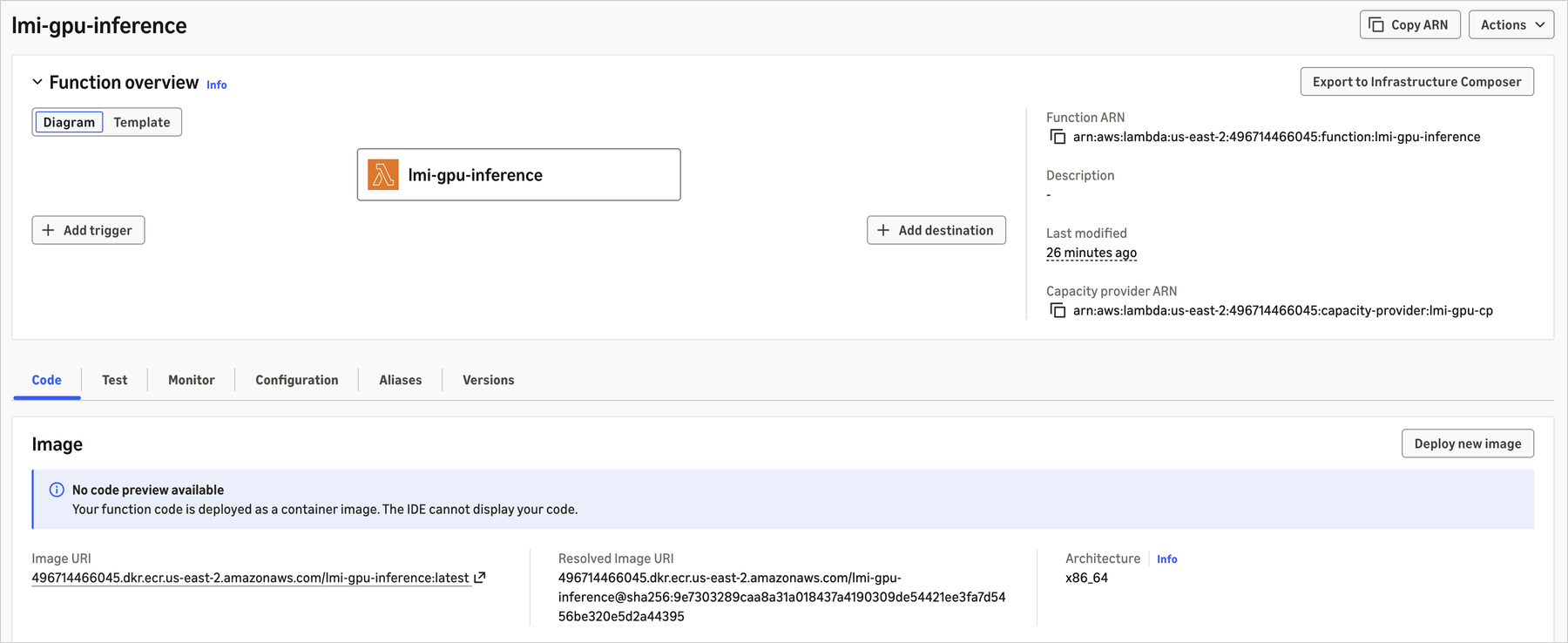
The integration of GPU support into AWS Lambda Managed Instances bridges this structural gap. By packaging accelerated workloads as Open Container Initiative (OCI) images, developers can now deploy functions that interface natively with over 200 AWS event sources—including Amazon S3, Amazon SQS, and Amazon API Gateway—without managing a single virtual machine or configuring a device plugin.
Architectural Mechanics and Deployment Workflow
The newly released feature integrates deeply into the existing Lambda programming model while leveraging the architectural foundation of Lambda Managed Instances. Unlike traditional serverless functions that run on heavily abstracted, short-lived micro-environments, LMI grants developers granular control over memory-to-vCPU ratios, ephemeral storage blocks, and accelerator memory sizes, while preserving the cost models and security baselines of Amazon EC2.
Deploying a GPU-accelerated function follows a structured four-phase workflow: capacity provider configuration, container image creation, function definition, and version publication.

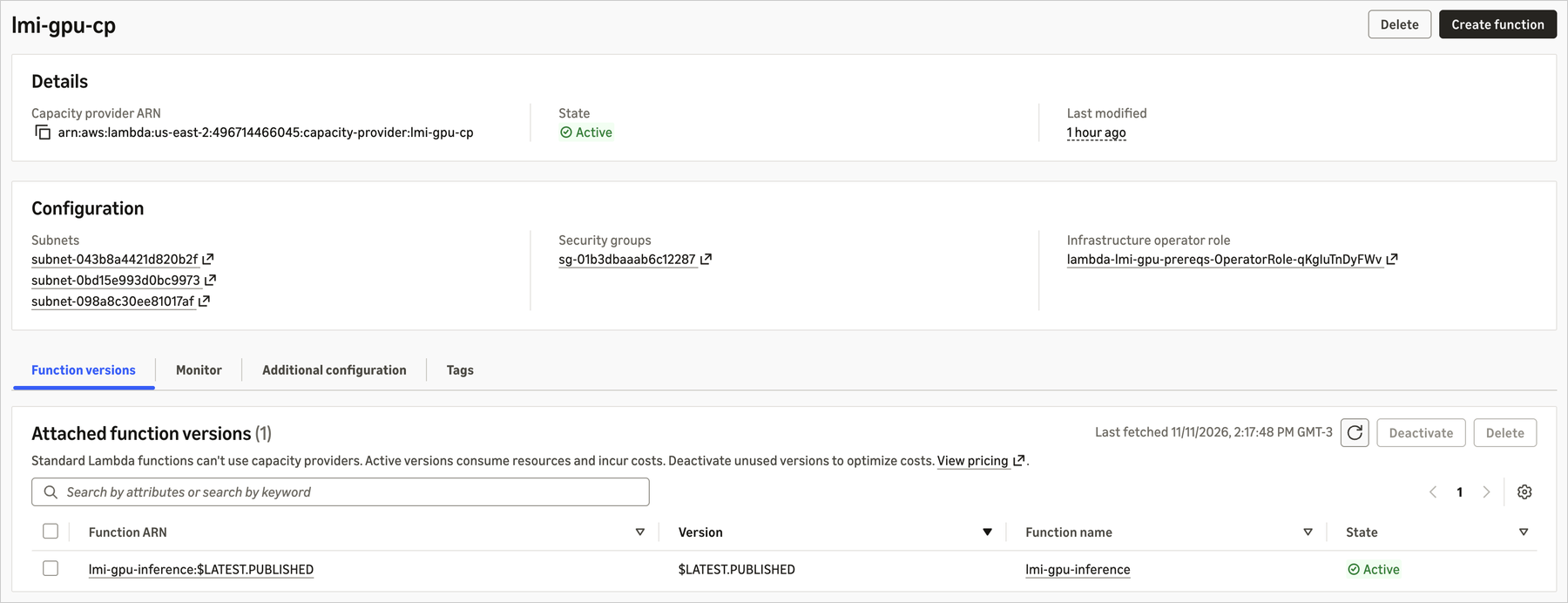
- Capacity Provider Setup: Users establish a capacity provider specifying permissible EC2 G-series instance types (such as g5, g6, and g6e instances) along with Virtual Private Cloud (VPC) configurations and scaling limits. Lambda dynamically handles auto-scaling across these families, falling back gracefully to alternate generations when regional capacity tightens.
- Container Image and Curated Runtimes: To eliminate manual software provisioning, AWS provides a curated suite of base images. These include
base:cuda,cupy:cuda,pytorch:cuda, and optimized serving runtimes likevllm:cudaandsglang:cuda. Developers can deploy open-source Large Language Models (LLMs) by simply defining the model repository within the environment variables. - Function Provisioning and Accelerator Configuration: Using the
AcceleratorConfigparameter, operators define the minimum accelerator memory required. Lambda matches this request to the most cost-effective underlying instance. Additionally, functions leverage Seekable OCI (SOCI) lazy loading, which can reduce execution environment startup times by up to 70 percent by streaming container layers on-demand. - Publishing and Invocation: Functions operate from published versions. The initialization phase—including model weight downloads and engine warm-up—occurs during the version-publishing step rather than upon the initial user invocation, preventing cold-start latency for end users.
Operational Efficiency and Concurrency Management
One of the primary engineering challenges solved by this release is low GPU utilization. In conventional deployments, a single low-volume inference query ties up an entire graphics card. Lambda Managed Instances resolve this inefficiency through multi-tenant execution environment concurrency.
By configuring the PerExecutionEnvironmentMaxConcurrency parameter, operators can route multiple concurrent requests to a single execution environment. Serving frameworks like vLLM batch these concurrent invocations together, sharing a single copy of the model weights residing in the GPU’s high-bandwidth memory. Consequently, throughput scales linearly without requiring redundant hardware allocation.
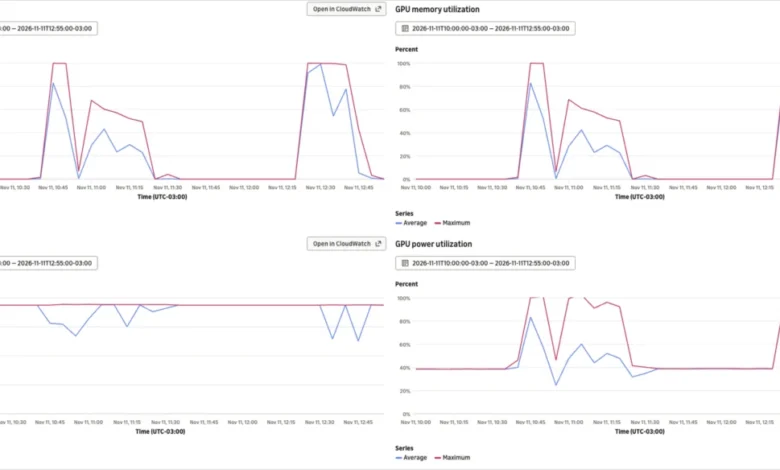
To maintain visibility into these complex computational environments, AWS has integrated GPU-specific metrics directly into Amazon CloudWatch. Engineers can monitor real-time GPU utilization, GPU memory utilization, total memory consumed, and power draw alongside standard Lambda execution metrics. This telemetry data provides the empirical signals necessary to optimize auto-scaling policies and audit infrastructure spend.
Ecosystem Integration and Advanced Workloads
Beyond basic text and chat completions via OpenAI-compliant APIs, the new capability interoperates cleanly with advanced AWS serverless patterns:
- Lambda Durable Functions: Multi-step, long-running workflows can orchestrate complex operations around the GPU step, complete with automatic checkpointing and state recovery.
- Lambda MicroVMs: Untrusted or dynamically generated code can execute safely within isolated CPU sandboxes before handing off heavy processing tasks to the GPU-accelerated function.
- Extended Timeouts: Supporting execution timeouts of up to 90 minutes for asynchronous and event-source-mapped invocations, organizations can execute long-running batch jobs, such as multi-step video transcoding or extensive data inference pipelines, without re-architecting their software.
Industry Context and Economic Implications
The convergence of serverless computing and hardware acceleration reflects a broader industry shift toward consumption-based infrastructure models for artificial intelligence. Industry analysts note that as organizations mature past the initial experimentation phase of generative AI, cost control and operational efficiency have become paramount.
By allowing businesses to run custom, smaller-scale models—such as the Qwen2.5-1.5B-Instruct model utilized in initial AWS demonstrations—directly within an event-driven architecture, companies can avoid the prohibitive latency and data privacy concerns associated with third-party managed APIs, while sidestepping the infrastructure burdens of self-hosted Kubernetes clusters.
Furthermore, economic flexibility is maintained through compatibility with existing financial instruments. GPU instances run as Amazon EC2 On-Demand instances, meaning existing AWS Savings Plans and Reserved Instances apply directly to the underlying hardware fees. AWS charges a 9.75 percent management fee for the GPU instances alongside standard Lambda request pricing of $0.20 per million requests. Organizations seeking guaranteed hardware availability can also pair the service with EC2 On-Demand Capacity Reservations (ODCR).
Availability and Getting Started
The GPU-accelerated functions feature is generally available in select AWS Regions, supporting EC2 G-series instances including G4dn, G5, G6, G6f, Gr6, Gr6f, and G6e families at launch, with broader hardware support anticipated. New accounts are advised to review and request increases to their On-Demand G and VT instance quotas prior to production deployments. Comprehensive documentation, curated container repositories, and infrastructure-as-code templates are available through the official AWS Lambda console and documentation portal.
Related posts: