How SmileID Scaled Identity Verification Across 18,000 Android Devices Using CameraX

The challenge of verifying digital identities in an increasingly fragmented mobile landscape has become a critical bottleneck for financial technology firms, particularly in emerging markets. SmileID, a leading provider of identity verification services across Africa, recently addressed this hurdle by migrating its core Android software development kit (SDK) to Google’s CameraX library. This transition allowed the company to overcome deep-seated hardware fragmentation, ultimately enabling the processing of over 160 million identity verifications. The shift not only resolved persistent technical failures on lower-end hardware but also served as a catalyst for a 20-fold increase in SDK adoption over two years.
The Landscape of Fragmentation
To perform accurate identity verification, applications must capture high-resolution imagery capable of passing rigorous liveness and anti-spoofing tests. These tests are designed to distinguish between a real human subject and a digital deepfake or physical spoofing attempt. Historically, achieving this on Android has been a notoriously difficult engineering task. The platform is characterized by a vast, heterogeneous ecosystem of devices, ranging from flagship smartphones with advanced image signal processors to entry-level handsets with highly constrained memory and obscure regional components.
For SmileID, the stakes were exceptionally high. Approximately 85% of the devices utilized by their customer base run on the Android operating system. This demographic includes not only consumer-grade smartphones but also ruggedized, custom-built Point of Sale (POS) terminals that often lack the standardized camera hardware found in mainstream devices. Before adopting a more robust framework, the engineering team at SmileID frequently grappled with critical issues such as stretched camera previews, incorrect sensor rotations, and, most damagingly, out-of-memory (OOM) crashes that disrupted the user journey at the most critical moment of account onboarding.
Chronology of the Migration
The transition to CameraX was not an overnight endeavor but a strategic response to the limitations of legacy APIs. Prior to the integration, SmileID relied on the aging Camera1 and the complex, low-level Camera2 APIs. These older systems forced developers to write exhaustive, device-specific code blocks to handle the idiosyncrasies of various hardware manufacturers.

By the time the migration project commenced, SmileID’s year-over-year SDK adoption was limited to a growth rate of 2-3x. A significant portion of their traffic had to be diverted to fallback mechanisms—such as uploading static images via REST APIs—because real-time, on-device liveness checks were failing on too many handsets.
The engineering team opted for a ground-up reconstruction of their SDK using CameraX, which is specifically designed to abstract away the underlying complexities of the device ecosystem. By leveraging CameraX’s native lifecycle-aware architecture, the team successfully implemented a dual-purpose pipeline that simultaneously handled user previews and backend image analysis. This transition allowed them to standardize the camera lifecycle, ensuring that the camera would release resources appropriately when an app went into the background, thereby significantly reducing the frequency of OOM errors.
Empirical Impact and Performance Metrics
The results of the migration were immediate and quantifiable. According to internal data provided by SmileID, the integration of CameraX provided a technological foundation that allowed them to support over 18,000 distinct Android device types.
Perhaps the most significant business impact was the 20% increase in verification pass rates. In the context of digital banking and mobile money, where user churn is often driven by friction during the sign-up process, this improvement represents a substantial gain in accessibility. Furthermore, the ability to capture higher-quality images allowed for a 4x increase in the resolution of selfies and liveness frames without incurring additional network overhead. This was achieved through intelligent cropping and processing, ensuring that the data sent to the cloud for deepfake detection remained optimized for low-bandwidth environments.
The scalability of this new architecture is best illustrated by the adoption trajectory. Within the first year of the CameraX implementation, SmileID experienced a 15x surge in adoption, which climbed to 20x by the end of the second year. To date, the platform has successfully processed more than 160 million verifications, a volume that would have been mathematically impossible under the limitations of their previous camera implementation.

Technical Precision: The ResolutionSelector API
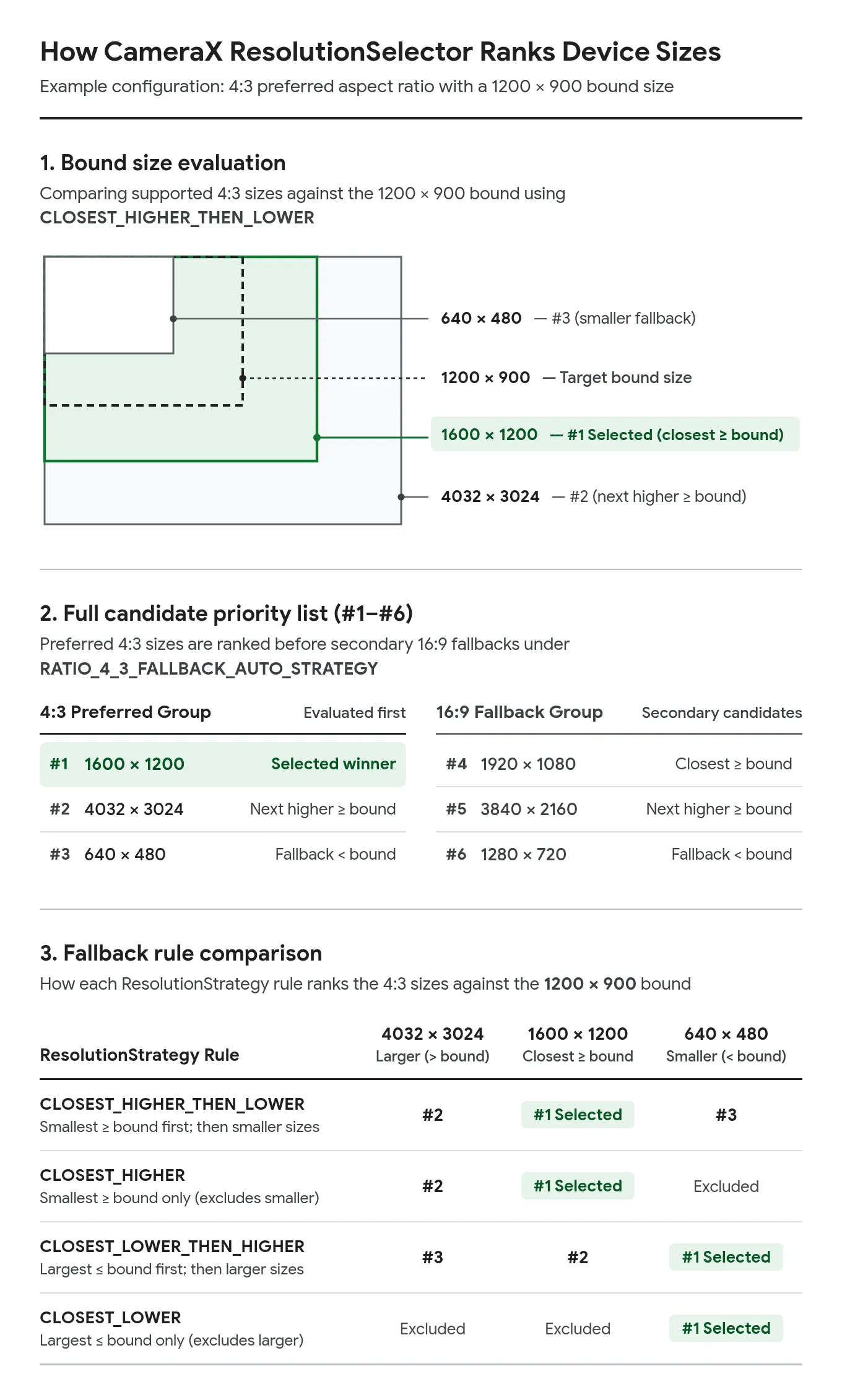
Central to this success was the utilization of the CameraX ResolutionSelector API. This tool allowed the engineering team to define a target resolution—specifically 1200×900 pixels—and implement a fallback strategy for devices that did not support that exact specification. By utilizing FALLBACK_RULE_CLOSEST_HIGHER_THEN_LOWER, the developers ensured that the SDK prioritized image sharpness whenever the hardware allowed, while maintaining a fallback to lower resolutions to preserve memory when necessary.
This configuration was paired with ImageAnalysis.STRATEGY_KEEP_ONLY_LATEST, a backpressure strategy that proved vital for low-memory devices. By dropping older frames when the CPU was occupied with processing a previous frame, the system maintained UI responsiveness. This prevented the "lag" that often causes users to abort the verification process, directly contributing to the observed increase in conversion rates.
The Role of Google’s Infrastructure
The stability of SmileID’s new SDK is also a testament to the infrastructure provided by the Google Camera and Media Test Lab. This facility utilizes an automated testing suite that continuously runs on a rotating library of over 190 physical Android device models. This rigorous environment catches library regressions before they can impact production code.
Furthermore, CameraX maintains a repository of "quirks"—internal classes that automatically detect when a specific device is known to exhibit non-standard behavior, such as reporting inverted image data or failing to apply exposure settings. By automatically injecting workarounds for these device-specific bugs, Google allows developers like those at SmileID to avoid writing thousands of lines of conditional "if-else" code for specific device models.
Broader Implications for the Fintech Industry
The success of SmileID’s migration offers a clear blueprint for other developers operating in emerging markets or sectors where hardware diversity is a primary constraint. The move toward abstraction and lifecycle-aware camera frameworks is likely to become an industry standard for any application requiring high-stakes biometric authentication.
As financial services continue to move from physical branches to mobile applications, the ability to ensure consistent, reliable biometric capture on entry-level hardware becomes a prerequisite for financial inclusion. By removing technical barriers to identity verification, firms can reach demographics that were previously underserved due to the limitations of their mobile devices.
Moreover, the release of the "CameraX Skill" for AI coding agents signals a new era in development efficiency. By providing a framework that AI can use to generate production-ready code, Google is lowering the barrier to entry for complex camera features. Whether it is managing concurrent camera feeds or integrating Machine Learning (ML) analysis, the use of AI-assisted development tools is expected to further accelerate the pace at which companies can deploy secure, high-performance camera features.
In conclusion, the migration to CameraX has proven to be a transformative milestone for SmileID. By addressing the fundamental challenges of hardware fragmentation through sophisticated architectural choices and leveraging the evolving suite of Android development tools, the company has successfully scaled its operations to meet the demands of a rapidly digitizing African economy. The 160 million verifications processed to date stand as a testament to the importance of robust, platform-native engineering in the pursuit of secure and inclusive digital identification.
Related posts: