The Break-Even Line: Strategic Auditing for AI Integration in Professional Workflows

In the current era of rapid enterprise software transformation, the allure of Artificial Intelligence often blinds product teams to the fundamental reality of human-computer interaction: an AI feature is only as valuable as the time it saves, rather than the technology it employs. A recent case study involving a major health insurer serves as a stark reminder of this principle. When the company implemented an AI tool designed to automate written benefit determination reports, the software performed exactly as specified. Yet, the outcome was paradoxical: specialists who utilized the tool spent more time completing cases than those who relied on traditional manual methods. The reason was simple but often overlooked in the rush to innovate—the cognitive load required to verify an AI-generated draft for accuracy and nuance was equivalent to, or in some cases exceeded, the effort required to write the document from scratch.
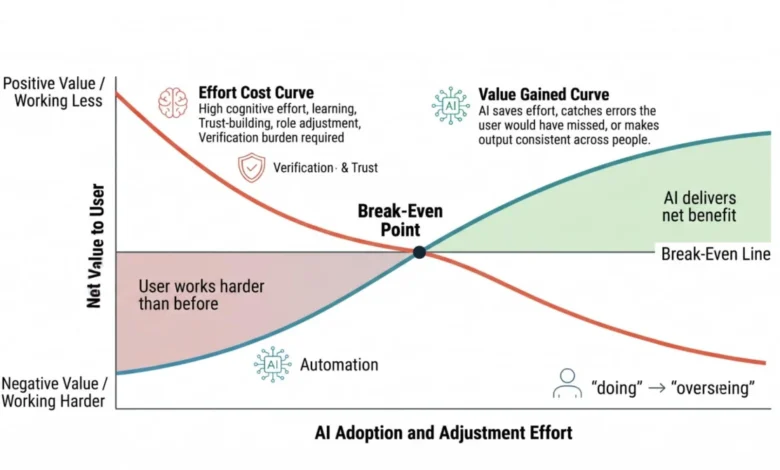
This phenomenon highlights a critical gap in product development: the failure to identify the "break-even line." Before an AI feature can provide a net benefit, it must overcome the initial cost of user adjustment. This cost is not merely technical; it is psychological and cognitive, involving the time required to learn new interfaces, adjust existing mental models, and establish a threshold of trust.
The Cognitive Economics of AI Adoption
The limitations of human cognition, specifically working memory, remain a primary constraint in the adoption of complex AI systems. Research pioneered by Nelson Cowan in 2001 suggests that human working memory is limited to roughly four items at any given time. When an enterprise tool introduces AI, it forces the user to juggle existing job requirements with the new task of monitoring machine logic. When a worker is demoted from a "creator" to a "checker," the change in professional identity can lead to increased fatigue and decreased job satisfaction.
Data from a 2025 study by Sophia Ackerhans and her colleagues underscores this tension. When physicians were tasked with signing off on AI-assisted clinical decisions, they reported a significant sense of threat to their professional identity. While explanations of the AI’s reasoning sometimes bolstered trust, they simultaneously increased the sense of professional displacement. This data suggests that the "break-even line"—the point where the utility of AI exceeds the cognitive cost of its oversight—is not a static metric but a dynamic threshold that varies by user seniority and task complexity.
Chronology of a Failed Deployment
The insurer’s initial attempt to automate benefit appeals followed a standard, albeit flawed, trajectory.
- Phase 1: Procurement and Development (Months 1–4): The insurer identified benefit determinations as a high-volume, time-consuming task. Development focused on generative models that could synthesize policy documents and patient records into a final determination letter.
- Phase 2: Deployment and Initial Friction (Months 5–6): The tool was rolled out. Feedback from specialists was immediate and negative. Users noted that they could not simply "sign off" on the AI’s work because the errors were subtle and high-stakes.
- Phase 3: Diagnostic Audit (Month 7): The product team conducted an intensive evaluation. They discovered that the "writing" component was where specialists exercised the most expertise. By removing the writing task, the AI actually stripped away the specialists’ ability to synthesize information effectively.
- Phase 4: Rescoping and Optimization (Months 8–10): The team pivoted. Instead of drafting the full letter, the AI was repurposed to perform "retrieval-augmented generation," surfacing only the relevant policy provisions and prior case decisions. The specialists retained control over the narrative, resulting in a marked decrease in total case-handling time.
The Four-Question Audit Framework
To prevent similar failures, product teams are increasingly adopting a rigorous four-question audit designed to evaluate an AI feature before a single line of code is written.
1. Does this reduce the total effort the task takes for this user?
Teams must account for the "hidden" work of checking, verifying, and correcting. If a feature reduces clicks but increases the cognitive burden of verification, it has failed the first test. It is essential to distinguish between repetitive, low-thought tasks—which are prime for automation—and complex tasks that require professional synthesis.
2. Does this beat the way the user does the task now?
If a user has developed a highly efficient manual workflow, AI often struggles to compete. The technology only earns its place if it offers superior performance in ambiguity, scale, or accuracy. If the existing manual route is reliable and fast, the AI is likely an unnecessary layer.
3. Can the user catch the errors?
This is the most critical safety check. Product teams must map the "error surface" of the tool. If an error is low-visibility—such as a hallucinated date or an incorrect citation—and the consequence is high, the tool must provide "provenance." Users need to see exactly where the AI pulled its data. Without transparency, the user remains blind to the machine’s potential for failure.
4. After a year, can the user still tell when the AI is wrong?
Automation bias is a well-documented phenomenon where users become over-reliant on machine output. If a task is fully delegated to an AI, the human’s underlying skill set will atrophy. Designers must build in mechanisms—such as mandatory blind reviews or periodic manual spot-checks—to ensure that the human expert maintains the ability to audit the machine’s output.
Broader Implications for Enterprise AI
The industry-wide move toward "Human-in-the-Loop" (HITL) systems is not merely a technical trend; it is a necessity for risk mitigation. When AI is applied to domains like healthcare, finance, or law, the implications of a "false positive" or a subtle error are severe.

Professional bodies have begun to react to these risks. Regulatory agencies are increasingly looking at "provenance display" as a mandatory requirement for AI tools in decision-critical environments. The expectation is shifting away from "black-box" models toward explainable AI (XAI) that allows users to trace the logic of every recommendation.
Furthermore, the "pro-innovation bias," as described by Everett Rogers in his seminal work Diffusion of Innovations, continues to drive companies toward premature adoption. The pressure to match competitors’ AI capabilities often overrides the practical necessity of evaluating whether the tool actually improves the bottom line or the quality of service. The 60-minute audit process is a vital corrective to this trend, forcing teams to move beyond roadmap-driven mandates and toward user-centric, evidence-based design.
Conclusion: Designing for Value
The transition from a "creator" to an "editor" is one of the most significant shifts in the modern workforce. However, if the editing process becomes more arduous than the creation process, the AI feature is not an asset; it is a debt.
The successful insurer example teaches a vital lesson: the technology used to draft a document and the technology used to search for relevant information may be identical at the algorithmic level, but they represent vastly different values to the end user. By scoping AI to assist in discovery rather than decision-making, the team not only reclaimed the specialists’ time but also preserved the integrity of the professional workflow.
As organizations continue to integrate AI, the teams that succeed will be those that view every feature as a potential cost. By asking if the feature reduces total effort, beats the existing method, allows for error detection, and preserves human skill, companies can ensure that AI is a tool that empowers, rather than exhausts, its users. The goal is not to maximize the use of AI, but to maximize the impact of the human worker. Only when these two objectives align does an AI feature truly cross the break-even line.
Related posts: