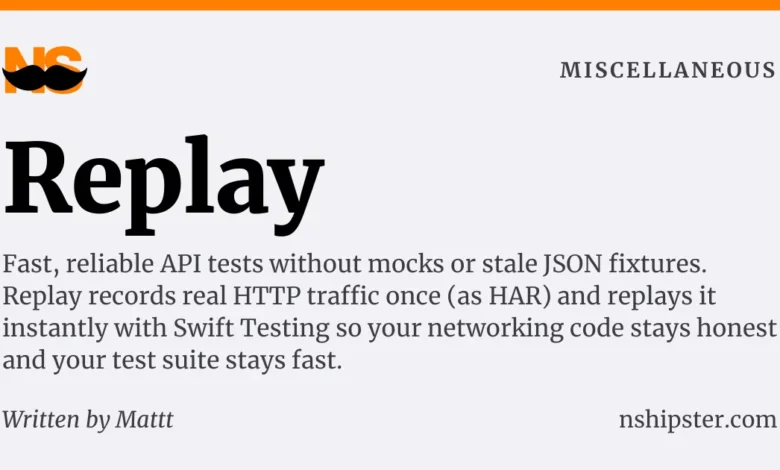
The landscape of mobile application development is currently undergoing a significant shift as developers prioritize robust, high-speed testing cycles in an increasingly complex network environment. As of 2025, the release of the open-source library Replay marks a departure from traditional, manual mocking techniques in the Swift language, introducing a framework for recording and replaying live HTTP traffic. By leveraging the industry-standard HTTP Archive (HAR) format and modern Swift testing infrastructure, Replay aims to solve the perennial challenges of latency, test flakiness, and the maintenance burden associated with manually curated API fixtures.
The necessity for such a tool stems from the inherent volatility of network-dependent software. When developers rely on live API endpoints for unit and integration testing, they introduce external points of failure—server downtime, rate limiting, and shifting response schemas—that can render a test suite unreliable. Conversely, manual mocking often requires the creation of two distinct implementations for every networking layer: the production code and the testing stub. This duality frequently leads to "fixture rot," where the static mock data no longer accurately reflects the reality of the evolving backend.
A Historical Perspective on HTTP Recording
The concept of capturing network interactions for deterministic testing is not novel, having been refined over the past fifteen years across multiple programming ecosystems. The foundational movement began in February 2010 when developer Myron Marston released VCR for the Ruby programming language. Drawing an analogy to the home video cassette recorder, VCR allowed developers to capture the "broadcast" of an HTTP interaction once and replay it indefinitely during subsequent test executions.
This paradigm proved exceptionally effective, leading to a wave of ports across the industry. Python developers adopted VCR.py and pytest-recording, while the Java community utilized Betamax. The Go language eventually saw the emergence of go-vcr. Despite this widespread adoption, the Swift community remained underserved for years. While the library DVR by Venmo provided an early attempt at this functionality by utilizing the URLProtocol injection point within the Apple Foundation framework, it was architected before the emergence of modern Swift language features. Specifically, it predated the robust macro support and the advanced testing primitives now available in Swift 6.1 and beyond, which allow for a more declarative and seamless integration into a developer’s workflow.
The Technical Evolution of Testing in Swift
The arrival of Replay is timed to coincide with significant advancements in Apple’s development toolchain. Two primary factors have enabled this modern implementation: the solidification of the HAR format as a universal standard and the maturation of Swift’s testing architecture.
The HTTP Archive (HAR) format, originally championed by Jan Odvarko of the Firefox developer tools team, has evolved into the de facto language of network analysis. Today, almost every major browser and professional proxy tool—including Charles Proxy, Proxyman, mitmproxy, and Postman—natively exports HAR files. By adopting this format, Replay eliminates the need for a custom, proprietary data structure. This interoperability allows developers to capture traffic from a live browser or proxy tool and import it directly into their Xcode test suites, ensuring that fixtures are grounded in real-world network behavior rather than hypothetical scenarios.
Furthermore, the introduction of the Swift Testing framework, particularly the TestScoping protocol, has provided a level of extensibility that was previously unavailable. These protocols allow for per-test configurations that feel native to the language, enabling the use of declarative traits like .replay(). By utilizing the Foundation URL Loading System, Replay can intercept requests at the engine level without requiring the developer to modify their production networking code or inject custom protocols, thus maintaining the integrity of the original codebase.
Operational Workflow and Security Considerations
The operational model for Replay is designed to balance developer productivity with rigorous security standards. The system functions by intercepting HTTP traffic and redirecting it to a local HAR file. However, in a departure from automatic recording, Replay forces a deliberate, opt-in workflow.
When a test is executed with a new endpoint, the framework intentionally fails, notifying the developer that no matching entry exists in the local archive. This design choice is critical in preventing the accidental leakage of sensitive information. In modern application development, API requests often contain proprietary session tokens, user-specific authorization headers, or personally identifiable information (PII). By requiring an explicit command—REPLAY_RECORD_MODE=once—to capture traffic, the system ensures that the developer is cognizant of the data being written to their repository.
Security is further bolstered through built-in filtering mechanisms. Developers can configure the library to automatically scrub sensitive headers or query parameters during the recording process. By defining these filters at the test configuration level, teams can ensure that credentials are stripped from the HAR files before they are committed to version control systems. This "filter-first" approach is considered a best practice in modern CI/CD pipelines, mitigating the risk of credential exposure while maintaining the fidelity of the captured network response.
Impact on Development Velocity
The implications of adopting a replay-based testing strategy are measurable in terms of both speed and stability. Traditional integration tests that rely on live network calls are frequently the slowest components of a CI pipeline, often requiring seconds or minutes to complete due to network handshake latency. By switching to local replay, these tests execute in milliseconds, facilitating a tighter feedback loop for developers.
Beyond raw performance, the deterministic nature of these tests addresses the issue of "flakiness." A flaky test—one that passes or fails inconsistently despite no changes to the underlying code—is a primary source of frustration for engineering teams. By decoupling the test suite from the stability of a third-party API, teams can ensure that a failure is genuinely indicative of a bug in the application logic rather than an external infrastructure issue.
Broader Industry Implications
The introduction of Replay into the Swift ecosystem signals a maturing view on the role of networking in mobile testing. As mobile applications become increasingly API-centric, the ability to effectively test the integration between the client and the server has become a competitive advantage. The ability to use inline stubs for specific edge cases, such as simulating server-side 500 errors or malformed JSON responses, further extends the utility of the library.
By providing a tool that is compatible with widely-used libraries like Alamofire and the native URLSession, Replay reduces the barrier to entry for teams looking to improve their test coverage. Industry analysts suggest that the adoption of standardized, record-replay testing patterns can reduce the time spent on "debugging the test suite" by significant margins, allowing developers to focus on feature development.
As the Swift language continues to expand into server-side and multi-platform domains, the standardizing influence of libraries like Replay is likely to persist. The integration with Swift Testing, and the reliance on open standards like HAR, positions Replay as a sustainable solution that is less likely to become obsolete as the language evolves. For organizations grappling with complex API dependencies, the migration toward these deterministic testing patterns represents a necessary step in scaling their software quality assurance processes.
The library is now available as an open-source project, inviting community contributions and integration into existing enterprise Swift architectures. The shift toward this methodology underscores a broader industry trend: as software systems grow in complexity, the tools used to verify them must become more sophisticated, more transparent, and more closely aligned with the standards of the wider development ecosystem. Through the systematic adoption of these practices, the Swift community is effectively bridging the gap between the speed of local development and the reliability of real-world network integration.