Getting Reliable Structured Outputs from LLMs: Validation, Retries and Constrained Decoding

The Problem of Premature Trust in Model Outputs
The current landscape of AI development is heavily influenced by the availability of structured output APIs. Platforms like OpenAI’s Responses API, along with local server implementations like vLLM supported by xgrammar, have simplified the process of requesting JSON. By providing a JSON schema or a Pydantic model, developers can receive a response that theoretically fits a predefined contract. However, relying solely on the successful parsing of JSON is a significant architectural vulnerability.
Consider an automated invoice processing system. When a model is asked to extract data from an invoice—such as the invoice ID, currency, total amount in cents, and a direct quote from the source text—it may return perfectly valid JSON. The syntax is correct, the keys are present, and the data types match the schema. Yet, the content itself can be logically false. For example, if an invoice displays a total of 1,250.00 EUR, an LLM might mistakenly calculate or hallucinate a value of 12,500 cents (125 EUR) while simultaneously providing the correct "Total due: EUR 1,250.00" string in the quote field.
Standard JSON parsers and schema validators do not detect this discrepancy because 12,500 is a valid integer. The failure occurs at the semantic level, where the extracted data contradicts the source evidence. Without a robust validation layer, this erroneous data could propagate through an enterprise database, triggering incorrect payments or financial reporting errors.
Establishing the Contractual Foundation
To achieve reliability, developers must move beyond treating model output as "truth" and start treating it as "input to be verified." The first line of defense is a strictly enforced contract. Using Python’s Pydantic library, developers can define a model that mandates specific data structures.
The implementation of "Strict Mode" in Pydantic 2.14.1 is essential for this process. By disabling default coercion, the system ensures that a string containing numbers is not silently converted to an integer, and unexpected keys are forbidden via extra="forbid". This creates a high-fidelity gate: if the model outputs an extra field or a data type that doesn’t match the strict definition, the object is immediately flagged as a shape error.
However, as the invoice example demonstrates, a valid object is merely an entry ticket. It signifies that the message is formatted correctly, but it does not guarantee that the content is accurate to the source document.
The Multi-Layered Validation Framework
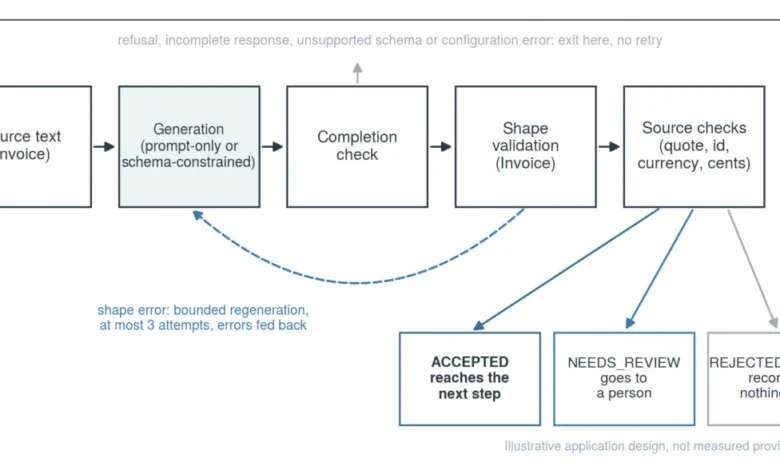
A professional-grade pipeline must incorporate a multi-step validation logic:
- Structural Validation: The output is parsed against the Pydantic schema. If this fails, the system identifies a "shape error."
- Verbatim Source Verification: The system confirms that the "total_quote" exists within the original document. If the quoted text is not present, the data is inherently untrustworthy.
- Cross-Field Consistency: The extracted values (e.g., total in cents) must be derived mathematically from the quoted text. This is where the 12,500 vs. 125,000 cent discrepancy is identified.
- Contextual Logic: If fields are missing but the model returns "null," the system must distinguish between a genuine missing fact and a model failure. Under strict protocols, a "null" value for essential information should trigger a "needs_review" status, routing the document to a human operator rather than allowing the system to guess or invent a value.
Strategic Retries and the "Bounded Loop"
A common mistake in pipeline design is the implementation of an infinite retry loop. This is dangerous, as it can lead to wasted API costs, latency spikes, and potential "hallucination loops" where the model continues to fail in new ways.
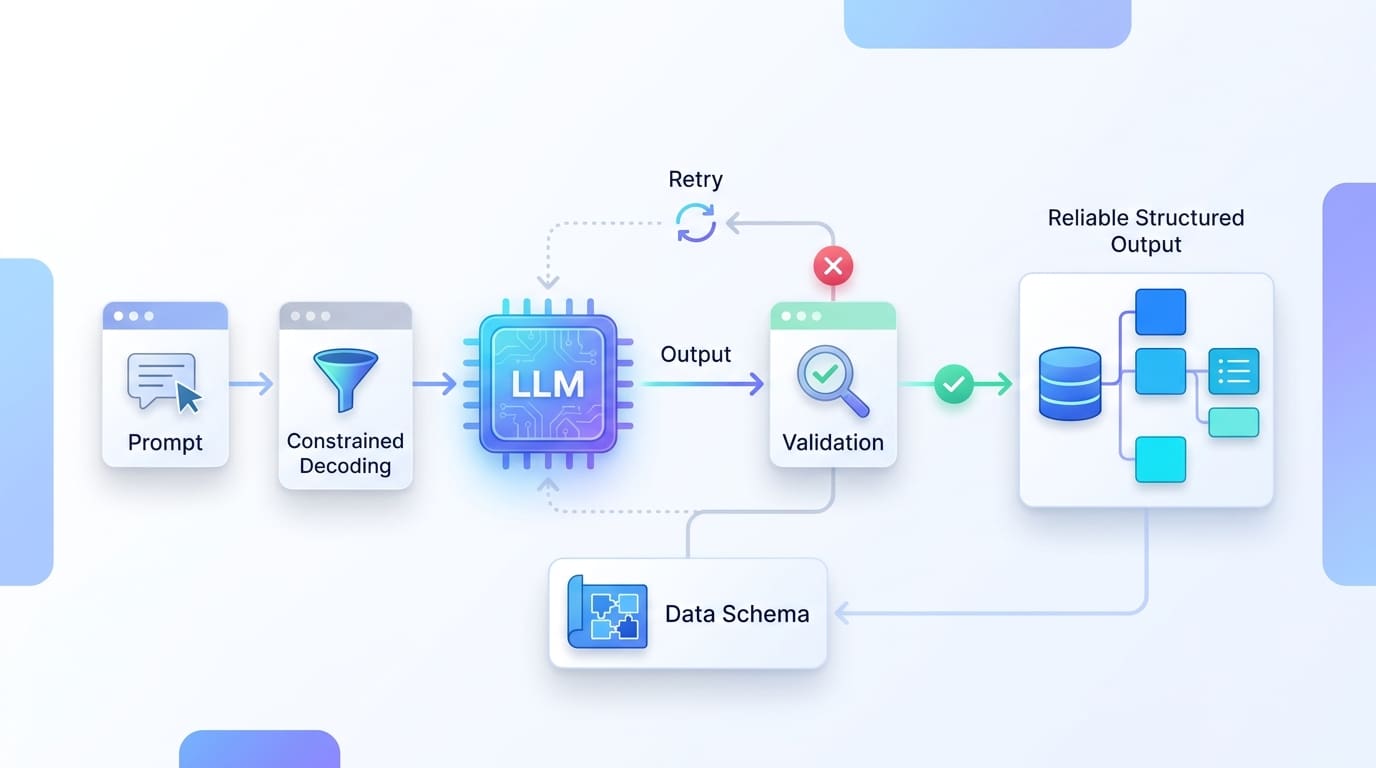
The industry-standard approach is to define a "Bounded Retry" policy. In this framework, only "shape errors" (e.g., malformed JSON or schema violations) warrant a retry. If the model returns a syntactically correct JSON that fails the semantic validation (e.g., the amount is wrong), the system should reject the result entirely. Because the source document remains static, asking the model to re-process the same text will not change the fundamental facts, and therefore, further attempts are often futile.
The retry budget should be strictly limited—typically to three attempts. Furthermore, developers must account for the hidden retries performed by the underlying SDKs. Libraries like the OpenAI Python SDK may automatically retry on 429 (rate limit) or 5xx (server error) status codes. If a developer sets an application-level retry of three, they might inadvertently trigger a much larger number of HTTP requests than intended. Setting max_retries=0 on the client and managing the retry logic manually is the preferred method for production stability.
Constrained Decoding: The Final Frontier
While validation catches errors after they happen, "Constrained Decoding" attempts to prevent them from occurring at all. By masking out tokens that would lead to invalid JSON or violate the schema during the generation process, the model is physically prevented from emitting a non-compliant output.
This method, often implemented via libraries like xgrammar or through native API support for structured outputs, ensures that the model cannot "hallucinate" a field that isn’t in the schema or provide a string where an integer is expected. However, it is vital to remember that constrained decoding only enforces the shape of the output, not the correctness of the data.
Even with constrained decoding, the system must perform the downstream check against the source text. A model constrained to output an integer will still output the wrong integer if it misreads the document. Therefore, constrained decoding is an efficiency tool, not a replacement for rigorous validation.
Implications for Enterprise AI Deployment
The shift toward this validation-heavy architecture has significant implications for how businesses manage AI risk.
- Auditability: By logging the "status" of every extraction (accepted, rejected, or needs_review), organizations can generate audit trails that demonstrate exactly why a decision was made.
- Operational Efficiency: Human-in-the-loop (HITL) workflows become more targeted. Instead of manually checking every document, humans only intervene when the system explicitly flags a "needs_review" outcome.
- Cost Management: By rejecting incorrect data early and limiting retry attempts, companies prevent the "runaway costs" associated with failed AI tasks.
As of late 2026, the industry is moving away from the "black box" approach to AI. The current trend prioritizes deterministic, contract-based interaction between models and software systems. Whether using GPT-6-based models or local open-source alternatives, the principle remains constant: the model is a component of a larger system, and its outputs must be treated as untrusted until they pass through a predefined validation gate.
In conclusion, achieving reliability in LLM-driven automation is not about finding a more "intelligent" model, but about building a more resilient pipeline. By combining strict contractual definitions, source-based semantic validation, and bounded, policy-driven retries, developers can build systems that provide the speed of AI with the reliability of traditional software. The goal is to move beyond the excitement of the initial generation and toward the maturity of consistent, auditable, and accurate data processing.