The traditional method for exchanging two files on a Linux filesystem has long been a cumbersome, three-step process involving temporary renaming, a practice that introduces potential points of failure and race conditions. However, the introduction of the --exchange flag in GNU coreutils version 9.5 and later has fundamentally altered this workflow. By leveraging the kernel-level renameat2() system call, users can now perform atomic swaps of files and directories in a single command, eliminating the risk of data loss or file invisibility during the transition.
The Evolution of File Management in Linux
For decades, the standard procedure for swapping two files, such as fileA and fileB, required a temporary placeholder. A typical sequence would involve renaming fileA to fileA.tmp, moving fileB to fileA, and finally moving fileA.tmp to fileB. While functional, this method is fundamentally non-atomic. If a system failure, power loss, or process interruption occurs during this sequence, the user may be left with missing files or corrupted configuration states.
The requirement for an atomic exchange has been a long-standing request within the systems administration community. Atomic operations ensure that an action either completes entirely or does not happen at all, preventing the "in-between" state where a file appears to vanish from the directory index. The GNU coreutils project, which provides the essential command-line tools for the Linux operating system, officially addressed this requirement in the release of version 9.5, reflecting a broader movement toward modernizing low-level system utilities to handle concurrency and data integrity more robustly.

Technical Implementation and System Requirements
The functionality is powered by the renameat2() system call, which was introduced to the Linux kernel to extend the capabilities of the traditional rename() system call. Specifically, the RENAME_EXCHANGE flag allows the kernel to swap two paths atomically. Because this operation is handled directly by the kernel, the filesystem metadata is updated in a single transaction.
To utilize this feature, the system must meet two primary criteria:
- Software Versioning: The user must be running GNU coreutils 9.5 or higher. Users can verify their current version by executing
mv --version. It is important to note that versioning in coreutils follows a semantic approach where "9.11" represents a release subsequent to "9.5." - Filesystem Compatibility: The swap must occur within the same filesystem partition. Because the atomic exchange relies on modifying inodes within the same directory structure, it cannot perform cross-filesystem operations. Filesystems such as ext4, Btrfs, XFS, and tmpfs are fully compatible with this operation.
Practical Application: Files and Directories
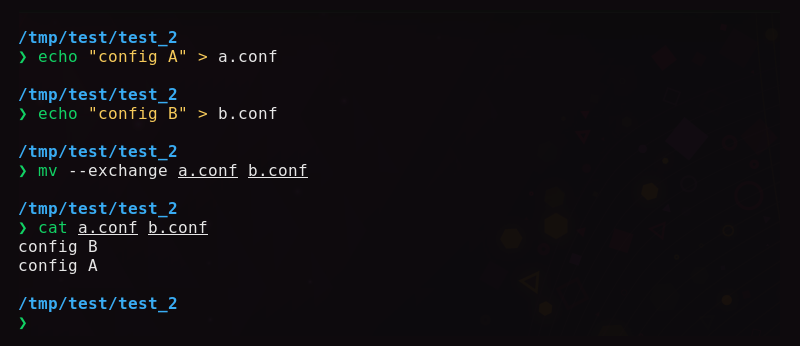
The syntax for the command is straightforward: mv --exchange source target. When executed, the kernel immediately swaps the identity of the two paths.
A critical nuance discovered by early adopters involves the behavior of the command when dealing with directories. By default, the mv command interprets a trailing argument as a destination directory. If a user attempts mv --exchange dirA dirB, the system may misinterpret the instruction, attempting to move dirA into a subdirectory of dirB rather than swapping the two entities. To circumvent this, the -T (or --no-target-directory) flag must be employed. This forces the utility to treat the arguments strictly as pathnames, enabling the atomic swapping of entire directory structures.

Implications for DevOps and Systems Administration
The ability to perform an atomic exchange of configuration files or directory trees has significant implications for deployment pipelines and high-availability systems. In environments where uptime is critical, swapping configuration files for services like Nginx or Apache without triggering a "file not found" error during the transition period is a major improvement.
Furthermore, this feature reduces the need for custom scripts designed to handle file locks or temporary directories. By offloading this complexity to the kernel, developers reduce the potential for bugs in their automation scripts. The simplicity of a one-line command enhances the reliability of cron jobs, automated updates, and routine maintenance tasks.
Limitations and Error Handling
While the mv --exchange command is a powerful addition to the Linux toolkit, it is not a universal solution for file movement. The primary limitation is the cross-filesystem restriction. If a user attempts to exchange a file located on a primary disk partition with one residing on a volatile RAM-based filesystem (like /dev/shm), the kernel will return an error.
The error reporting for this specific scenario can be cryptic, often manifesting as "Unknown error -1." This is because the kernel, when faced with an unsupported filesystem configuration, returns a generic failure code. Users should be aware that if they encounter this error, the most likely culprit is an attempt to cross filesystem boundaries or a failure to include the -T flag when dealing with directories.
Industry Context and Adoption
The integration of this feature into coreutils signals a maturation of the Linux command-line interface. Major distributions such as NixOS, Fedora, and Debian 13 have already adopted the updated version of coreutils, making the feature accessible to a large portion of the Linux user base.
As more users migrate to newer distributions, the reliance on the "three-step dance" of file renaming is expected to decline. For developers and system administrators, this shift represents a move away from defensive programming—where one must account for the state of a file during a rename operation—toward a more declarative and reliable management style.
Conclusion and Future Outlook
The mv --exchange utility is a prime example of how small, surgical updates to foundational software can have an outsized impact on user productivity and system stability. By formalizing the atomic exchange process, the GNU coreutils team has mitigated a common source of frustration and potential data corruption.
For those managing complex systems, the recommendation is to audit existing shell scripts for opportunities to replace legacy renaming patterns with this atomic command. As the Linux ecosystem continues to evolve, the standard of "atomic, safe, and efficient" operations will likely remain a priority, further cementing the role of tools like mv as the bedrock of modern computing infrastructure. Moving forward, users should continue to monitor the release notes for GNU coreutils, as ongoing development is expected to further refine how these utilities interact with the increasingly sophisticated capabilities of the Linux kernel.