Unlocking Seamless Publishing: How Docsify-This Eliminates Website Setup and Bridges Content Management Gaps

The modern digital publishing landscape has long been dominated by complex content management systems, static site generators, and intricate build processes. For educators, technical writers, and content creators who simply want to write in Markdown and share their work instantly, the overhead of managing a dedicated website can present a formidable barrier. Enter Docsify-This, an innovative open-source project designed to bridge the gap between simple text-based authoring and dynamic web delivery. By leveraging the power of Docsify.js, this platform enables users to transform raw Markdown files hosted on public repositories into responsive, standalone web pages without requiring a traditional website infrastructure.
The Evolution of Markdown Publishing and the Birth of Docsify-This
Markdown has achieved ubiquitous status across the software development and technical writing communities due to its lightweight syntax, human-readable format, and portability. However, rendering Markdown for a general audience traditionally required compiling static sites using tools like Jekyll or Hugo, or deploying heavy database-driven content management systems (CMS). These approaches often introduce steep learning curves, maintenance burdens, and unnecessary complexity for projects that require rapid deployment.

Recognizing these friction points, open-source contributors sought to streamline the workflow. Docsify.js emerged as a dynamic documentation generator that renders Markdown pages on the fly in the browser. Building upon this foundation, Docsify-This was developed to take the concept a step further. By providing a centralized utility capable of parsing URL parameters and fetching raw repository contents, Docsify-This allows creators to bypass the build step entirely. Whether publishing a standalone article, a syllabus for a university course, or internal documentation for an enterprise team, users can generate a live, responsive web page simply by pointing to a public file on platforms like GitHub or Codeberg.
Core Architecture and Web Page Builder Functionality
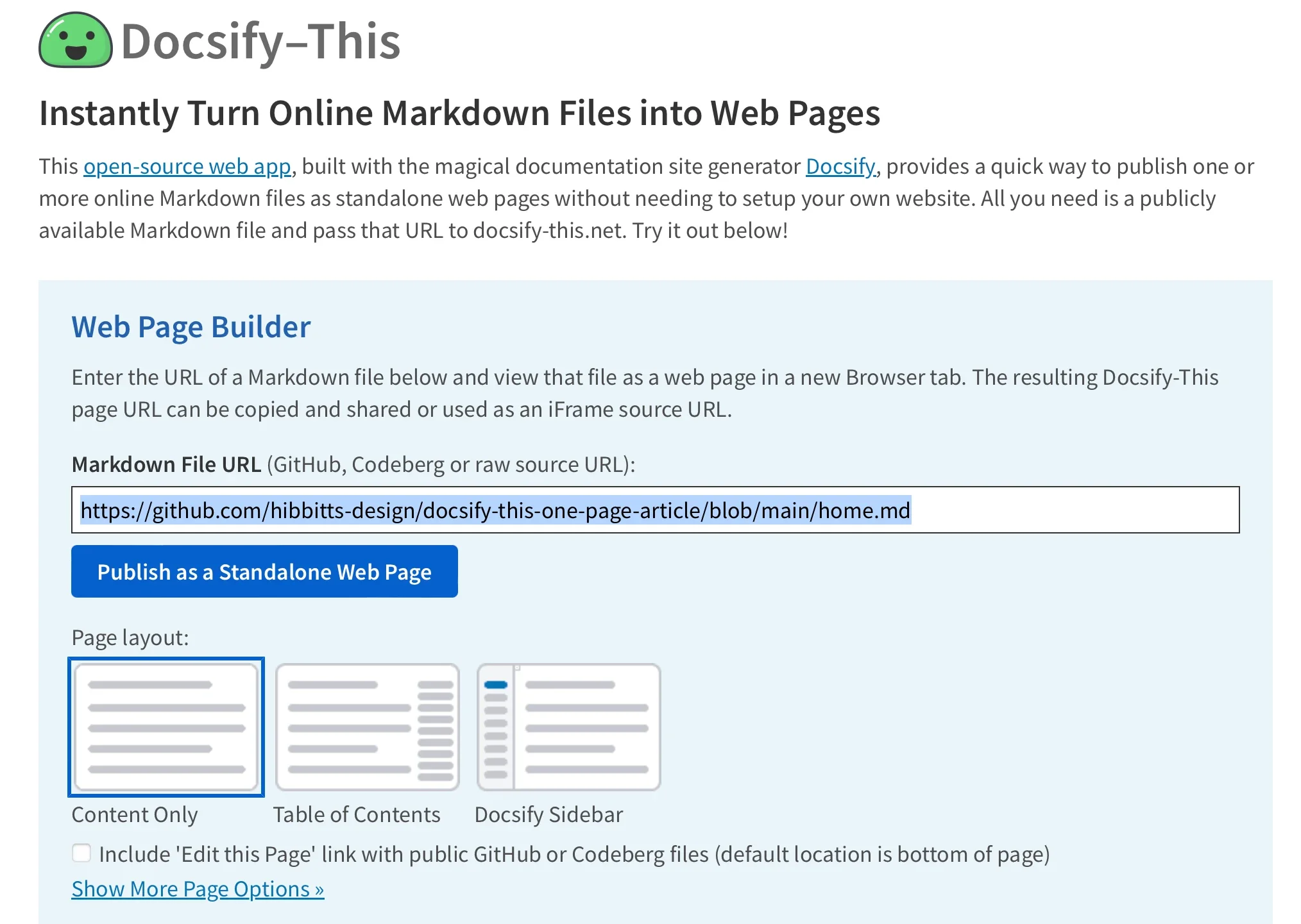
At the heart of Docsify-This is a streamlined user experience centered around its Web Page Builder interface. Creators navigate to the official web application or a self-hosted instance, paste the URL of a public Markdown file, and instantly receive a rendered web page accompanied by a shareable URL.
The underlying architecture relies heavily on URL parameters to control behavior and presentation. For instance, the basePath and homepage parameters instruct the application where to locate the root repository and which specific document to display upon initial load. This modular approach allows administrators to manage entire multi-page documentation sets within a single Git repository simply by swapping out file names in the URL string, eliminating the need for complex routing configurations.
Furthermore, Docsify-This supports collaborative authoring workflows. When content is hosted on platforms such as GitHub or Codeberg, the service can automatically append an "Edit this Page" link to the rendered output. This feature empowers readers, students, or team members to propose immediate corrections or additions via pull requests, fostering a community-driven approach to content maintenance. Because the project is open source under permissive licensing, organizations can easily deploy their own private or public instances, effectively eliminating the risk of vendor lock-in associated with proprietary SaaS publishing platforms.
Advanced Styling and Platform Integration
One of the primary challenges content creators face when distributing digital materials is maintaining visual consistency across disparate platforms. Educational institutions often rely on Learning Management Systems (LMS) such as Canvas or Moodle, while corporate environments utilize various intranet solutions and CMS platforms. Embedding external content into these systems frequently results in clashing typography, broken layouts, and inconsistent user experiences.
Docsify-This addresses this challenge by offering robust styling controls directly through URL parameters and custom CSS classes. Administrators can dynamically modify cascading style sheet (CSS) attributes—including font family, font size, link color, and line height—to match the visual identity of the destination platform.
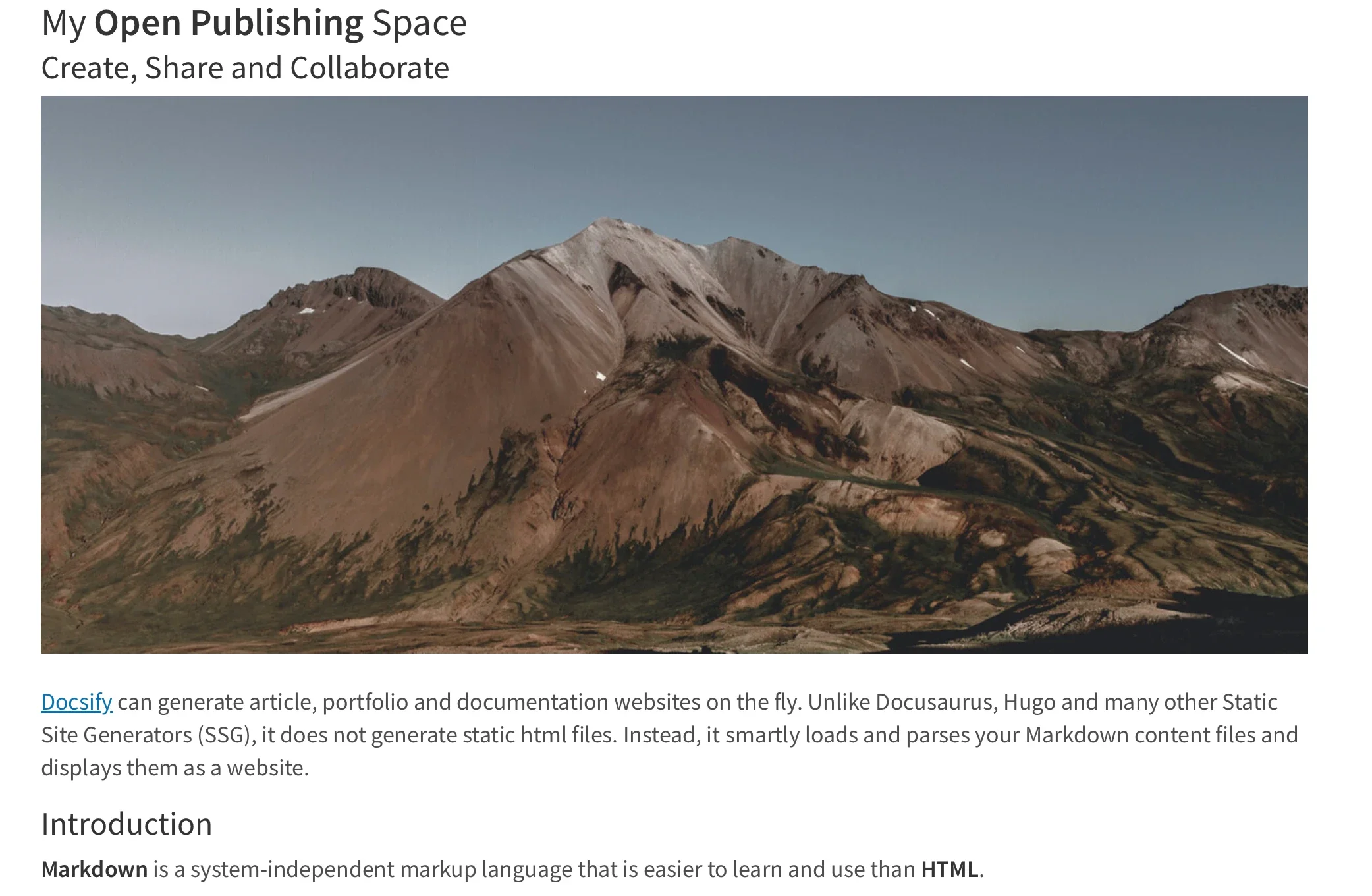
For advanced layout design, Docsify-This supports both built-in Markdown CSS classes and user-defined styles. Creators can transform standard text links into interactive buttons, organize content into responsive multi-column grids using standard HTML snippets, or implement custom button styling by embedding scoped CSS directly within their Markdown source files. This flexibility ensures that the final rendered output integrates harmoniously into foreign environments, whether viewed natively on the web or embedded via an HTML <iframe>.
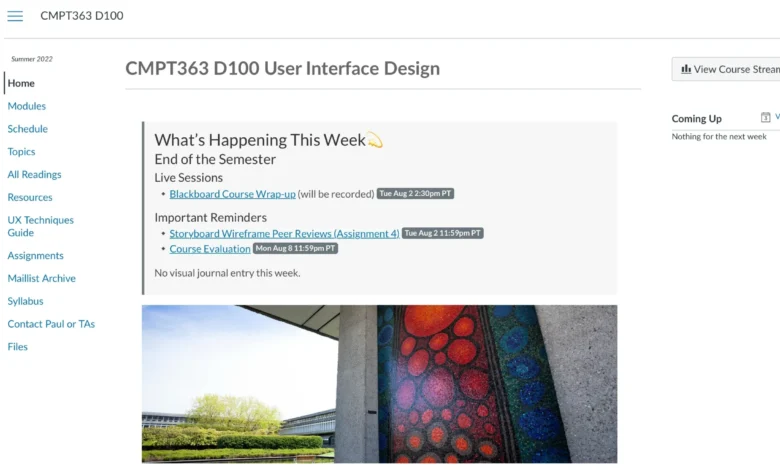
Integration with learning management systems represents a significant use case for the platform. Instructors can embed comprehensive course modules, resource lists, or reading schedules directly into an LMS course page using responsive frames or external navigation links—such as the Canvas Redirect Tool. Because updates made to the underlying Markdown file in a Git repository are reflected immediately without altering the embed code, educators can maintain and update course materials efficiently throughout an academic term.
Workflow Integration with Version Control Systems
The synergy between Docsify-This and modern version control systems transforms how non-traditional developers interact with Git. While Git and GitHub are native to software engineering, their underlying benefits—change tracking, version history, rollback capabilities, and collaborative editing—are immensely valuable for general content creation.

To lower the barrier to entry, a growing ecosystem of graphical Git clients and integrated development environments (IDEs) has emerged. Tools such as GitHub Desktop, Git-Cola, and SparkleShare provide intuitive graphical user interfaces that allow content creators to manage repositories without mastering the command line. Additionally, advanced text editors like Visual Studio Code and Pulsar Edit feature robust, native Git integrations, enabling writers to commit and push changes directly from their writing environment.
By storing Markdown files in these repositories, authors automatically gain a complete audit trail of their document’s evolution. If an error is introduced or content needs to be reverted to a previous iteration, the version control system handles the rollback seamlessly, while Docsify-This instantly displays the updated state to end users.
Industry Implications and Future Outlook
The rise of tools like Docsify-This signifies a broader industry shift toward decentralized, lightweight publishing pipelines. As organizations increasingly prioritize speed, accessibility, and platform independence, heavy monolithic content management systems are frequently being supplemented or replaced by headless and file-based architectures.

Industry analysts note that reducing the technical debt associated with web publishing allows subject matter experts—such as educators, researchers, and policy makers—to focus on content quality rather than technical implementation. By abstracting away the complexities of server configuration, database management, and build pipelines, open-source utilities democratize digital publishing.
Security and data ownership also play pivotal roles in the adoption of self-hosted publishing solutions. Because organizations can deploy their own instances of Docsify-This on custom domains, sensitive internal documentation can be shared securely within closed networks or authenticated environments without exposing proprietary data to third-party SaaS providers.
As the open-source community continues to refine these workflows, the boundaries between document authoring, version control, and web delivery will continue to blur. Projects like Docsify-This demonstrate that powerful, responsive web publishing does not require bloated infrastructure, offering a sustainable blueprint for the future of digital content distribution.