Streamlining Incident Response: Integrating AWS DevOps Agent with Jira Cloud via Amazon EventBridge

In the modern enterprise software environment, operational efficiency is frequently hindered by context switching. Engineers managing cloud infrastructure often find themselves toggling between specialized monitoring dashboards and project management tools, a fragmented workflow that risks delaying critical remediations. AWS DevOps Agent, a tool designed to investigate operational anomalies and propose root causes, has introduced a new event-driven architecture that allows organizations to bridge this gap by integrating directly with industry-standard ticketing platforms such as Jira, ServiceNow, and PagerDuty.
By leveraging Amazon EventBridge, AWS Lambda, and the AWS Cloud Development Kit (CDK), teams can now ensure that every investigation conducted by the AWS DevOps Agent is automatically synchronized with a central system of record. This transition from a siloed investigation console to a unified ticketing workflow marks a significant shift in how DevOps teams maintain visibility over their incident lifecycle.
The Problem of Tool Fragmentation
The challenge facing many cloud-native teams is not a lack of data, but a lack of continuity. When an AWS DevOps Agent initiates an investigation into an operational issue, the findings—ranging from initial discovery to final root cause analysis—are contained within the AWS console. However, most engineering organizations manage their work through external platforms. When these environments remain disconnected, the history of an incident becomes fractured. Information logged in the DevOps Agent console is often decoupled from the corresponding Jira ticket or PagerDuty incident, making it difficult for stakeholders to perform post-incident reviews or audit trails without manual reconciliation.
The newly documented integration pattern addresses this by treating investigation events as first-class citizens within the AWS ecosystem. By routing these events through an automated pipeline, organizations can ensure that the "source of truth" remains consistent across all platforms.
Architectural Framework and Event Flow
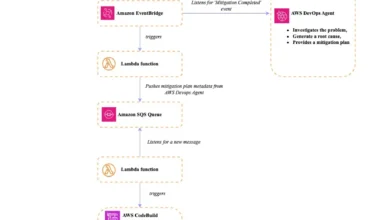
The solution relies on an event-driven architecture that is both modular and scalable. When the AWS DevOps Agent detects an anomaly, it generates a structured event notification with the source attribute aws.aidevops. This event is published to the Amazon EventBridge bus.
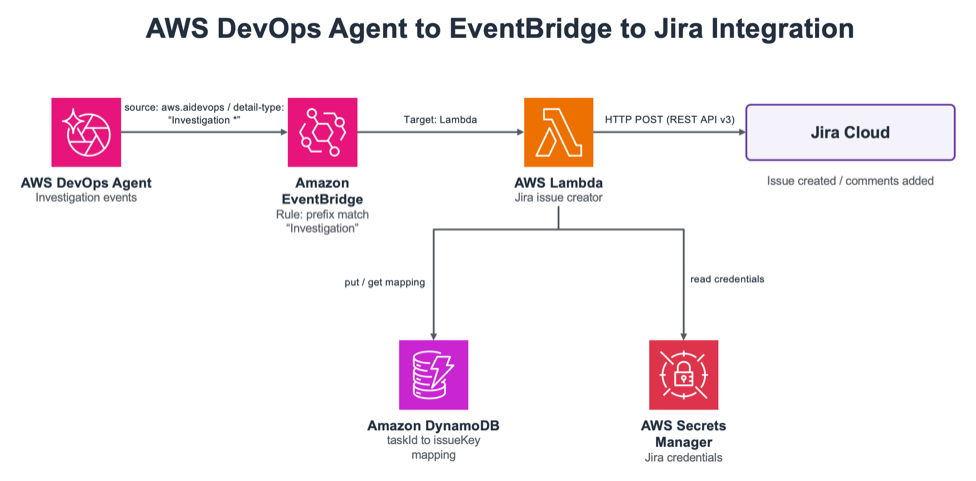
An EventBridge rule is configured to monitor for any detail-type starting with the Investigation prefix. This wildcard approach ensures that all stages of the investigation—from the initial "Investigation Created" trigger to updates regarding status changes and final completion—are captured. Once the rule matches, it invokes an AWS Lambda function, which acts as the orchestrator for the integration.
To maintain state across the lifecycle of an incident, the architecture utilizes Amazon DynamoDB. When an investigation is first created, the Lambda function generates a mapping between the unique task_id provided by the DevOps Agent and the corresponding issue key in the destination ticketing system (e.g., a Jira ticket ID). This mapping is essential for subsequent updates. As the investigation progresses through its various states—such as "In Progress," "Completed," or "Failed"—the Lambda function queries the DynamoDB table to identify the correct issue and appends relevant data as a comment.
Security is managed via AWS Secrets Manager. By storing sensitive information, such as Jira API tokens, user emails, and project keys, within Secrets Manager, the implementation adheres to the principle of least privilege. The Lambda function retrieves these credentials at runtime, ensuring that no sensitive tokens are hardcoded into environment variables or source control.
Implementation and Deployment
Deploying this solution requires a standard cloud-native toolchain. Developers must have the AWS Command Line Interface (CLI) configured, along with the AWS CDK and Node.js. The process follows a clear, four-step trajectory:
- Credential Preparation: The Jira connection details are stored in AWS Secrets Manager as a single JSON object. This step is crucial for decoupling the integration logic from infrastructure configuration.
- Infrastructure as Code (IaC) Deployment: Using the AWS CDK, the developer deploys the required resources—the EventBridge rule, the Lambda function, the DynamoDB table, and the necessary IAM roles. This approach provides a repeatable, version-controlled deployment that can be audited and managed using standard DevOps practices.
- Event Schema Handling: Understanding the event structure is key for customization. Because the event notification contains high-level metadata but not the full depth of an investigation, the Lambda function is programmed to call the
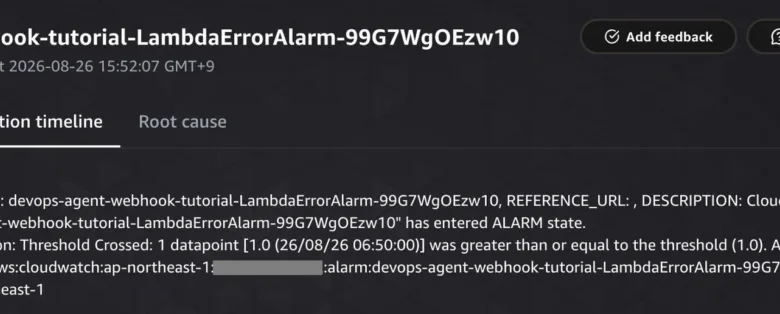
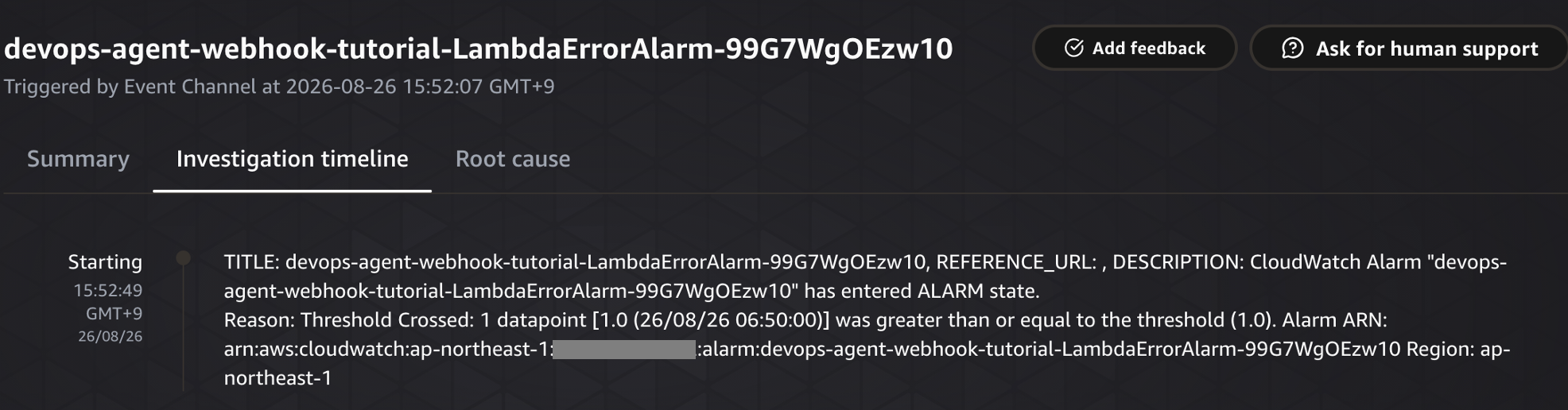
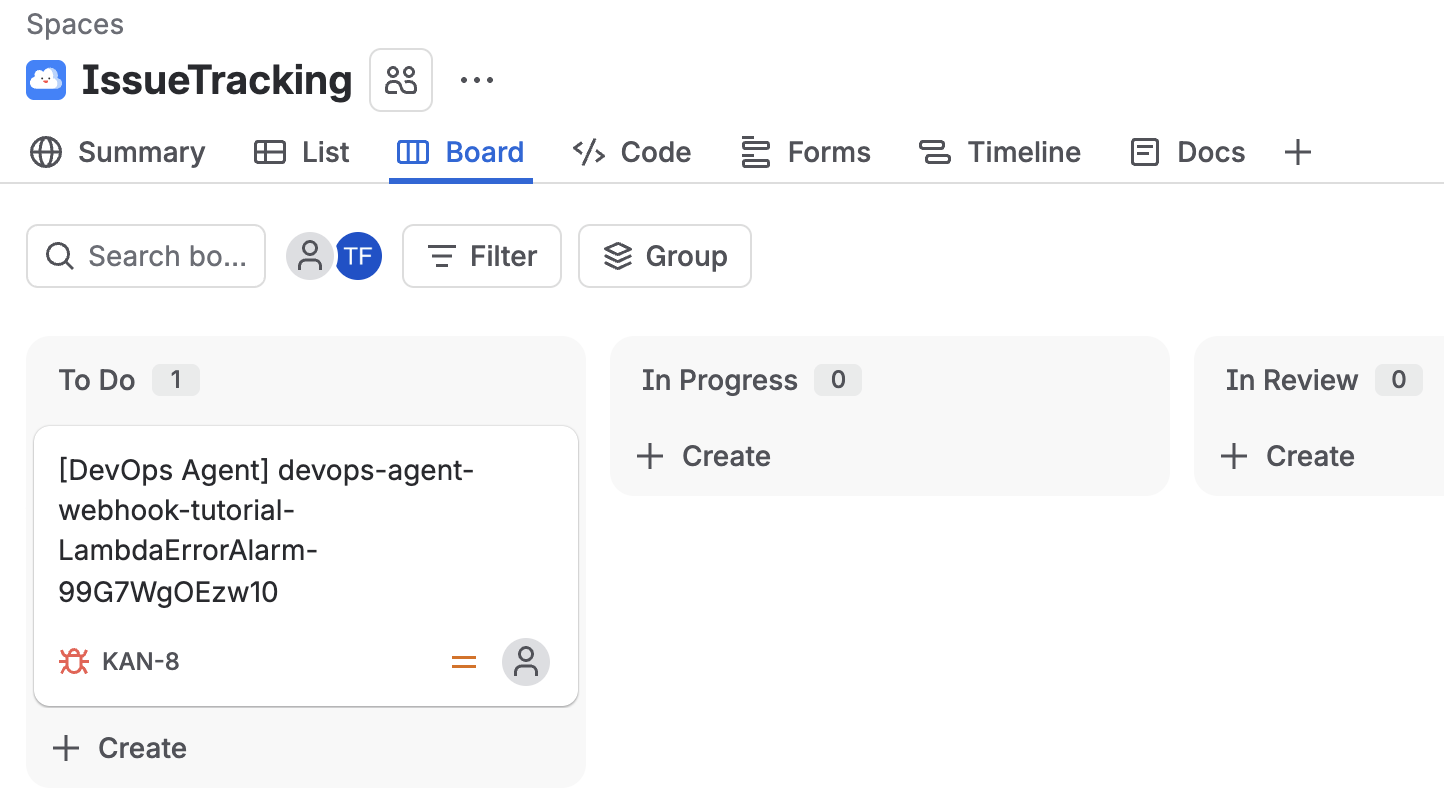
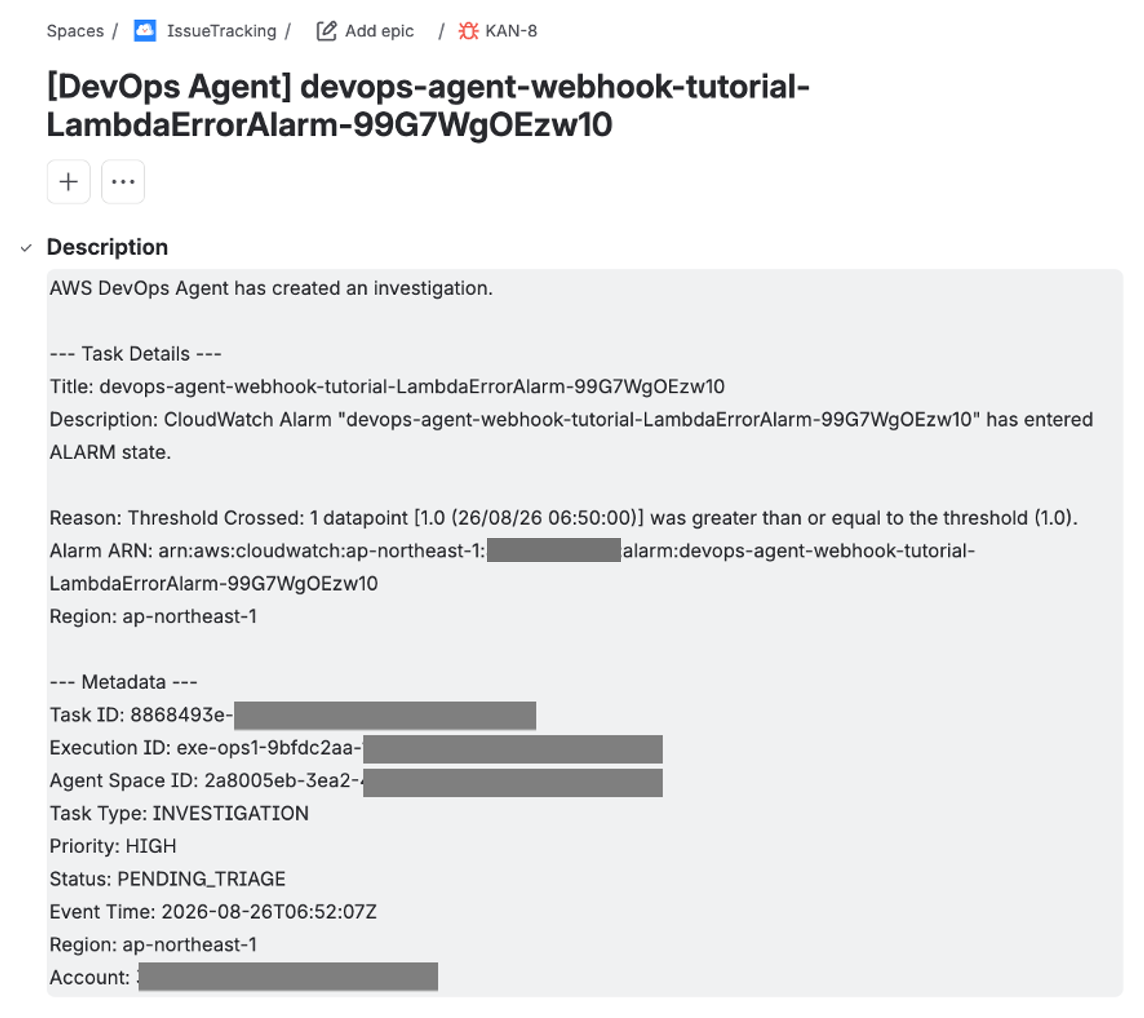
GetBacklogTaskAPI. This allows the integration to pull granular details, such as alarm summaries and symptom descriptions, which are then formatted and pushed to the ticketing system. - Validation: Once the stack is deployed, starting an investigation in the DevOps Agent console automatically triggers the creation of a corresponding ticket in Jira. As the agent identifies the root cause—such as a failing Lambda function or an misconfigured resource—the information is automatically appended to the ticket.
Broader Implications and Strategic Value
The implications of this integration extend beyond simple convenience. By centralizing operational findings, organizations can reduce the "Mean Time to Acknowledge" (MTTA) and "Mean Time to Resolve" (MTTR). When an engineer receives a Jira ticket that already contains a summary of the root cause, they can skip the manual discovery phase of the incident response process.
Furthermore, this architecture demonstrates the flexibility of modern serverless patterns. Because the processing logic is encapsulated within a Lambda function, the transition from Jira to other platforms is straightforward. An organization could, for instance, mirror the investigation results to both a Jira ticket for project management and a Slack channel or PagerDuty incident for real-time notification, simply by adding additional targets to the EventBridge rule.
Contextualizing the Need for Automation
The demand for such integrations has surged as cloud environments grow in complexity. According to industry data, the average enterprise utilizes dozens of distinct monitoring and management tools. The inability to correlate data across these platforms is frequently cited as a primary bottleneck in digital transformation efforts. By automating the documentation of operational issues, companies can minimize human error and ensure that compliance and reporting requirements are met without requiring additional administrative overhead.
Official guidance from AWS suggests that this pattern is intended to be a template. As the DevOps Agent evolves, the ability to extend its reach through native event-driven integrations allows developers to tailor their toolsets to the specific needs of their organization, rather than being forced into a rigid, monolithic monitoring suite.
Conclusion and Future Outlook
The ability to integrate the AWS DevOps Agent with external ticketing platforms via Amazon EventBridge represents a significant advancement for site reliability engineers (SREs) and DevOps practitioners. By removing the friction associated with platform switching, the solution fosters a more efficient, documentation-heavy culture where incident history is preserved and accessible.
As organizations continue to shift toward highly automated, event-driven architectures, the reliance on these types of middleware patterns will likely increase. Future iterations of this solution may include more sophisticated filtering and routing logic, or perhaps native integrations with a wider array of enterprise resource planning (ERP) and IT service management (ITSM) tools. For now, the combination of AWS CDK, Lambda, and EventBridge offers a robust, secure, and highly customizable path to operational excellence, ensuring that teams can focus on remediation rather than administration. By deploying these patterns today, organizations can establish a foundation for more resilient and transparent cloud operations.