How HERE Technologies transformed software delivery through orchestrated agentic AI and the Kiro framework

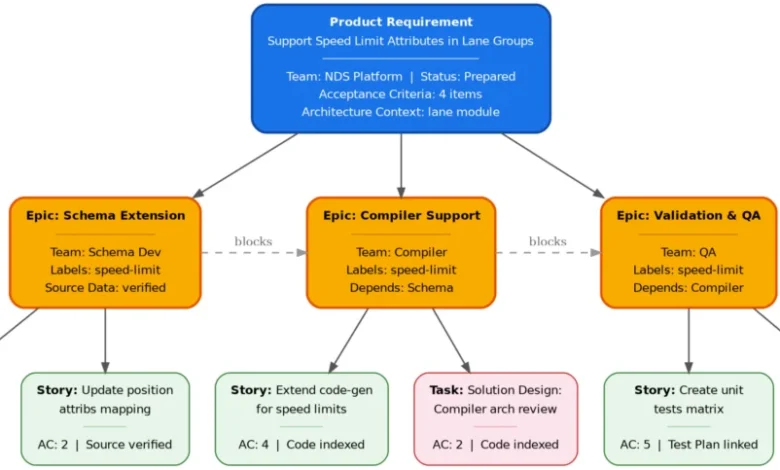
Managing the intricate demands of modern automotive navigation requires more than just code; it requires a symphony of architectural consistency, regulatory compliance, and real-time data streaming. For HERE Technologies, the challenge of maintaining the Navigation Data Standard (NDS.Live) has historically been a labor-intensive endeavor, characterized by manual ticket decomposition and the persistent risk of human error. By integrating an orchestrated multi-agent system powered by AWS Kiro, the company has successfully transitioned from a fragile, manual workflow to a streamlined, automated, and highly traceable development lifecycle.
The Shift from NDS Classic to NDS.Live
The automotive industry is currently undergoing a structural transformation, moving from static, batch-delivered map data to the dynamic, streaming-first environment of NDS.Live. Historically, NDS Classic relied on offline storage, where vehicles received periodic map updates. In contrast, NDS.Live allows modern vehicles—particularly those produced by automotive giants like BMW and Volkswagen—to pull high-definition, real-time map data via APIs.
This evolution has fundamentally altered the Software Development Life Cycle (SDLC). Engineers at HERE are no longer just managing a database; they are managing dozens of interdependent schema definitions that must remain perfectly synchronized with customer requirements. The necessity for 100 percent architectural consistency, combined with the industry’s stringent Automotive SPICE (ASPICE) compliance requirements, created a bottleneck. ASPICE mandates bidirectional traceability between system requirements, software architecture, and implementation artifacts. Manually mapping these relationships in tools like Jira resulted in fragmented knowledge, "context switching" fatigue, and, ultimately, delays in product releases.
The Orchestrated Multi-Agent Architecture
To mitigate these inefficiencies, HERE Technologies adopted an orchestrated, multi-agent approach utilizing Kiro, a sophisticated software engineering agent developed by AWS. Rather than relying on a single, general-purpose AI that might suffer from context window saturation—leading to hallucinations or missed architectural nuances—HERE implemented a "team of specialists" model.
In this workflow, the system mimics a high-functioning engineering department. Six persona-based agents—the Architect, Product Owner, Tech Lead, Developer, QA Engineer, and Data Modeler—operate in parallel to analyze every incoming product requirement. By sequencing and parallelizing these roles, the orchestration layer ensures that each agent operates only within its specialized domain, using exactly the context required for its specific task.
This orchestration is facilitated by the Kiro Command Line Interface (CLI), which allows the workflow to operate autonomously within the company’s continuous integration and continuous delivery (CI/CD) pipelines. When a Jira webhook triggers an event, the system automatically initiates the decomposition of high-level product requirements into a structured, fully linked Jira hierarchy, ranging from Epics to individual tasks.
Cognitive Memory and Code Intelligence
A persistent hurdle in agentic AI development is "context loss," where the assistant forgets project nuances between sessions. HERE addressed this by implementing a three-layer memory system based on cognitive science principles: semantic, episodic, and procedural memory. Through automated Kiro hooks, the system records "episodes" at the end of each session and recalls relevant prior context at the start of new ones, allowing the AI to compound its expertise over time—much like a veteran employee who becomes more efficient with every sprint.
Furthermore, the integration of Code Intelligence has proven to be a critical differentiator. By cloning and indexing repositories, the agents can query the existing codebase in natural language. If a task requires adding error handling to a registry service, the agent does not rely on generic coding standards; it queries the repository to understand the service’s existing patterns. This ensures that the generated acceptance criteria are grounded in reality, significantly reducing the number of revision cycles during the peer review process.
Operational Impact and Quantitative Results
The impact of this transition has been measurable across the engineering organization. Workflows that previously consumed days of manual effort are now completed in minutes. Internal data from HERE Technologies highlights several key improvements:
- Speed of Decomposition: The time required to translate high-level product requirements into a structured Jira hierarchy has been reduced by approximately 80 percent.
- Architectural Consistency: Automated verification against the NDS.Live schema has virtually eliminated structural errors in ticket hierarchies.
- Traceability Compliance: By automating the linking of requirements to implementation artifacts, the system now produces a comprehensive audit trail that meets ASPICE standards by default, rather than as an afterthought.
- Reduced Rework: Because tickets are generated with acceptance criteria grounded in the actual codebase, developer rejection rates for incoming tasks have dropped significantly.
- Knowledge Retention: The three-layer memory system has successfully mitigated the onboarding friction often associated with complex, long-term mapping projects.
Lessons in Agentic Evolution
The path to this level of automation was iterative. The team at HERE discovered early on that "always-on" context—feeding every agent every piece of available documentation—degraded performance. They shifted to a "progressive disclosure" model, where domain-specific instructions are loaded only when triggered by specific task requirements. This optimized token usage and increased the precision of the agents’ outputs.
Additionally, the implementation of "confirmation gates" proved essential for maintaining quality control. By placing human-in-the-loop checkpoints at critical decision points—such as after initial analysis but before ticket generation—the system prevents the cascading errors that could arise if an AI were to misinterpret a complex requirement. These gates, which present options to Approve, Modify, or Cancel, have proven that AI orchestration is most effective when it augments human oversight rather than replacing it entirely.
Implications for the Automotive Sector
The collaboration between HERE Technologies and AWS serves as a case study for the broader automotive industry. As vehicles become increasingly software-defined, the ability to manage complex, interlinked data structures at scale will determine a manufacturer’s competitive advantage.
The success of the orchestrated agentic workflow suggests a future where engineering teams can focus on high-level innovation rather than the "plumbing" of ticket management and compliance documentation. By utilizing spec-driven development—where the agentic system itself is designed and improved using the same rigorous, requirement-based methodology it applies to navigation data—HERE has established a blueprint for sustainable AI adoption.
Looking ahead, the scalability of this model suggests that other sectors with high regulatory burdens and complex data schemas—such as aerospace, medical device manufacturing, and industrial automation—could see similar gains. The core takeaway from the HERE Technologies experience is clear: agentic AI is not merely a tool for code generation; it is a framework for institutional knowledge management. By grounding AI in a combination of domain-specific memory, real-time code intelligence, and structured human oversight, enterprises can transform their development pipelines from rigid, error-prone processes into dynamic, learning systems that evolve in lockstep with the technology they produce.