Navigating the Landscape of AI Agent Benchmarks: Beyond the Leaderboard Hype

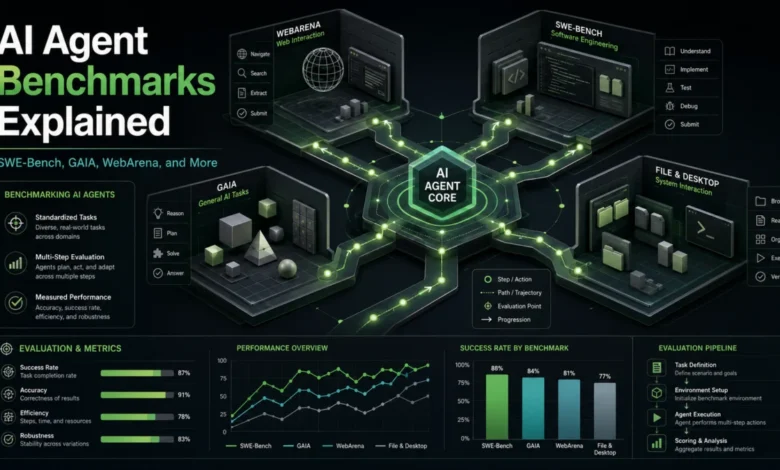
The rapid proliferation of autonomous AI agents has triggered a competitive arms race among developers, with each release accompanied by bold claims of state-of-the-art performance. As AI providers jockey for top positions on public leaderboards, industry practitioners are increasingly finding that these metrics, while technically rigorous, often fail to correlate with the realities of production-grade deployments. To understand the true capabilities of an agent, one must look past the surface-level percentages and examine the fundamental divergence between static model benchmarks and the dynamic, multi-step environment of modern agentic workflows.
The Evolution of Evaluation: From Language to Action
Historically, the evaluation of large language models (LLMs) focused on isolated capabilities. Standardized tests like the Massive Multitask Language Understanding (MMLU) benchmark or the HumanEval coding dataset were designed to measure a model’s "zero-shot" or "few-shot" proficiency. These tests are essentially static; they present a prompt, receive a single completion, and score the output based on accuracy or semantic alignment. While these metrics provided a necessary baseline for early LLM development, they are fundamentally insufficient for the current era of agentic AI.
The transition from "chatbots" to "agents" represents a shift from passive text generation to active environmental manipulation. An AI agent is expected to operate within a loop: observe, reason, act, and observe again. Unlike traditional benchmarks, agent-based evaluations must account for latency, tool-use proficiency, error recovery, and long-horizon planning. This shift necessitates a new class of benchmarks that treat the AI not as a respondent, but as a worker in a simulated environment.
A Chronology of Benchmark Development
The push for more realistic evaluation frameworks began in earnest as LLMs started demonstrating latent capabilities in code generation and web navigation. The timeline of major benchmark releases reflects this maturity:
- 2023 (Early): The emergence of the first generation of comprehensive agent benchmarks, most notably SWE-bench, which moved beyond simple coding snippets to full-repository software maintenance.
- 2023 (Mid-Late): The launch of GAIA (General AI Assistants), designed to bridge the gap between abstract reasoning and practical tool usage, highlighting the need for multi-modal capability.
- 2024: The refinement of these benchmarks, including the introduction of "Verified" subsets to combat data contamination and ensure that tasks remain truly challenging for even the most advanced models.
- 2024-2025: The shift toward OS-level interaction through projects like OSWorld, acknowledging that agents must eventually inhabit the same computing environments as human users.
Analyzing the Industry Standards
SWE-bench and the Problem of "Pass@k"
SWE-bench has established itself as a cornerstone of software engineering evaluation. By requiring models to resolve actual GitHub issues from repositories like scikit-learn and Django, it tests an agent’s ability to parse complex codebases, locate relevant files, and implement functional patches. However, industry analysis suggests that the "Pass@k" metric—which tracks the success rate over multiple attempts—can be misleading. A patch that satisfies a unit test is not inherently "correct" or "maintainable." It may introduce technical debt or security regressions that automated test suites fail to capture. The recent introduction of "SWE-bench Verified" represents a critical step in addressing these flaws by human-validating the underlying test cases.
GAIA and the Limits of Multi-Step Reasoning
GAIA was designed to address the "human-in-the-loop" aspect of AI. By tasking agents with multi-step operations—such as finding a specific piece of data, downloading a file, and synthesizing it with web-based information—GAIA pushes models to coordinate external tool usage. The primary challenge identified by researchers is the "cascading failure" effect: if an agent fails at the first step of a five-step process, the entire workflow collapses. While GAIA is excellent for measuring logical coordination, its reliance on a singular "ground truth" answer remains a limitation in real-world scenarios where ambiguity is the norm.
WebArena and the Browser Frontier
WebArena and its successor tools like BrowserGym focus on the browser as the primary interface for the digital economy. These benchmarks operate within sandboxed environments, requiring the agent to perform tasks such as navigating a CMS, purchasing items on an e-commerce site, or managing forum posts. The challenge here is data contamination. Because these web environments are often simulated using public websites, there is a high risk that the model has "seen" these tasks during its training phase. High scores in WebArena may therefore represent effective pattern matching rather than genuine, generalized web-navigation intelligence.
OSWorld: The Final Frontier of Desktop Automation
OSWorld represents the most ambitious attempt to date to simulate a human’s digital workspace. By placing the agent inside a GUI-driven desktop environment, the benchmark tests navigation, file system management, and inter-application coordination. The complexity here is not just in the agent’s reasoning, but in the infrastructure stability. As observed in early trials, the agent’s performance is often tethered to the responsiveness of the simulated OS. If the environment lags or the rendering engine misinterprets a click, the agent is unfairly penalized.
Data Limitations and the "Black Box" Problem
A recurring concern among enterprise users is the lack of transparency regarding cost and efficiency. Public leaderboards almost exclusively track success rates, ignoring the "cost per task." In a production environment, an agent that achieves a 90% success rate at the cost of $5.00 per task may be economically unviable compared to an agent that achieves an 80% success rate at $0.05 per task.
Furthermore, these benchmarks do not measure "safety boundaries." An agent’s ability to refuse a request that falls outside of its security policy is just as vital as its ability to execute a task. The current focus on positive performance—doing things—ignores the critical negative performance—knowing when to stop.
Implications for Enterprise Adoption
The implications for companies looking to integrate AI agents are clear: public benchmarks should serve as a diagnostic tool, not a procurement guide. A low score on a benchmark like SWE-bench is a reliable indicator that an agent lacks the necessary reasoning depth for software development, effectively functioning as a "negative filter." However, a high score should not be interpreted as a guarantee of production readiness.
Industry leaders are increasingly moving toward "custom evaluation suites." This methodology involves taking a subset of a company’s own internal workflows, anonymizing the data, and using them as a proprietary benchmark. By testing an agent against the specific idiosyncrasies of their own software stack, file structures, and business logic, firms can gain a realistic projection of performance that no public leaderboard can provide.
The Path Forward: Towards Standardized Reliability
The current state of AI benchmarking is analogous to the early days of automotive safety testing. We have moved from simple acceleration tests to more rigorous crash simulations, but we are still far from a standardized, universal safety rating system. Future advancements in benchmarking will likely focus on:
- Efficiency Metrics: Incorporating token usage and API latency into the final score.
- Robustness Testing: Deliberately injecting errors (e.g., broken links, missing files) into the test environment to measure how well an agent recovers.
- Human-Alignment Scores: Moving away from "automated graders" (which are prone to bias) toward human-in-the-loop evaluations that assess the quality and safety of the final output.
In conclusion, while benchmarks like SWE-bench, GAIA, WebArena, and OSWorld are essential for driving innovation and tracking the velocity of AI progress, they remain, at best, directional signals. The responsibility of bridging the gap between "benchmark success" and "production reliability" rests with the developer. Those who rely solely on leaderboard positions risk being blindsided by the complexities of real-world deployment, whereas those who use these tools as a starting point for their own rigorous, internal testing will be better positioned to build truly resilient autonomous systems.