Beyond Vector Search: How Context Graphs and GraphRAG Are Transforming AI Agent Memory and Retrieval Architecture

The landscape of generative artificial intelligence is undergoing a profound structural shift. For years, Retrieval-Augmented Generation (RAG) systems have relied heavily on vector databases, indexing documents and querying them based purely on semantic text similarity. While this vector-centric paradigm successfully propelled early enterprise AI deployments, it has revealed severe limitations in handling complex enterprise workflows, multi-step reasoning, and long-running autonomous agents. When information relevance depends on relational connections rather than matching keywords, traditional vector search falters, causing accuracy drops, excessive token consumption, and opaque "black box" behavior.
To solve these compounding engineering bottlenecks, the artificial intelligence industry is increasingly turning to context graphs and GraphRAG (Retrieval-Augmented Generation powered by knowledge graphs). By mapping explicit relationships between enterprise entities, conversation histories, and decision traces, graph-based contextual retrieval allows AI agents to navigate data the way humans do: by following logical connections rather than scanning for isolated word matches. This evolution promises to redefine how modern organizations build persistent, explainable, and cost-efficient agentic architectures.
The Structural Limits of Vector-Only RAG in Enterprise Workflows
Since the mainstream emergence of large language models (LLMs), vector-only RAG has served as the default retrieval architecture for connecting models to private corporate data. In this traditional model, an enterprise document is sliced into text chunks, converted into numerical embeddings via an embedding model, and stored in a vector database. When a user submits a query, the system calculates the semantic similarity—typically via cosine distance—between the query embedding and the stored chunks, returning a ranked list of the closest matches.
However, this methodology assumes that information relevancy is inherently tied to lexical or semantic similarity. In real-world enterprise environments, this assumption frequently breaks down. Data entities are routinely related in critical ways that semantic scoring cannot detect. For example, a customer service policy might dictate a specific refund procedure based on a customer’s service tier and purchase history, yet the policy document itself may share very few overlapping words with the initial customer complaint.
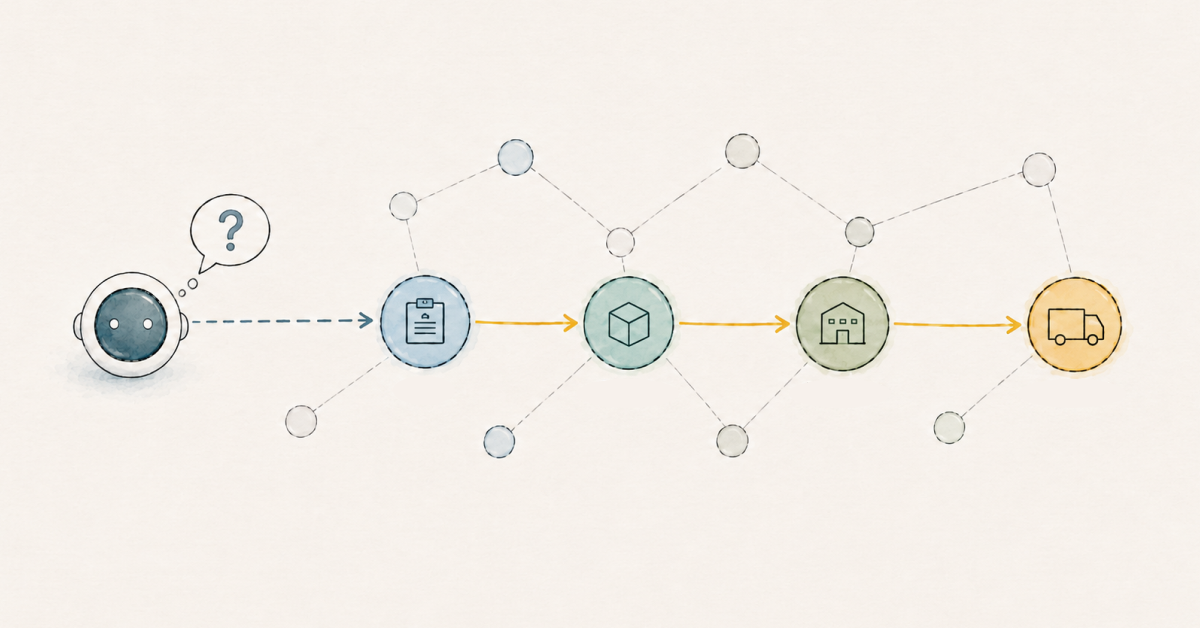
When a retrieval mechanism fails to surface these hidden relational pathways, the downstream AI model suffers from a lack of necessary context. Even a sophisticated reasoning model will produce inaccurate, incomplete, or hallucinated responses if the underlying retrieval layer fails to provide the full picture. As enterprises transition from simple static question-answering bots to autonomous, multi-turn AI agents, these limitations have transformed from minor annoyances into critical architectural liabilities.
The Rise of Context Graphs: Persistent Memory for Agentic AI
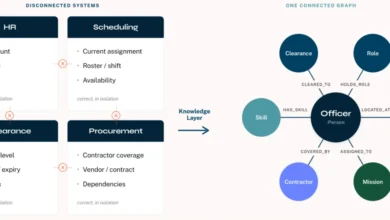
To address the shortcomings of fragmented data stores, developers are implementing context graphs—specialized knowledge graph frameworks that serve as persistent, unified memory layers for AI agents. Unlike traditional databases that isolate static documentation, chat logs, and execution steps into separate silos, a context graph establishes a durable, traversable structure that links enterprise data entities directly to ongoing operations.
Industry adoption of this architecture has accelerated rapidly through specialized infrastructure tools. Frameworks such as Neo4j Agent Memory have emerged to streamline the integration of graph layers into existing application stacks. By treating memory as a connected network of nodes and edges, these systems allow agents to execute precise function calls—such as asynchronously pulling session data via structured client queries—without forcing developers to manually rebuild complex relational joins across multiple database schemas on every execution cycle.
context = await client.get_context(
    query=user_message,
    session_id=session_id,
    limit=5,
)
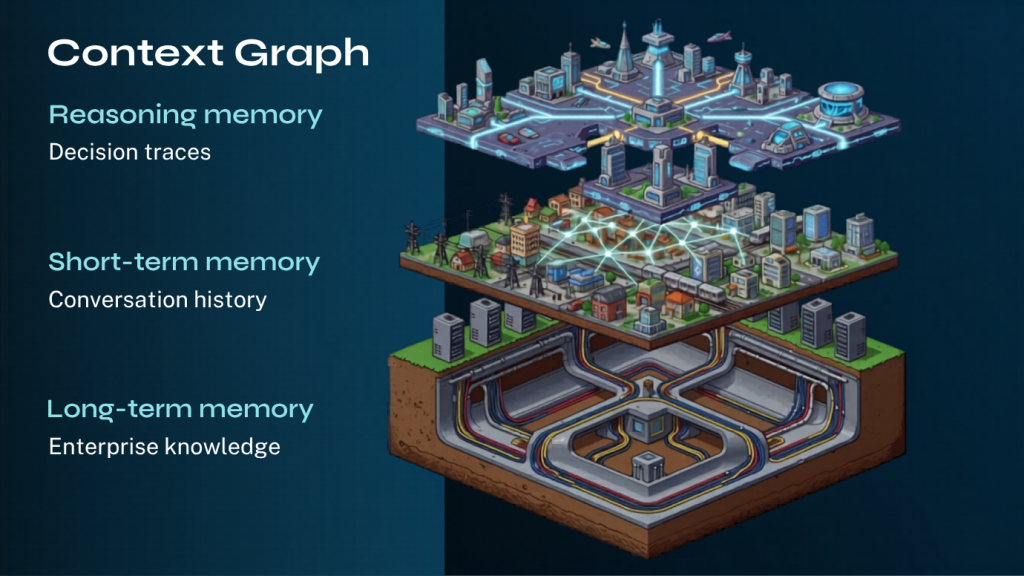
A robust context graph categorizes operational information into three distinct, interconnected memory layers:
- Long-Term Memory: Encapsulates durable enterprise knowledge, including corporate policies, product catalogs, customer profiles, organizational hierarchies, and historical service records.
- Short-Term Memory: Captures immediate conversational history, maintaining continuity across the current session state and tracking user intent through active interactions.
- Reasoning Memory: Records the cognitive lifecycle of the agent, documenting formulated plans, executed tool calls, programmatic results, final outcomes, and detailed decision traces.
To illustrate this architecture in practice, consider a customer requesting an order refund. In a graph-based system, long-term memory instantly provides customer profile data and applicable return policies. Short-term memory supplies the specific order number and the exact remedy requested by the user. Simultaneously, reasoning memory surfaces historical traces of how similar refund exceptions were handled previously, which evidentiary checks were performed, and what administrative approvals were granted.
Because these records are linked explicitly within the graph topology, the agent can retrieve the necessary information based on task association rather than semantic keyword overlap. The application no longer needs to reconstruct fractured relationships across separate enterprise systems on-the-fly, drastically streamlining the execution pipeline.
GraphRAG and Multi-Hop Reasoning: Bridging the Gap
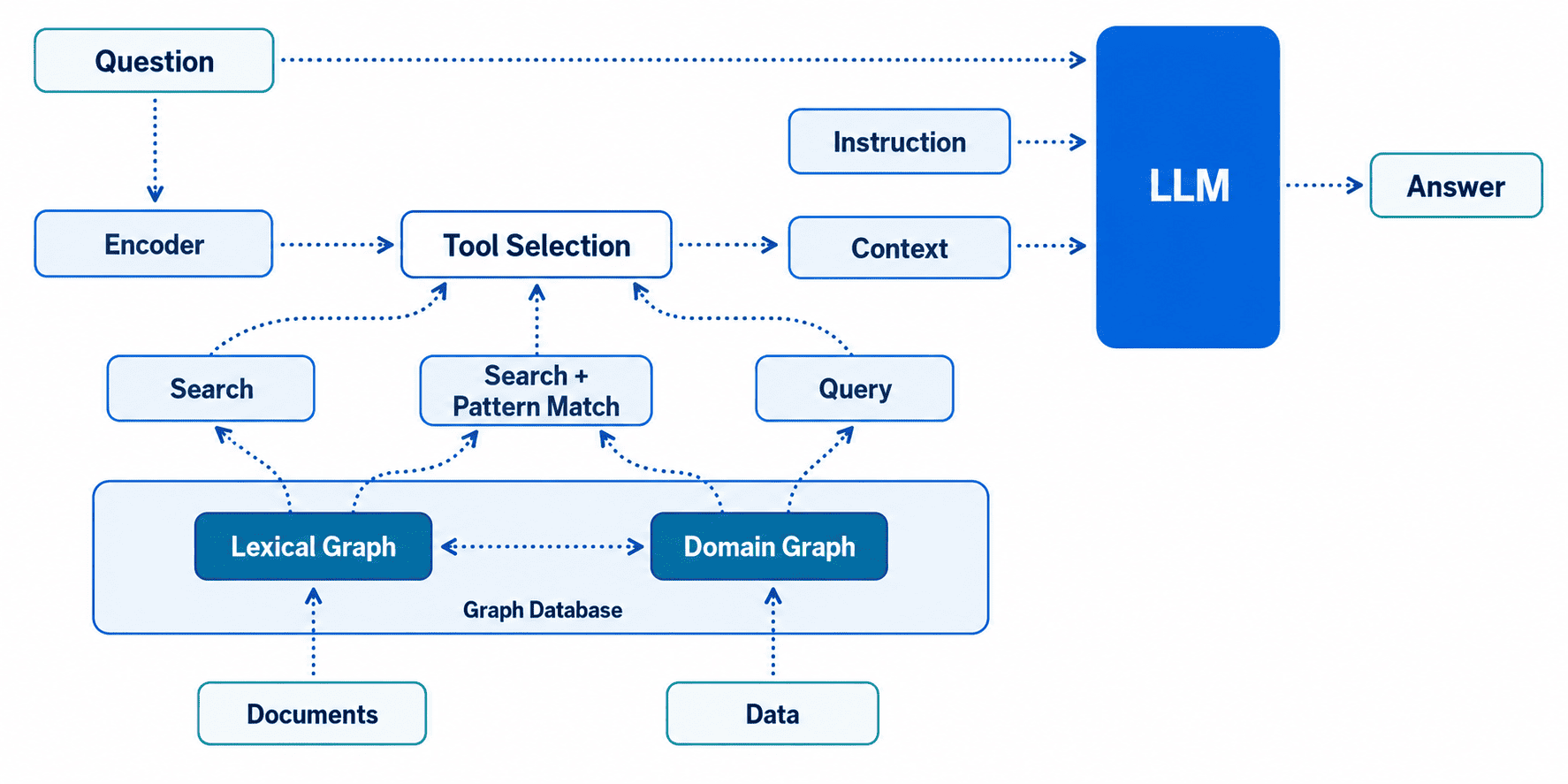
Contextual retrieval leverages GraphRAG to traverse the explicit connections residing within the context graph. Unlike linear vector searches that return static lists of text fragments, GraphRAG executes a dynamic, multi-step retrieval process:
- Initial Vector or Full-Text Entry: The system uses vector or keyword search to identify a viable entry point within the graph, such as a specific customer ID, support ticket, or product SKU.
- Graph Traversal and Expansion: From that starting anchor, the retrieval engine traverses outwards across connected edges, moving through related facts, prior messages, intermediate tool outputs, and historical decisions.
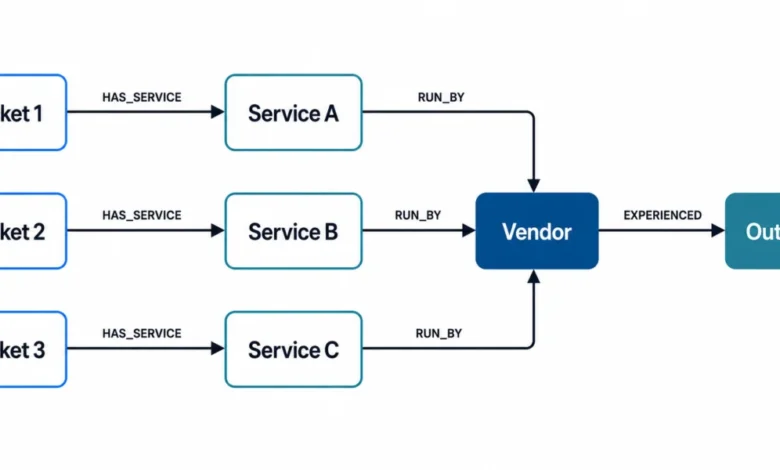
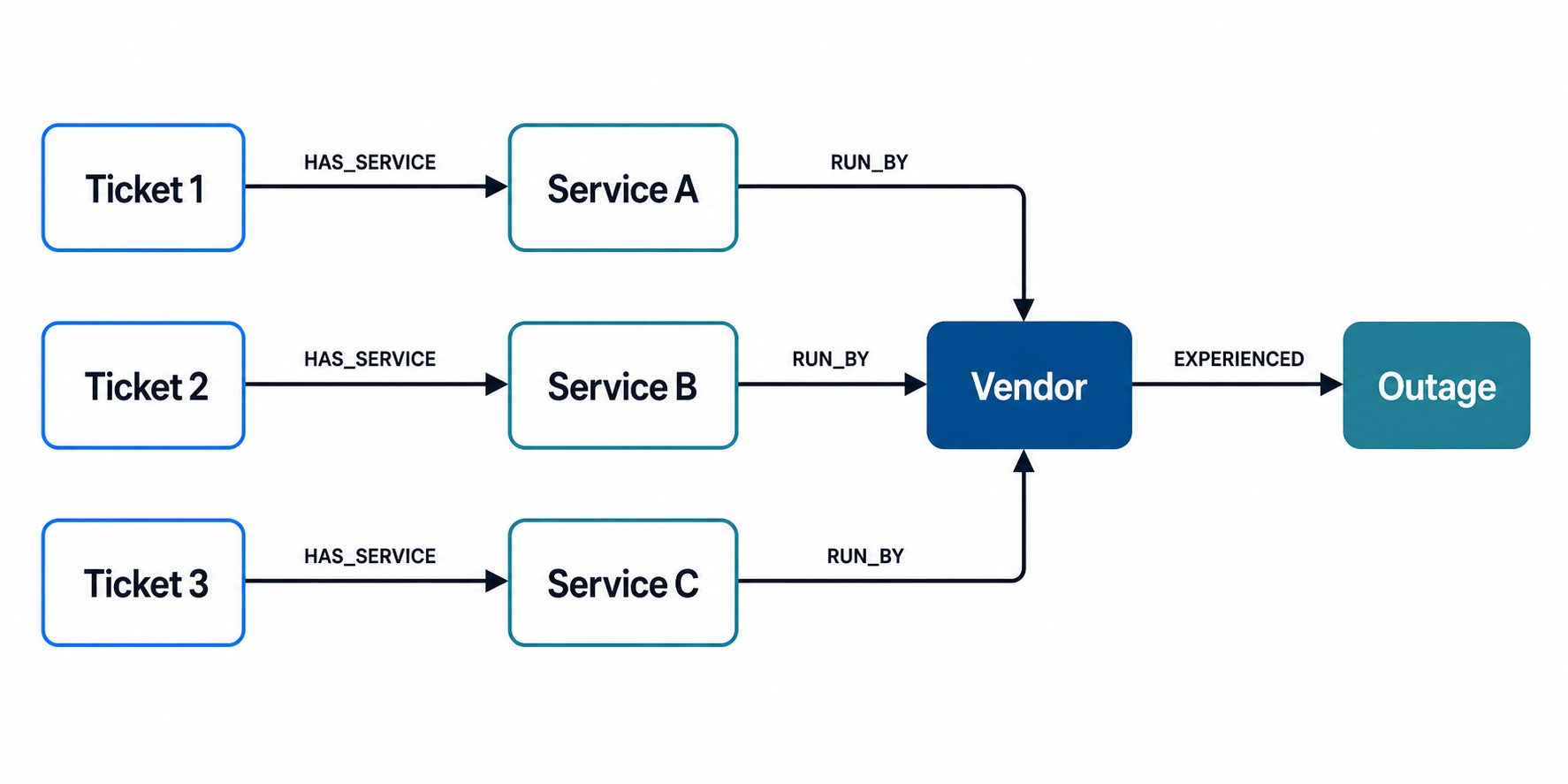
This methodology unlocks true multi-hop reasoning. In complex operational scenarios, an agent may need to traverse multiple relational steps to synthesize an answer. For instance, consider an operations agent tasked with answering the query: "Which vendor’s outage resulted in three different support tickets last week?"
The incoming support ticket descriptions might discuss localized service degradations, error codes, or impacted end-users without ever explicitly naming the underlying vendor. Resolving this query requires a multi-hop traversal path: connecting support tickets to affected software microservices, linking those services to their respective hardware or cloud vendors, and correlating those vendors with documented system outages. A graph query executes this traversal natively, following the explicit relationships to pinpoint the root cause regardless of how the individual documents are worded.
| Feature Comparison | Vector-Only RAG | Graph-Based Contextual Retrieval |
|---|---|---|
| Primary Signal | Semantic text similarity | Semantic/full-text similarity combined with explicit relationships |
| Typical Output | Text chunks ranked by similarity scores | Connected entities, facts, messages, decisions, and traversable paths |
| Multi-Step Reasoning | Requires custom data structures and complex retrieval logic | Native relationship traversal across multiple hops |
| Agent Memory Management | Managed separately in fragmented silos | Unified memory connecting enterprise knowledge, chats, and decisions |
| Explainability | Opaque; minimal insight into retrieval rationale | Fully transparent; traversable paths expose logical decision traces |
Quantifying the Impact: Accuracy, Explainability, and Token Economics
The integration of graph-based contextual retrieval yields measurable operational advantages across enterprise deployments, fundamentally altering agent accuracy, debugging transparency, and operational expenditure.
Enhanced Accuracy and Reduced Hallucinations
Providing LLMs with richly connected relational evidence significantly improves factual grounding. Independent empirical benchmarks illustrate the profound performance gap between traditional and graph-augmented retrieval architectures. Research conducted by the United Kingdom’s National Innovation Centre for Data evaluated vector-only RAG against GraphRAG across 510 complex, multi-faceted enterprise queries. The evaluation revealed that the GraphRAG system scored approximately 80% higher on overall truthfulness, successfully answering 65.3% of the complex test prompts compared to just 28.9% for the vector-only baseline.
Furthermore, enterprise market research highlights broader systemic benefits. An IDC study examining early deployments of generative artificial intelligence found that organizations utilizing connected knowledge layers experienced a 44% reduction in model hallucinations, underscoring the vital role relational context plays in stabilizing enterprise AI outputs.
Debugging Transparency and Explainability
One of the most persistent hurdles in enterprise AI engineering is the "black box" nature of model failures. When an autonomous agent makes an erroneous decision or generates an unexpected output in a vector-only architecture, developers are forced to decipher opaque numerical similarity scores and unstructured text chunks.
Context graphs solve this observability crisis by generating an inspectable, deterministic decision trace. Developers can visually or programmatically trace the exact sequence of entities, relationships, messages, and facts the agent traversed to construct its operational context. This transparent audit trail transforms debugging from speculative prompt engineering into straightforward system diagnostics, allowing engineering teams to instantly identify missing edges, faulty tool outputs, or logical missteps.
Mitigating Context Debt and Controlling Token Costs
As autonomous agents execute longer workflows, they accumulate vast amounts of state data. Replaying entire conversation histories, reviewing every previously retrieved document, and forcing models to reason from scratch on every turn introduces what industry analysts term "context debt."
According to analyses by firms like Forrester, long-running agentic workflows can consume up to four times as many tokens as standard chat interactions, while complex multi-agent systems can scale token consumption by a factor of fifteen. Carrying forward irrelevant conversational noise inflates operational expenditure and degrades model performance through cognitive clutter.
GraphRAG mitigates context debt by surgically retrieving only the precise, connected information required for the immediate task state. By storing historical states within the context graph rather than dumping raw chat logs into the model prompt, agents retain access to institutional memory without wasting financial resources on redundant token processing.
Strategic Implications for Enterprise AI Deployment
As artificial intelligence transitions from experimental proofs-of-concept to mission-critical production systems, the underlying infrastructure must mature to support high-stakes operational demands. Simple vector search, while still valuable for broad semantic discovery across unstructured document libraries, is no longer sufficient as a standalone retrieval engine for advanced agentic workflows.
By combining the semantic flexibility of vector search with the structural rigor of knowledge graphs, context graphs and GraphRAG provide a comprehensive cognitive foundation for AI systems. They bridge the chasm between static corporate data and dynamic agent execution, ensuring that enterprise AI applications remain accurate, transparent, and economically sustainable as they scale to meet increasingly complex operational demands.
Related posts: