Overcoming the Retail Data Silo: How Microsoft Fabric and Neo4j Are Revolutionizing AI Copilots with Graph Intelligence


Modern retail enterprises rarely suffer from a scarcity of information. Operating across omnichannel frameworks, modern merchant ecosystems generate terabytes of signals daily, encompassing intricate customer profiles, real-time point-of-sale transactions, granular inventory levels, and complex promotional schedules. Despite this vast accumulation of data, retail organizations frequently struggle to extract actionable, real-time insights from their information stores. The underlying bottleneck lies within legacy relational architectures, which traditionally keep enterprise data locked inside siloed systems. Point-of-sale platforms, standalone inventory management networks, and customer relationship management applications operate in functional isolation, preventing a unified view of the enterprise.
This structural fragmentation creates acute operational challenges as enterprises increasingly deploy advanced artificial intelligence systems. When organizations integrate AI Copilots or specialized autonomous agents to handle hyper-personalization, customer service, and inventory forecasting, they immediately encounter a severe architectural limitation. AI agents require rich, interconnected business context to function effectively, rather than isolated, flat transactional rows. Relational tables are engineered primarily for fast transactional logging and structured record-keeping. Consequently, they collapse under the weight of multi-hop queries, inadvertently obscuring nuanced customer habits and complex, interdependent product relationships.
To resolve these architectural roadblocks, a strategic technology integration has emerged, uniting Microsoft Fabric with Neo4j Graph Intelligence. By combining Microsoft’s centralized data analytics foundation with advanced graph modeling, retailers can bridge the gap between transactional storage and contextual AI reasoning. This dual-engine architecture equips AI agents with multi-hop relationship intelligence, transforming how modern commerce platforms understand consumer behavior, process recommendations, and optimize supply chains.
The Architectural Bottleneck of Legacy Relational Systems
For decades, relational databases have served as the backbone of enterprise data infrastructure. Built on structured tables, rows, and columns connected by primary and foreign keys, relational architectures excel at processing high-volume, repetitive transactions such as credit card authorizations and stock level updates. However, the rise of generative AI and large language models has exposed the fundamental limitations of these legacy structures.
When a retail Copilot attempts to generate a personalized product recommendation or answer a complex shopper query, it relies on semantic search and database queries to retrieve relevant context. In a purely relational environment, this process typically involves executing multiple database joins across massive tables. As the complexity of the query increases—such as attempting to trace a customer’s purchasing history alongside regional seasonal trends, product category affinities, and localized inventory levels—query latency increases exponentially.
More critically, relational tables struggle to represent the multi-dimensional nature of human behavior. Shopper preferences do not exist in neat, isolated rows; they form intricate, overlapping webs of influence, timing, location, and demographic context. When AI agents are forced to operate solely on flattened transactional data, their outputs often lack depth, resulting in generic recommendations that fail to capture genuine consumer intent.
The Convergence of Microsoft Fabric and Neo4j Graph Intelligence
To eliminate systemic data silos without requiring complex extraction, transformation, and loading (ETL) pipelines or duplicate data copies, enterprises are increasingly adopting Microsoft Fabric. Fabric centralizes disparate enterprise data within OneLake as open Delta tables, providing a unified, scalable data foundation.
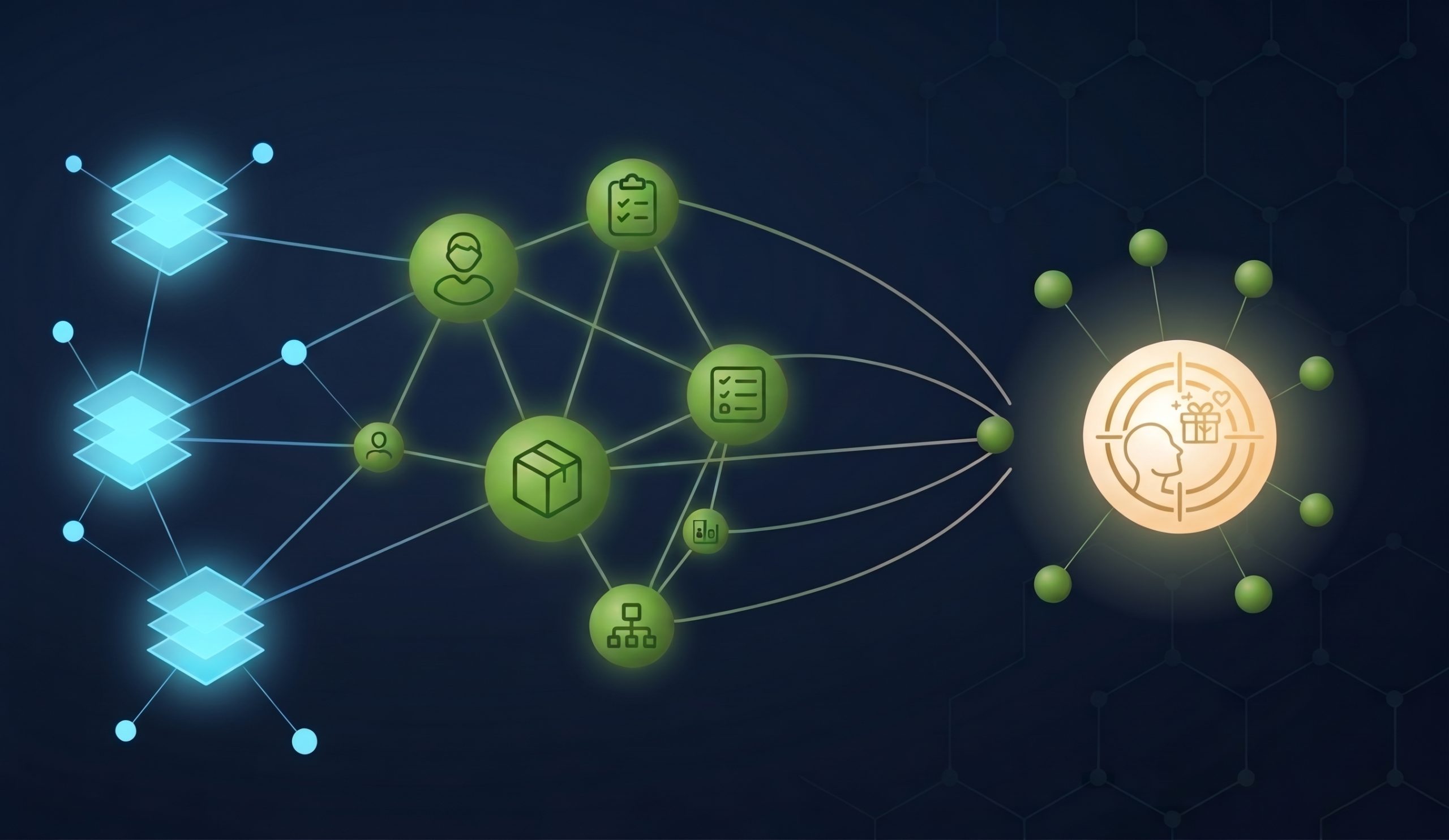
Building directly on top of this robust foundation is Neo4j Graph Intelligence, which projects Fabric’s relational tables into highly connected graph models. This integration exposes deep relationships across core retail entities, including customers, orders, products, aisles, and promotional schedules. Instead of treating these data points as isolated records, the graph architecture maps them as interconnected nodes and edges.
This dual-engine architecture delivers multi-hop relationship intelligence. When an AI agent initiates a query, it no longer has to rely on slow, superficial table joins. Instead, it traverses the graph topology in milliseconds, regardless of depth. This gives conversational Copilots and automated data agents instant access to real-time, context-rich business intelligence, dramatically improving recommendation accuracy and operational efficiency.
The Cost of Inaccurate Recommendations and the Banana Problem
The financial implications of inadequate AI recommendations extend far beyond minor inconveniences for shoppers. When AI Copilots rely on superficial semantic searches or basic relational queries, poor recommendations directly impact bottom-line profit margins and long-term brand equity. Customers who repeatedly encounter irrelevant product suggestions quickly lose trust in conversational interfaces, leading to reduced platform engagement, higher cart abandonment rates, and diminished customer lifetime value.
A prime illustration of this limitation is what data scientists refer to as "the banana problem" in standard market basket co-occurrence analysis. Consider a routine scenario where a shopper adds organic spinach, avocado, and peanut butter to their digital shopping cart. A standard SQL query operating on traditional co-occurrence logic examines historical purchasing patterns and recommends bananas.
Because bananas appear in nearly every grocery cart, standard relational queries mistakenly confuse high aggregate popularity with true customer intent. This common statistical flaw drowns out genuine customer preferences under a mountain of high-frequency noise. It is the retail equivalent of assuming that every consumer who purchases coffee simultaneously requires bottled water; while the combination may occur frequently in raw transaction logs, it fails to identify what the customer actually needs to complement their specific, current order.
To unlock true incremental revenue and deliver high-converting personalization, AI agents must bypass high-frequency noise. They must be equipped to identify subtle, long-tail affinity patterns that reveal a consumer’s true next-purchase intent.
Surfacing True Intent Through Graph Data Science and Node Similarity
To overcome the limitations of simple co-occurrence counts, modern graph-grounded architectures utilize advanced Graph Data Science (GDS) techniques. Rather than simply counting direct purchases, platforms like Neo4j analyze product neighborhoods using complex algorithmic models such as Node Similarity, which incorporates Jaccard or Cosine Neighborhood algorithms.
By comparing the surrounding contextual environment of items—such as products frequently purchased alongside cauliflower versus those bought with pepper jack cheese—the system identifies genuine product affinity, entirely independent of total sales volume. By evaluating overlapping connections across the broader graph topology, the architecture uncovers non-obvious, highly relevant complements, such as artisanal hot sauces or specialty dips, rather than defaulting to generic, high-volume staples.
| Capability | Standard Relational SQL Agent | Neo4j Graph-Grounded Copilot |
|---|---|---|
| Data Structure | Flat transactional tables | Connected property graphs (:Customer, :Order, :Product, :Aisle) |
| Primary Logic | Direct co-occurrence counts (COUNT, GROUP BY) |
Node Similarity & neighborhood overlap analysis |
| Noise Filtering | Over-indexes on high-volume staples (e.g., Bananas) | Filters out volume bias to find true product affinity |
| Unseen Carts | Fails, times out, or returns null for novel item combinations | Traverses multi-hop graph paths to find contextual substitutes & complements |
| Query Latency | Exponential degradation as joins increase | Constant millisecond traversal regardless of graph depth |
This structural comparison highlights the operational divergence between legacy data retrieval and modern graph intelligence. While relational agents remain trapped by volume bias and latency degradation, graph-grounded architectures maintain consistent performance while delivering contextually superior results.
Empowering Retail Teams Through Natural Language Interfaces
Deploying sophisticated graph algorithms historically required specialized data science expertise and the manual construction of complex query languages. However, the integration of Microsoft Fabric Data Agents with Neo4j Graph Intelligence democratizes access to this advanced capability.
Fabric Data Agents empower business users, merchandise managers, and supply chain analysts to interact with complex graph data through natural language. Instead of requiring technical staff to write intricate graph traversal scripts—such as Neo4j Cypher queries—Data Agents automatically translate everyday business questions into optimized database queries behind the scenes.
The system retrieves relationship-rich insights from the underlying graph and returns them within an intuitive, conversational interface. This allows retail teams to explore consumer affinities, evaluate product relationships, and identify high-lift cross-sell opportunities using familiar enterprise terminology.
Furthermore, because this architecture operates natively within the Microsoft Fabric ecosystem, organizations retain full control over existing security and governance frameworks. Retailers can leverage Microsoft Purview for comprehensive data governance, native single sign-on (SSO) protocols, and stringent tenant-level security boundaries. This ensures that enterprises can deploy graph-grounded AI solutions safely and compliantly within their established infrastructure, eliminating the need to manage fragmented security models or disparate external environments.
Implementation and Industry Implications
As retail enterprises increasingly turn to artificial intelligence to drive digital transformation, the underlying data architecture remains the ultimate determinant of success. The integration of Neo4j Graph Intelligence within Microsoft Fabric represents a critical maturation point in enterprise AI deployment, shifting the focus from mere data accumulation to contextual reasoning.
Organizations looking to modernize their recommendation engines and upgrade their AI Copilots can implement these capabilities directly through the Fabric Workload Hub, ensuring native single sign-on and unified workspace management. Alternatively, deployments can be executed seamlessly via the Azure Marketplace. By mapping OneLake data into robust graph models and empowering teams with natural language Data Agents, retailers are well-positioned to eliminate data silos, neutralize high-frequency noise, and deliver the hyper-personalized shopping experiences demanded by today’s consumers.
Related posts: