In modern corporate governance, the simple task of identifying who is accountable for a specific business line can often devolve into a frustrating exercise in ambiguity. This operational bottleneck recently played out at AcmeBank, a mid-sized retail and small-and-medium-business (SMB) institution that grew rapidly through a series of corporate acquisitions. During a routine lending review, Rosa Delgado, the bank’s head of Risk and Compliance, posed a straightforward question: Who was ultimately accountable for SMB lending? Within sixty minutes, her query generated three distinct, plausible answers from different departments. None of them, however, satisfied the rigorous documentation requirements of a compliance audit, which demanded a single, indisputable owner of the risk.
When AcmeBank executives attempted to resolve the discrepancy by consulting the official corporate organizational chart, they encountered a familiar enterprise artifact: a static slide deck, last updated prior to a major operating model restructuring, which still listed departed personnel among active management. This scenario highlights a pervasive structural flaw across modern enterprises. While institutional knowledge exists within an organization, it is typically trapped in human memory, fragmented across legacy systems, or buried within static presentation files that drift from reality the moment they are exported. As enterprises increasingly look to deploy autonomous artificial intelligence agents to execute complex business workflows rather than merely answer basic queries, this lack of machine-readable operational clarity presents a critical barrier to deployment.
The Genesis of the Enterprise Knowledge Layer
To address these systemic organizational blind spots, enterprise architects are turning away from traditional relational databases and toward graph-based intelligence platforms. Jesus Barrasa, a leading voice in enterprise data architecture, formalized this approach in the foundational manifesto for the enterprise knowledge layer. According to architectural blueprints, the enterprise knowledge layer functions as a unified, queryable network model that captures the structural reality of a business—mapping business units, internal teams, role definitions, and reporting lines into a cohesive graph.
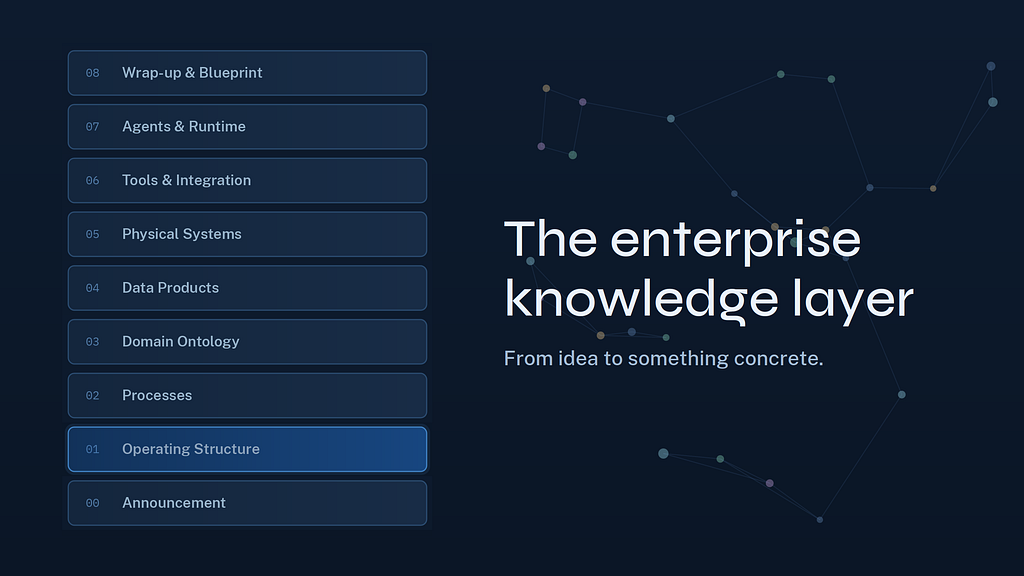
The initiative at AcmeBank serves as a fictionalized case study for a broader multi-part series detailing how organizations can construct a complete enterprise knowledge layer from the ground up, utilizing modern graph database technologies such as Neo4j Enterprise Edition paired with Cypher 25. The initial phase of this architectural build focuses specifically on the foundational element of the stack: the operating structure.

An Operating Structure Tailored for Network Analysis
Traditional relational database management systems struggle to represent corporate hierarchies cleanly without complex join tables and resource-intensive recursive queries. Business organizations naturally form networks: business units contain multiple operational teams, roles report upward to higher-level authorities, and individual personnel fill designated positions over specific time intervals. Because an enterprise operating structure is inherently a graph, utilizing a native graph database allows systems to store and navigate these relationships naturally.
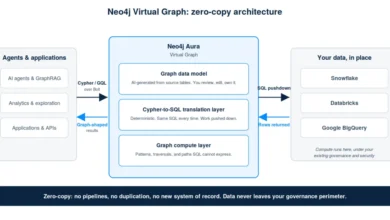
AcmeBank’s organizational landscape comprises six core business units: Retail Banking, SMB Banking, Operations, Risk and Compliance, Data and Technology, and Marketing. Within this architecture, data flows from established systems of record—such as human capital management platforms like Workday or BambooHR and identity management systems—through a governed ingestion pipeline. This pipeline transforms raw HR records into structured graph nodes and relationships, handling entity resolution, data validation, and historical temporal tracking before the information populates the central knowledge graph.

Inside the Graph: Nodes, Functions, and Roles
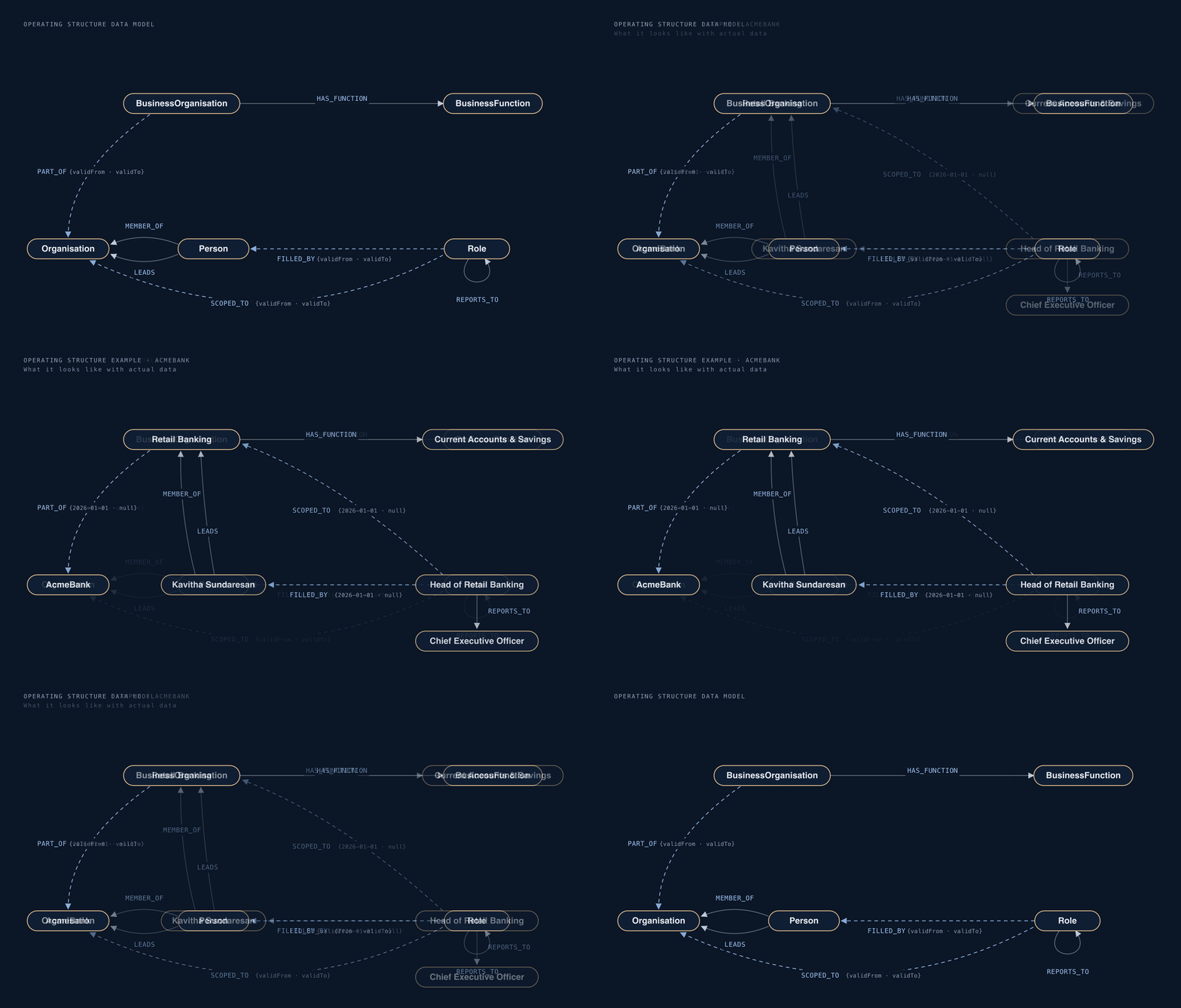
The operational structure model relies on several distinct entity types that categorize corporate architecture down to the individual level. The overarching corporate entity is categorized as an Organization. Beneath this umbrella, BusinessOrganisation nodes encompass the bank’s divisions and internal teams, each associated with validity dates and nested hierarchically via specialized relationships.
To define the operational responsibilities of each unit, the architecture introduces BusinessFunction nodes, which categorize activities such as credit underwriting, regulatory compliance, and risk assessment. These functions attach to business units using explicit relationship markers, serving as foundational anchor points for future process automation layers.

Crucially, the architecture separates the concept of a Role from the individual person occupying it. A position such as Head of SMB Lending is modeled as a distinct node containing a specific title and seniority level. Roles are scoped to specific organizations and maintain formal reporting structures via upward-facing reporting edges. Meanwhile, individual human staff are modeled as Person nodes characterized by a name, title, and active or inactive status. People are linked to positions via occupancy relationships, maintaining historical records of tenure without corrupting the structural chain of command.
Four Critical Design Decisions in Enterprise Modeling
Based on production experience across large-scale deployments, enterprise architects emphasize four critical design decisions when structuring operational graphs to avoid common pitfalls:

First, reporting lines must be modeled between roles rather than between individuals. Direct reporting relationships anchored to specific people break down during organizational restructuring, temporary leaves, or sudden departures. By anchoring reporting chains to permanent role definitions, the enterprise maintains structural continuity regardless of personnel changes.
Second, personnel assignments must be treated as temporal relationships. By assigning start and end dates to the connection between a person and a role, the system preserves historical accountability, allowing auditors to query who held a specific position at any given historical timestamp.
Third, business functions must be decoupled from organizational units. Separating what an organization does from where it sits in the hierarchy allows leadership to restructure reporting lines without invalidating core operational definitions and workflows.

Fourth, data freshness must be governed at the ingestion boundary. By enforcing schema validation rules—such as Neo4j’s native graph types—at the point of entry, enterprises ensure that the graph functions as a trusted single source of truth rather than a repository of unverified data feeds.
Implementation and Querying Capabilities
Deploying this architecture requires an enterprise-grade database environment capable of enforcing strict schema contracts. Using graph types—a schema enforcement mechanism within the database engine—administrators can define permitted node labels, required properties, and valid relationship paths. This acts as a rigid governance contract for the entire data ecosystem.

The effectiveness of this structural graph becomes immediately apparent when querying organizational data. Revisiting Rosa Delgado’s initial compliance dilemma—identifying accountability for SMB lending—illustrates the power of graph traversal. Rather than navigating conflicting departmental claims or outdated slide decks, a compliance officer or an automated governance agent can execute a simple traversal query. The system instantly returns a single, verified record: the active Head of SMB Lending, Yusuf Rahman, linked directly to the relevant line in the corporate risk register.
Furthermore, historical queries that previously required extensive manual investigation become instantaneous. When auditing past decisions, the graph can retrieve historical tenure data, revealing precisely who held a specific operational role and during what exact date range. Similarly, traversing complex organizational hierarchies—such as tracing the complete chain of command from an operational underwriting team up to the Chief Executive Officer—requires only a single hop-list query, regardless of corporate depth.
Broader Impact and Implications for Enterprise AI

The deployment of a queryable operating structure carries significant implications for the future of enterprise artificial intelligence and automation. As organizations move past experimental generative AI deployments toward autonomous agentic workflows, governance requirements shift from theoretical policy documents to machine-readable control frameworks.
An AI agent tasked with executing business transactions—such as processing a commercial loan application or initiating compliance escalations—must operate under explicit authority limits. It requires automated visibility into whose authority it acts under, who owns the asset it is modifying, and where to route escalations when anomalies arise. Without a live, queryable operating structure, autonomous agents are effectively operating blind, relying on probabilistic guesses rather than deterministic enterprise context.
By establishing a unified knowledge layer that bridges human organizational charts with machine-readable graph structures, enterprises can transition from static, fragmented documentation to dynamic organizational memory. As AcmeBank’s architectural roadmap demonstrates, this operational foundation serves as the prerequisite for subsequent layers in the enterprise knowledge stack, laying the groundwork for process automation, data product integration, and truly governable artificial intelligence.