In the realm of graph databases, data integrity is rarely compromised by hardware failures or erroneous deletions; instead, it is frequently obscured by the very logic used to retrieve it. Developers utilizing graph query languages often encounter a subtle architectural phenomenon known colloquially as the query trap. This logical blind spot can inadvertently filter out newly ingested, sparsely populated, or unlinked records, creating the false impression that data is missing from the system. A recent analysis by database practitioners highlights how improper pattern matching on graph topologies can conceal valid nodes and examines how modern query structuring—specifically utilizing list comprehensions and scalar subqueries—resolves these visibility issues while optimizing execution performance.
The Anatomy of a Graph Query Trap
The mechanics of this issue stem from how declarative graph query languages, such as Neo4j’s Cypher, evaluate pattern matches. When a database administrator or software engineer constructs a query that strings together multiple relationships and nodes into a single, linear MATCH clause, the query engine treats that entire chain as a strict logical conjunction. Every specified node and edge acts as a mandatory filter, functioning similarly to an exclusive membership gate.
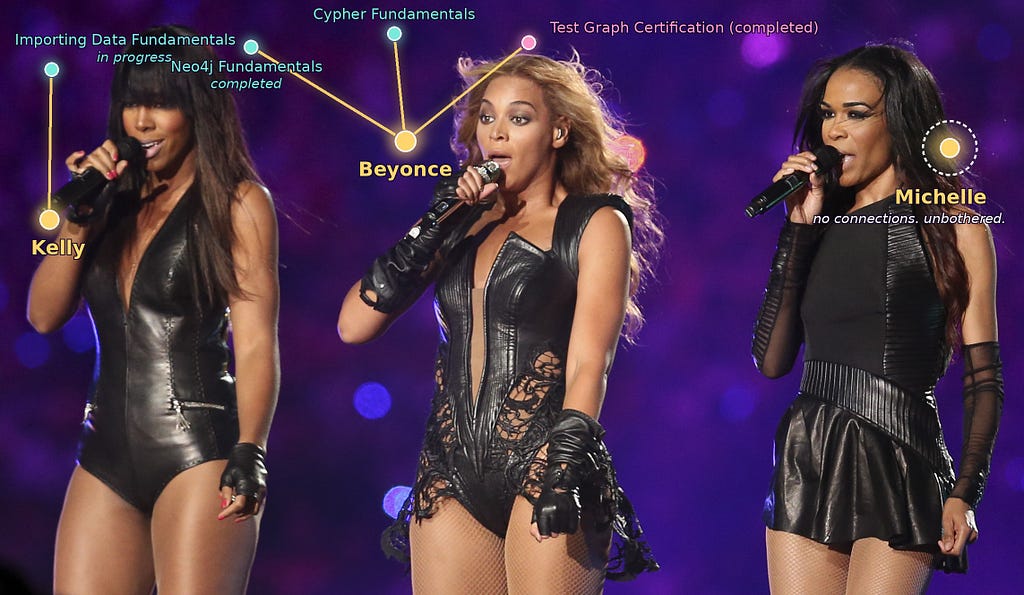
To demonstrate this operational dynamic, developers frequently deploy controlled testing environments. In a recent scenario designed to validate a support automation bot, an engineer established a synthetic dataset within a cloud-hosted Neo4j Aura instance. Using pop culture identifiers for clarity, three distinct user profiles were seeded under the common label TestData:
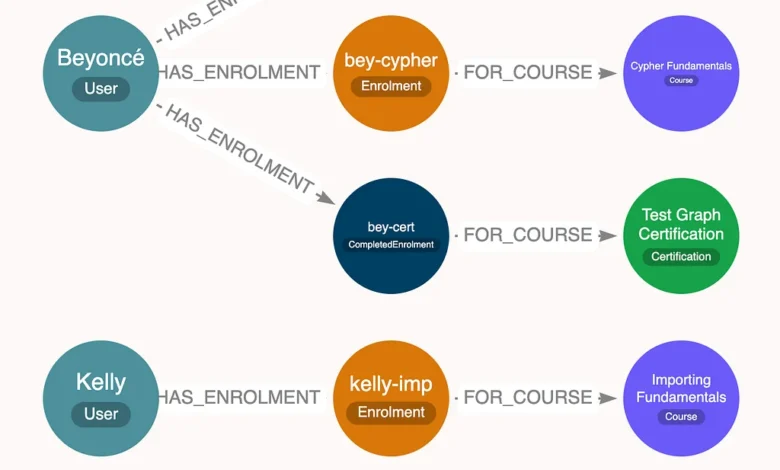
- Beyoncé: Represents an advanced, highly active user profile, featuring two completed courses, a certification, and specific completion timestamps anchored via relationship properties.
- Kelly: Represents a moderately active user, mapped to a single course currently in progress without a completion marker.
- Michelle: Represents a newly registered account with zero historical activity, intentionally designed to evaluate how downstream systems handle cold-start users devoid of relational context.
The initial seeding script utilized the Cypher MERGE command, a standard idempotent operation designed to match existing patterns or create them if absent. Crucially, best practices dictate that structural identifiers—such as unique email addresses—remain inside the primary search brackets, while mutable attributes like display names or timestamps are relegated to the SET clause. This prevents accidental data duplication should scripts be executed multiple times with minor string adjustments.
The Visibility Crisis: When Nodes Disappear
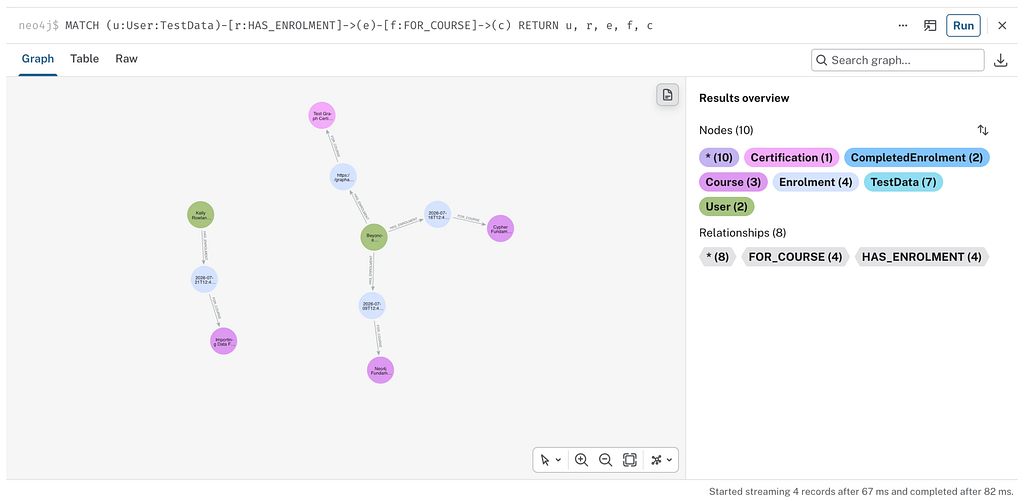
Upon successfully committing the seed script, the engineering team executed a standard retrieval query to inspect the newly created graph topology:
MATCH (u:User:TestData)-[r:HAS_ENROLMENT]->(e)-[f:FOR_COURSE]->(c)
RETURN u, r, e, f, c
When read aloud as a natural language sentence, the query translates to: "Find my test users, their enrolments, and the courses those enrolments point to."
However, upon executing the command, a discrepancy emerged. The visualization interface rendered the complex achievement constellation associated with Beyoncé and the single threaded path belonging to Kelly, but Michelle was entirely absent from the visualization panel. The metadata indicated that only two user nodes had been returned, despite three existing in the database.
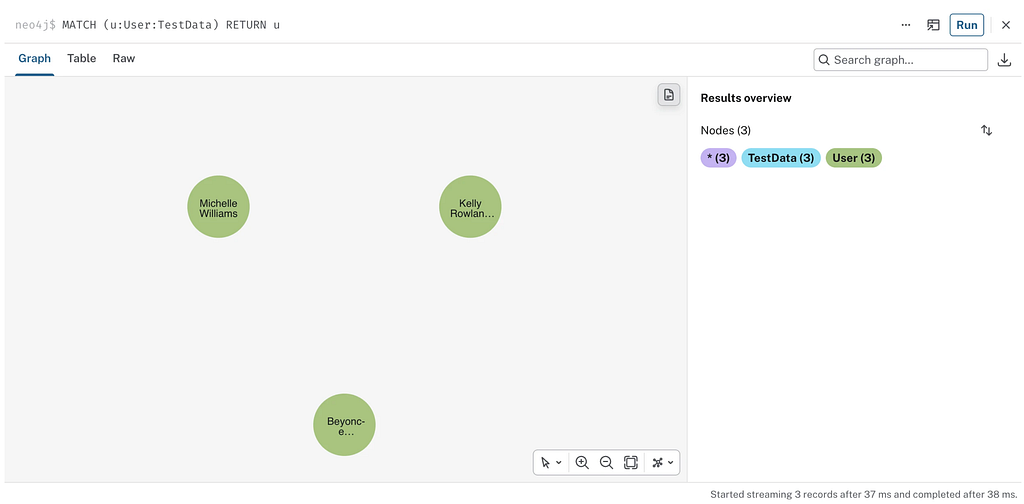
A subsequent diagnostic query requesting all nodes under the User label without relational constraints—MATCH (u:User:TestData) RETURN u—immediately confirmed that Michelle’s node was present, correct, and intact within the storage layer. The data had not vanished; rather, the initial query structure had systematically excluded it.
Evaluating the Pattern-Matching Gatekeeper
The root cause of Michelle’s invisibility lay in the strictness of the graph pattern. By chaining the User node through an enrolment relationship to a course, the query engine enforced an inner join across the entire path. Because Michelle possessed a User node and nothing else, her record failed to satisfy the structural prerequisites of the MATCH clause.

In database architecture, this pattern functions as an implicit bouncer. It interrogates every node matching the primary label, evaluates whether it possesses the downstream relational path specified in the query, and discards any record that falls short. In production environments, this behavior poses a significant risk: the very records that require administrative attention—such as dormant accounts, incomplete onboarding flows, or orphaned data points—are precisely the ones filtered out by linear, tightly coupled match patterns.
Technological Evolution and Optimization Strategies
Historically, developers attempting to resolve this limitation relied on the OPTIONAL MATCH clause. Analogous to an outer join in relational SQL, OPTIONAL MATCH permits the traversal of specified paths while returning null values for missing relationships, thereby preserving the primary node in the result set.
While functional, database optimization experts advise caution regarding the habitual use of multiple OPTIONAL MATCH clauses. When a single primary node possesses multiple independent outgoing relationships—such as multiple course enrolments and multiple team memberships—evaluating separate optional paths can trigger a Cartesian product expansion. If a user is linked to three courses and two teams, the database engine processes multiple redundant rows of data to account for every permutation before aggregation. While negligible on a dataset of three test users, this computational overhead scales exponentially in production environments containing millions of nodes, severely degrading query performance.
To circumvent this inefficiency, modern Cypher development increasingly relies on anchor-and-collect methodologies, utilizing list comprehensions and scalar subqueries. By anchoring the query strictly to the primary node and delegating secondary collections to evaluated sub-expressions, the database retrieves all necessary data without inflating row counts.
Refactoring the Query for Performance and Completeness
To capture all users—including inactive profiles like Michelle—while simultaneously aggregating their relational data without performance degradation, engineers refactored the retrieval statement using list comprehensions:
MATCH (u:User:TestData)
RETURN u.displayName AS learner,
[ (u)-[:HAS_ENROLMENT]->()-[:FOR_COURSE]->(c) | c.title ] AS courses,
COUNT (u)-[:HAS_ENROLMENT]->(:CompletedEnrolment) AS completed
In this optimized structure, the primary MATCH clause anchors exclusively to the User:TestData label, ensuring that every user is evaluated and returned regardless of their relational degree. The secondary data points—course titles and completion counts—are retrieved via isolated, non-blocking list expressions and subqueries.
If a user possesses no courses, the list comprehension evaluates to an empty set rather than discarding the user row. This approach parallels list comprehension patterns found in high-level programming languages like Python, bridging the conceptual gap between application-level logic and graph-level retrieval.
Broader Implications for Enterprise Data Architectures
The implications of query trap vulnerabilities extend far beyond synthetic test environments. Across enterprise applications utilizing graph technology—ranging from fraud detection networks and supply chain tracking to recommendation engines and identity access management—unintended data filtering can obscure critical systemic anomalies.
Industry analysts note that as organizations scale their graph implementations to handle complex, interconnected datasets, query efficiency and accuracy become paramount. Common scenarios where similar query traps manifest include:
- Fraud Detection: Queries that search for transactional patterns while strictly requiring secondary verification nodes may accidentally omit newly emerging, sophisticated fraud rings that lack historical flags.
- Customer 360 Platforms: Marketing segmentation queries that mandate active engagement history can inadvertently drop high-value prospects who have registered accounts but have not yet completed a purchase funnel.
- Knowledge Graphs: Automated reasoning engines searching for validated factual relationships may overlook newly ingested documents awaiting entity resolution.
Best Practices for Query Design
To mitigate the risk of hidden data loss during data retrieval operations, database architects and software engineers recommend adherence to standardized design principles:
- Anchor First, Traverse Second: Ensure that the primary target nodes are established clearly in the initial MATCH clause without forcing unnecessary relational constraints that could act as unintended filters.
- Leverage Subqueries and List Comprehensions: Utilize inline collection subqueries and list comprehensions to retrieve auxiliary properties and relationships, preventing Cartesian product expansion and maintaining predictable row counts.
- Validate with Boundary Testing: Routinely test graph queries against edge cases, including newly created nodes, isolated records, and sparsely connected components, to confirm that retrieval logic behaves inclusively.
- Read Queries Aloud: Translate complex Cypher syntax into plain natural language sentences to audit relational dependencies and verify whether implied requirements match intended business logic.
Conclusion
The hidden data trap serves as a reminder that graph database performance and accuracy depend as much on query design as on data ingestion integrity. By recognizing how strict pattern matching filters out unlinked records, developers can adopt more resilient querying strategies. Through the deliberate use of anchored node matching and list comprehensions, engineering teams ensure that all system participants—from high-achieving users to brand-new accounts—remain visible within analytical dashboards and operational applications.