Cloudflare Patches Critical Vulnerability Exposing Sensitive Data Across Shared Container Environments

A significant security flaw within Cloudflare’s container infrastructure recently exposed a vulnerability that allowed unauthorized access to data fragments belonging to other customers. The vulnerability, which stemmed from improper disk management in multi-tenant environments, enabled a customer to read residual data left behind by other containers previously hosted on the same physical server. While the incident did not allow for the modification of live workloads or cross-account control, the exposure of sensitive files—including database records and configuration files—highlights the inherent risks associated with cloud-native multi-tenancy and the complexities of secure storage isolation.
The Mechanism of the Flaw
The vulnerability was identified by Oren Yomtov of the security research firm Accomplish and reported to Cloudflare on September 4, 2024, through the company’s bug bounty program. At the heart of the issue was the implementation of "thin provisioning," a Linux kernel feature used by Cloudflare to manage storage efficiency.
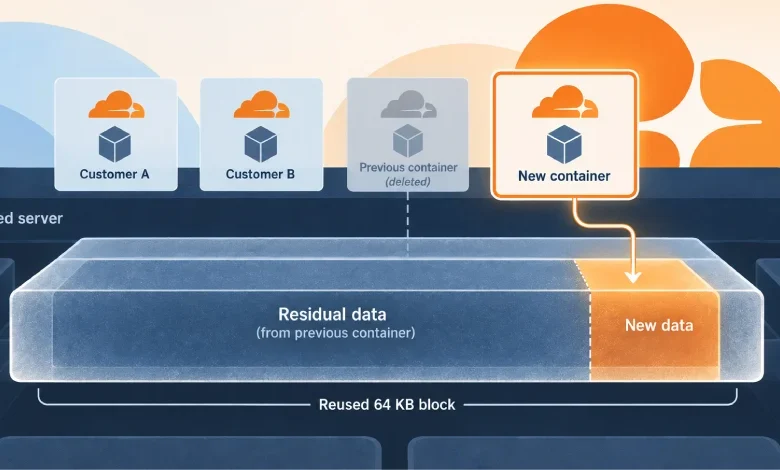
In a typical cloud container environment, storage is allocated in blocks—in this specific instance, 64-kilobyte segments. When a container is deleted, the storage blocks it utilized are returned to a global pool to be recycled for future use. Under normal operating conditions, these blocks should be "wiped" or zeroed out before being reallocated to a new tenant to ensure data privacy. However, a configuration error caused the system to bypass this critical sanitation step.
Consequently, when a new container was provisioned, it might be assigned a block of disk space that still contained fragments of data from a previous tenant. By writing a small amount of data to a block and then reading the entire segment at the raw disk level, a researcher could access the "leftover" 60 kilobytes of the block. This allowed for the recovery of sensitive information that had not been overwritten, ranging from directory structures and SQLite databases to browser profiles and environment variables containing API keys or credentials.

Chronology of Discovery and Remediation
The discovery by Accomplish triggered an immediate internal investigation by Cloudflare’s security engineering team. The timeline of the response was as follows:
- September 4, 2024: Oren Yomtov of Accomplish submits the vulnerability report through the Cloudflare bug bounty program, providing proof-of-concept evidence that the flaw was reproducible across multiple geographical regions.
- September 14, 2024: Cloudflare implements a fix that restores the "wiping" functionality for newly allocated disk blocks. The researchers verify that the initial proof-of-concept attack is no longer effective.
- September 19, 2024: Recognizing that the initial patch did not address blocks already residing in active container caches or currently mapped to running containers, Cloudflare completes a comprehensive cleanup. This involved retiring every active container disk and clearing image layer caches, a process conducted during low-traffic hours to minimize service disruption.
- September 24, 2024: Cloudflare publicly discloses the vulnerability, confirming that the flaw has been fully remediated and that no evidence of malicious exploitation by third parties was found.
Data Privacy and Impact Analysis
The recovered data identified during the researchers’ testing was substantial. According to technical documentation provided by Accomplish, the vulnerability allowed access to structurally complete database pages, Chromium browser profiles, and .env files. These files are particularly high-value targets for attackers, as they often contain configuration secrets, authentication tokens, and proprietary application logic.
Despite the potential severity, Cloudflare has emphasized that the risk was limited in scope. The company’s forensic analysis, which utilized detection signatures derived from the researchers’ methodology, revealed no evidence that the vulnerability was exploited by any malicious actors prior to the discovery. Cloudflare’s audit of disk-activity logs indicated that only the researchers and internal security engineers had accessed the data in a controlled manner.
Furthermore, the researchers themselves acted in accordance with responsible disclosure practices. They confirmed that the data retrieved during their tests was kept private, not shared with third parties, and was permanently deleted following the verification of the bug. Importantly, the vulnerability did not grant the researchers the ability to execute arbitrary code within other customers’ containers, nor did it allow for the interception of live data traffic or the disruption of existing workloads.
The Broader Context of Container Security
The incident serves as a poignant case study in the challenges of "Shared Responsibility" in cloud computing. As businesses increasingly shift toward containerized microservices and AI-driven agentic workflows—which often require robust sandboxing—the abstraction layer between the user and the underlying hardware becomes a critical security boundary.

Cloudflare’s "Sandboxes" product, which is designed to provide a secure environment for executing untrusted code (including code generated by AI), was also affected by this flaw. The event underscores that even with advanced security wrappers, the underlying system-level configuration—such as how the Linux kernel manages block devices—remains a potential attack vector.
The researchers at Accomplish have been prolific in identifying similar sandbox escape vulnerabilities throughout 2024. This latest finding marks the sixth such disclosure since July, following reports involving high-profile platforms like Anthropic’s Claude Cowork, Docker, and OpenAI’s Codex. These recurring discoveries suggest that the industry is currently grappling with a "growing pain" phase as it attempts to safely scale the execution of third-party or AI-generated code in shared environments.
Implications for Cloud Infrastructure
For enterprise users of cloud platforms, this incident reinforces the importance of several security best practices:
- Defense in Depth: Even when relying on managed services to handle infrastructure isolation, organizations should treat their data as if the underlying storage could be potentially exposed. This includes encrypting sensitive data at rest, not only at the application level but also within the container environment itself, to ensure that even if a block of memory or disk is leaked, the contents remain unintelligible.
- Secret Management: The recovery of .env files highlights the danger of storing credentials directly in plain text within container configurations. The use of dedicated secret management services, which inject credentials into memory rather than storing them on persistent disk volumes, is a vital mitigation strategy.
- Third-Party Audits and Bug Bounties: The fact that this vulnerability was caught via a bug bounty program underscores the value of external security research. Cloud platforms that foster transparent relationships with the security community are better positioned to identify and remediate systemic issues before they are weaponized.
Conclusion and Future Outlook
Cloudflare’s rapid response to the Accomplish report demonstrates the effectiveness of modern incident response protocols. By taking the proactive step of clearing all active container caches and restarting services across their global infrastructure, the company effectively eliminated the residual risk that a simple "new-block" patch would have missed.
As the industry continues to push the boundaries of serverless computing and AI-integrated infrastructure, the focus on low-level kernel security will likely intensify. The "thin provisioning" vulnerability is a reminder that in a world of shared resources, the smallest configuration detail can have significant consequences. Moving forward, providers will need to ensure that their underlying hardware abstraction layers are as rigorously audited as the high-level software services that sit atop them. For now, the successful resolution of this incident stands as a successful example of collaborative vulnerability disclosure and timely remediation in the cloud services sector.