September 2026 Microsoft Patch Tuesday Analysis and the Escalating Crisis of Software Vulnerability Management

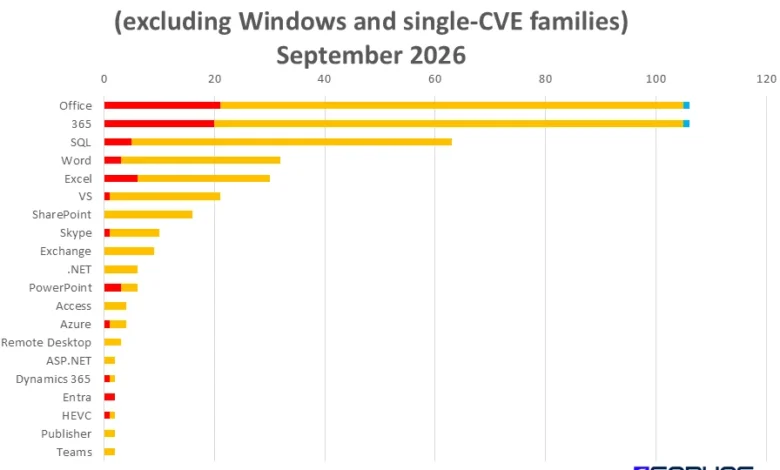
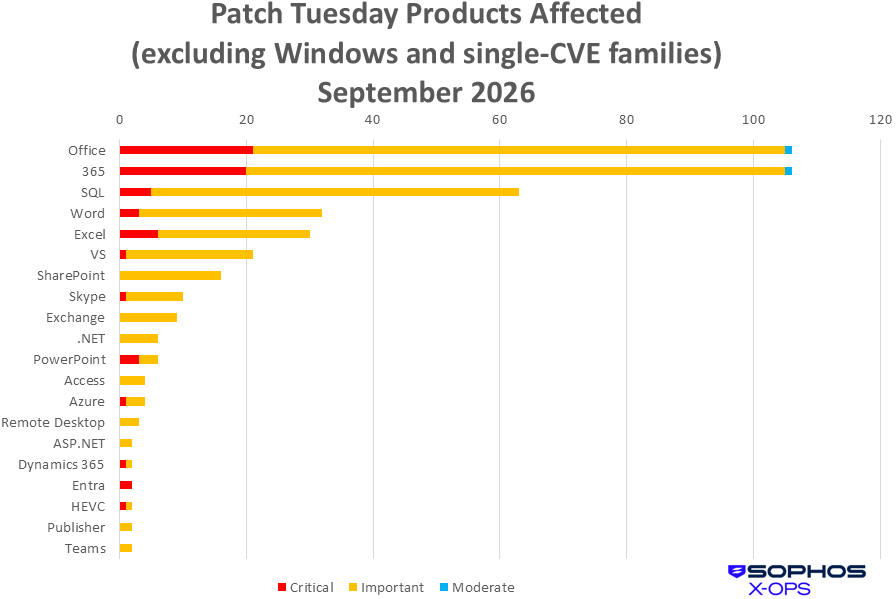
Microsoft’s September 9, 2026, security release cycle has brought the growing strain of modern patch management into sharp focus, as the company issued 973 distinct patches across 39 product families. This massive deployment underscores a widening gap between the speed of vulnerability discovery—often accelerated by AI-driven analysis tools—and the capacity of software vendors and administrators to remediate these flaws. Of the vulnerabilities addressed, 114 are classified as Critical, with 284 carrying a CVSS Base score of 8.0 or higher. Perhaps most concerning to security operations centers (SOCs) is the fact that 58 of these Common Vulnerabilities and Exposures (CVEs) are expected to be weaponized by threat actors within the next 30 days.
The Chronology of a Security Whirlwind
The September release did not occur in a vacuum; it was preceded by a flurry of related security activity. In the days leading up to the main Patch Tuesday event, the Chrome team released 24 patches specifically targeting the Edge browser. Simultaneously, Adobe addressed 21 vulnerabilities within its Acrobat suite. These auxiliary releases, coupled with the standard Servicing Stack update (ADV990001), highlight the interconnected nature of the modern software ecosystem, where a single security posture requires coordination across multiple vendors and browser architectures.
Furthermore, nine Microsoft CVEs—all carrying a Critical severity rating—were addressed prior to the September 9 release date. These vulnerabilities, which affected Azure, Copilot, Discovery Studio, Entra, Fabric, and Power Automate, included two flaws that earned a perfect 10.0 CVSS score. While these early patches prevented immediate exploitation, they contribute to a cumulative, record-breaking volume of security disclosures that has come to define the current fiscal year.
Analysis of Exploitability and Systemic Risk
The most immediate threats identified in the September batch are two Important-severity Elevation of Privilege (EoP) vulnerabilities in Windows: CVE-2026-81963 and CVE-2026-85880. Both are currently under active exploitation in the wild. CVE-2026-81963 involves a link-following flaw (CWE-59) paired with improper access control (CWE-284), while CVE-2026-85880 centers on a heap-based buffer overflow (CWE-122).
These two vulnerabilities represent a "mirror image" phenomenon; they affect different versions of Windows, ensuring that nearly every supported system requires intervention. The prevalence of heap-based buffer overflows—the most common weakness identified this month—suggests that memory safety remains an unresolved challenge in legacy codebases, even as Microsoft migrates newer services toward memory-safe languages.
Beyond the Windows environment, the OpenSSL Software Foundation issued a warning regarding CVE-2026-34182, an improper validation of integrity-check values within Cryptographic Message Services (CMS) data. With a CVSS score of 9.1, this vulnerability poses a significant risk to the integrity of secure communications, requiring immediate attention from infrastructure and cloud administrators who manage encrypted traffic.
The Patch Gap: Challenges for Non-Windows Platforms
A critical point of failure in the September cycle involves the delay of fixes for non-Windows environments. A total of 82 CVEs identified this month impact Office for Mac, yet these patches were not available at the time of the primary release. Among these, two carry a near-perfect 9.8 CVSS score. Thirteen of these vulnerabilities utilize the Preview Pane as an attack vector, while another allows for code execution simply by viewing a malicious message in Outlook.
This disparity creates a "patch desert" for Mac users, who must wait for Microsoft to finalize and distribute specific builds. This delay effectively exposes users to known, documented, and high-severity vulnerabilities for an indeterminate period, highlighting the inherent fragility of multi-platform software support in an era of hyper-accelerated threat disclosure.
The AI-Finder Era and Long-Term Implications
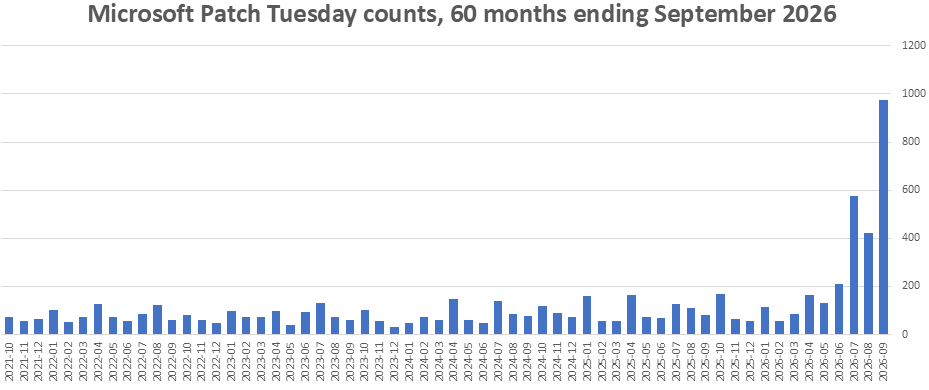
The volume of patches released in September is not an anomaly, but rather the continuation of a six-month trend that indicates the "AI-finder" age has fundamentally altered the vulnerability landscape. Over the last five years, the average monthly patch volume has climbed from fewer than 100 to nearly a thousand. This surge has forced a shift in how organizations prioritize security.
The sheer volume of data is staggering; if the internal summary documents provided by Microsoft for this month’s patches were formatted as a standard technical manual, it would span over 3,000 pages. For enterprise analysts, the cognitive and temporal burden of vetting, testing, and deploying these patches exceeds the bandwidth of many dedicated IT security teams.
Furthermore, the "rhythm" of Patch Tuesday—traditionally characterized by a lighter load in September—has been shattered. Analysts are now concerned that if September, historically a respite month, requires nearly 1,000 patches, the fourth-quarter release cycle could see an unprecedented volume of updates. This trend suggests that the traditional "monthly cycle" may soon become unsustainable for smaller enterprises, forcing a move toward automated, risk-based vulnerability management platforms that can filter "noise" from truly critical infrastructure threats.
Defense in Depth and Strategic Recommendations
In response to the complexity of the September release, security vendors have provided targeted detection signatures to mitigate the most dangerous threats. Sophos, for instance, has issued specific protections for dozens of the CVEs listed this month, ranging from endpoint IPS rules to firewall-level inspection. Administrators are encouraged to prioritize these protections for the CVEs under active exploit before addressing the broader, lower-severity updates.
For those overseeing large-scale deployments, the manual approach to patching—while still reliable—is becoming increasingly inefficient. Experts recommend:
- Leveraging the Windows Update Catalog: For systems that do not automatically pull updates, administrators should utilize
winver.exeto verify build numbers and download cumulative packages directly to ensure parity. - Utilizing Pivotable Data Sets: Given the breadth of the September release, static PDF reports are no longer sufficient. Organizations should utilize standardized Excel-based workbooks (such as the one provided by Microsoft for this cycle) to filter by product family, CVSS severity, and exploitability status.
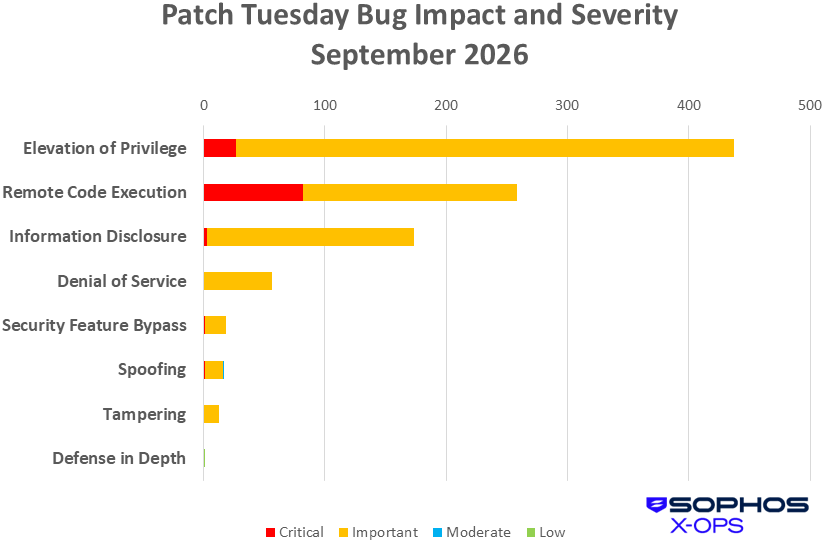
- Prioritizing EoP and Critical Infrastructure: With Elevation of Privilege (EoP) vulnerabilities passing the 1,000 mark for the year, these should be the primary focus of remediation efforts. EoP bugs are frequently the final step in a multi-stage attack chain, allowing adversaries to gain administrative control after initial network entry.
- Monitoring Non-Windows Vectors: Organizations with heterogeneous environments (Windows/Mac/Linux) must treat the 82 outstanding Office for Mac CVEs as "known risks" and implement compensatory controls—such as disabling the Outlook Preview Pane—until the official patches are deployed.
Conclusion
The September 2026 Patch Tuesday serves as a stark reminder of the escalating arms race between software developers and the security research community. While the commitment to providing regular, free updates remains a cornerstone of enterprise stability, the systemic volume of vulnerabilities is outpacing traditional remediation workflows. As the industry moves forward, the focus must shift from merely "applying patches" to implementing a more resilient, automated security architecture that can withstand the weight of a thousand vulnerabilities per month. The era of the "patch-it-and-forget-it" mentality has officially ended, replaced by a permanent state of high-alert, continuous vulnerability management.