Bridging the Performance Gap: Integrating Rust into Python via PyO3 for High-Efficiency Data Processing

Modern software development is increasingly defined by the synergy between high-level ease of use and low-level execution speed. Python has long reigned as the language of choice for data science, web development, and rapid prototyping, but its interpreted nature often creates performance bottlenecks in compute-intensive tasks. This reality has driven a trend in the engineering community: the adoption of Rust to handle critical data validation and parsing paths. By leveraging PyO3, developers can now build bridges between the flexibility of Python and the raw, memory-safe performance of Rust, as evidenced by the widespread success of libraries like Pydantic v2.
The Evolution of Performance Architecture
The architecture of modern Python libraries is shifting. Historically, performance-critical components were written in C or C++. However, the inherent memory safety risks associated with these languages have led developers to embrace Rust. The core of Pydantic v2, a staple in the Python ecosystem for data validation, is built upon pydantic-core, a Rust-based engine. This transition is not merely a preference; it is a tactical response to the increasing demand for high-throughput data processing in distributed systems and large-scale AI applications.
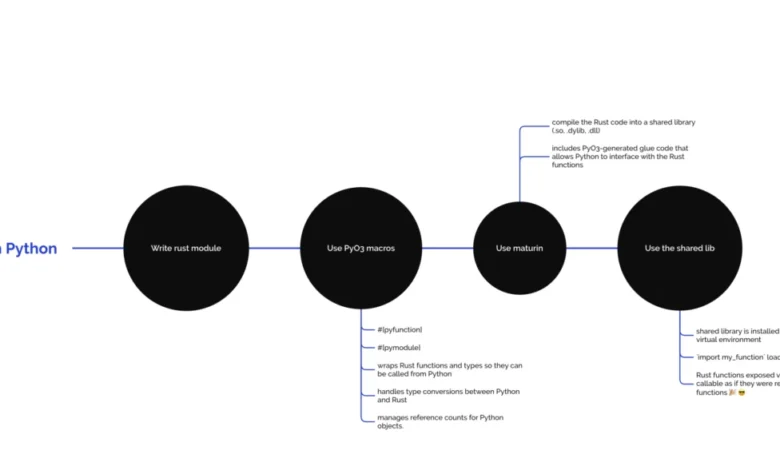
The integration process relies on four primary pillars: authoring a Rust module, annotating it with PyO3 macros, compiling the codebase using Maturin, and finally importing the shared library into the Python interpreter. This pipeline allows for a seamless transition where the end-user perceives the Rust-based module as a standard, native Python package.
Chronology of the Rust-Python Integration Lifecycle
The integration process follows a rigorous technical sequence designed to maintain Python’s expected interface while executing at Rust-level speeds:
- Module Definition: The developer constructs a Rust crate, utilizing macros such as
#[pyfunction]and#[pymodule]. These macros act as a bridge, performing the essential "wiring" that enables the Python interpreter to interact with Rust’s binary structures. - Type Mapping: Because Python and Rust manage memory differently, the developer must define how data flows across the "boundary." This involves converting Rust data types into Python-compatible objects.
- Compilation: Using Maturin, the Rust source code is compiled into a shared library file (such as .so, .dylib, or .dll). This file is then integrated into the Python environment, allowing the import statement to function without additional configuration.
- Execution and Materialization: When a Python script calls the function, the Rust logic executes, producing a result. This result is then translated back into a Python-friendly format, such as a dictionary or a list, for the user to consume.
Data-Driven Performance Analysis
The economic and technical incentive for this transition is clear. In academic and professional environments, such as the Python to Rust cohort programs, students have successfully built JSON parsers that significantly outperform standard library counterparts. For instance, optimized versions of these parsers have demonstrated execution speeds up to 3.5 times faster than CPython’s native json module.
However, these gains are not uniform across all implementations. The "return trip"—the process of converting a Rust value back into a Python object—represents a significant performance tax. In scenarios where a large document contains hundreds of thousands of individual data points, the cost of "materializing" these items into Python objects can exceed the time spent on the actual parsing logic. This phenomenon suggests that for developers seeking to optimize, the focus should not merely be on the algorithm’s efficiency in Rust, but on the efficiency of the data transition across the language boundary.

Architectural Implications for Future Development
The primary takeaway for engineers designing these interfaces is the necessity of profiling the boundary. If a function returns a simple scalar value, the performance overhead is negligible. However, if the function returns complex, nested data structures, the overhead of object creation becomes the bottleneck.
To mitigate this, industry experts suggest a shift in architectural philosophy: lazy evaluation. Rather than materializing the entire tree into Python objects at once, developers should consider returning a "view" or a pointer into the Rust-backed data structure. This allows Python to request only the specific nodes it needs, effectively deferring the cost of conversion and significantly reducing the time-to-first-result.
The Role of Type Safety and Error Handling
One of the significant advantages of utilizing Rust in this context is the robust nature of its error handling. When integrating with Python, Rust’s type-safe error enums can be mapped directly to Python exceptions using the From trait. For example, an UnterminatedString error in a Rust-based JSON parser can be translated into a ValueError in Python, complete with a descriptive message and the exact offset where the parser failed. This ensures that the Rust implementation remains transparent to the user, providing Pythonic feedback even when the underlying process is governed by Rust’s strict compiler rules.
Industry Impact and Future Outlook
The broader impact of this shift is the democratization of high-performance computing. As tools like PyO3 and Maturin continue to mature, the barrier to entry for writing "C-speed" Python extensions is lowering. Organizations that rely on data-heavy processing are no longer restricted to writing complex C extensions; they can instead leverage the modern, safety-conscious ecosystem of Rust.
While the technical complexity of the boundary remains a challenge, the industry is seeing a move toward more sophisticated serialization and deserialization techniques. The ability to handle large-scale data structures with the precision of Rust while retaining the accessibility of Python is creating a new tier of high-performance Python libraries. As developers continue to refine these integrations, the focus will likely shift from simple performance gains to the creation of smarter, more efficient interfaces that respect the unique memory models of both languages.
In summary, the transition toward Rust-backed Python libraries is a logical step in the evolution of software performance. By acknowledging the costs of cross-language communication—specifically the materialization of objects at the interface boundary—developers can build more efficient, scalable, and reliable software. The goal is no longer just to replace slow Python code with fast Rust code, but to design architectures that minimize the friction of the transition, ultimately providing the end-user with the best of both worlds.
Related posts: