Amazon Elastic Compute Cloud (EC2) Marks Two Decades of Revolutionizing Cloud Infrastructure and Global Computing

Twenty years ago, a modest blog post authored by Jeff Barr introduced the world to the Amazon EC2 Beta, a development that fundamentally altered how enterprises, startups, and developers conceptualized and deployed computing infrastructure. At its inception, the service offered a single instance type—the m1.small configuration—housed within a single AWS Region in the United States, providing resizable Linux virtual servers billed strictly by the hour. What began as a minimal yet profoundly useful utility has since matured into the invisible backbone of the modern digital economy. Today, Amazon Web Services (AWS) celebrates the twentieth anniversary of Amazon EC2, reflecting on two decades of unprecedented scale, architectural evolution, and the continuous democratization of high-performance computing.
The Genesis of Cloud Computing
Before the advent of Amazon EC2 in August 2006, provisioning computing infrastructure was an arduous, capital-intensive endeavor. Organizations were required to accurately forecast their capacity requirements months in advance, purchase physical hardware, transport it to data centers, and provision networks manually. This hardware-centric model frequently resulted in either costly, underutilized over-provisioning or catastrophic performance bottlenecks during unexpected traffic spikes.
Amazon’s leadership recognized that the internal infrastructure built to support its sprawling e-commerce retail operations could be productized and offered to external developers as an on-demand utility. By applying the principles of utility computing—where resources are accessed and paid for like electricity or water—Amazon EC2 removed the physical barriers to entry for software development. Startups could suddenly launch global applications from a dorm room without securing venture capital for server hardware, while established enterprises gained the agility to spin up thousands of servers in minutes rather than months.
A Chronology of Foundational Milestones

The evolution of Amazon EC2 over the past twenty years is defined by a series of critical engineering breakthroughs that steadily expanded the boundaries of cloud architecture.
In 2008, AWS introduced Amazon Elastic Block Store (EBS), delivering persistent, low-latency block storage volumes designed specifically for use with EC2 instances. This development solved the challenge of data retention, ensuring that critical data survived the lifecycle of a virtual server.
The year 2009 marked a massive leap forward in application availability and network isolation. AWS launched Elastic Load Balancing (ELB), Auto Scaling, and Amazon CloudWatch, empowering architectures to automatically distribute incoming traffic, scale capacity up or down based on real-time demand, and monitor system performance comprehensively. Simultaneously, the introduction of Amazon Virtual Private Cloud (VPC) gave customers the ability to provision logically isolated sections of the AWS cloud, bringing enterprise-grade security and networking controls to virtualized environments.
As virtualization workloads scaled globally, hardware-level virtualization overhead became a performance bottleneck. To address this, AWS engineered the AWS Nitro System, launched broadly in 2017. By offloading virtualization functions traditionally handled by the hypervisor onto dedicated hardware and software components, the Nitro System delivered near-bare-metal performance, enhanced security isolation, and accelerated the pace of new instance development.
In 2018, AWS challenged traditional processor paradigms with the introduction of AWS Graviton processors, custom-designed, Arm-based silicon optimized specifically for cloud workloads. This move provided customers with significantly improved price-performance ratios for scale-out applications, establishing AWS as a pioneer in custom silicon design for cloud infrastructure.
Expanding the Perimeter: From Regions to the Edge

While EC2 initially debuted within a single geographic region, the service footprint has expanded exponentially over the past two decades. Today, Amazon EC2 operates across 39 distinct AWS Regions globally, encompassing more than one hundred Availability Zones. Furthermore, the definition of cloud computing has evolved past centralized data centers to meet the demands of modern ultra-low-latency and data-residency requirements.
In 2018, AWS introduced AWS Outposts, bringing native AWS infrastructure and services directly to customer on-premises data centers. This was followed in 2019 by the launch of AWS Local Zones, which placed compute, storage, and database services closer to large population and industry centers. Concurrently, AWS Wavelength embedded EC2 computing power directly inside 5G telecommunications carrier networks, enabling real-time applications such as autonomous industrial equipment, augmented reality, and multiplayer gaming.
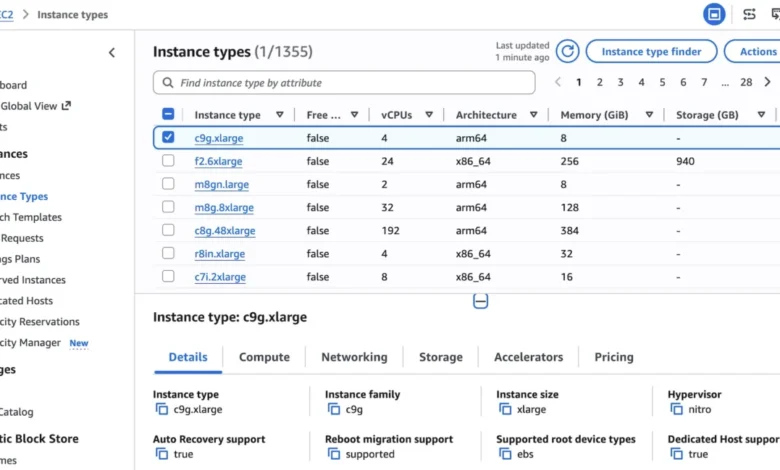
To support this sprawling geographic and functional distribution, the EC2 instance catalog has grown from a single configuration to over 1,200 specialized instance types. These optimized families span general-purpose, compute-optimized, memory-optimized, storage-optimized, accelerated computing (featuring advanced GPUs), and high-performance computing (HPC) architectures, ensuring that virtually any workload—from simple web hosting to complex quantum chemistry simulations—finds a tailored computational home.
The Underlying Engine of Modern Cloud Services
Despite its massive expansion, the core value proposition of Amazon EC2 remains unchanged: secure, resizable compute capacity delivered on-demand without long-term financial commitments. However, the true reach of EC2 extends far beyond virtual machines running operating systems.
Today, Amazon EC2 serves as the underlying foundational compute layer for nearly every higher-level service within the AWS ecosystem. Container orchestration platforms such as Amazon Elastic Container Service (ECS) and Amazon Elastic Kubernetes Service (EKS), serverless execution environments like AWS Lambda and AWS Fargate, and massive big data engines such as Amazon EMR and AWS Batch all ultimately draw their computational power from underlying EC2 capacity.

Furthermore, the artificial intelligence revolution relies fundamentally on this architecture. Modern machine learning workloads, ranging from traditional predictive modeling in Amazon SageMaker AI to the training and inference of trillion-parameter foundation models via Amazon Bedrock, leverage high-performance EC2 accelerated instance families equipped with specialized AI chips. Every architectural pattern engineered over the past twenty years—from basic static web pages to advanced generative AI infrastructure—traces its origin back to a single API call launching an EC2 instance.
Industry Analysis and Strategic Implications
Analyst consensus indicates that the longevity and continued dominance of Amazon EC2 stem from Amazon’s early and aggressive vertical integration, particularly in custom silicon development and proprietary hypervisor engineering through the Nitro System. By controlling the entire technology stack from silicon to virtualization layer to global network architecture, AWS has maintained structural cost advantages and performance margins that competitors continually strive to match.
The strategic implications of EC2’s twentieth anniversary extend into the next era of enterprise technology. As organizations grapple with the immense computational demands of generative AI, quantum computing integration, and edge-heavy IoT architectures, the foundational requirement for elastic, highly secure, and cost-effective compute remains paramount. The architectural blueprint established in 2006—characterized by minimal-yet-useful service design, rapid iteration based on customer feedback, and deep infrastructure investment—continues to dictate the playbook for cloud providers worldwide.
As Amazon EC2 enters its third decade, industry observers note that the service is no longer merely a product, but a fundamental utility underpinning the global digital economy. With ongoing investments in sustainable data center operations, custom silicon optimization, and ubiquitous edge deployments, Amazon EC2 is positioned to remain the central engine driving global technological innovation for the foreseeable future.