Microsoft Azure Databricks Delivers Unprecedented Economic Value, New Forrester Study Reveals

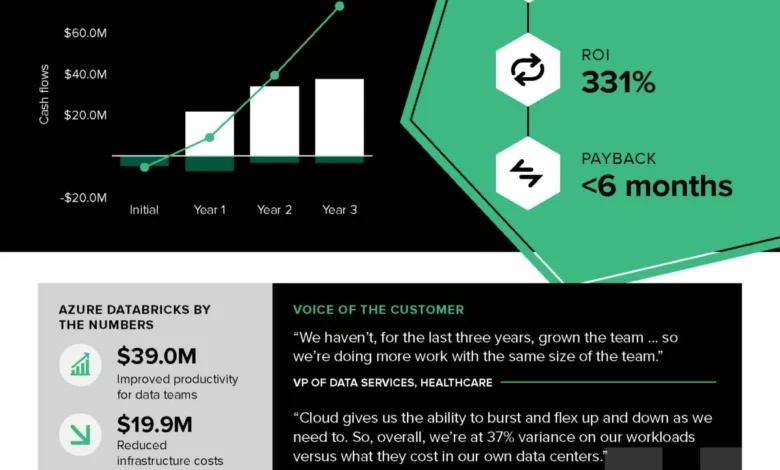
Microsoft Azure Databricks, the native integration of Databricks’ powerful analytics platform within the Microsoft Azure cloud ecosystem, has demonstrated significant and measurable economic benefits for organizations, according to a new Total Economic Impact™ (TEI) study commissioned by Microsoft and conducted by Forrester Consulting. The comprehensive analysis, which involved in-depth interviews with Azure Databricks customers, reveals a compelling financial case for adopting the co-engineered solution, showcasing substantial returns on investment, significant net present value, and rapid payback periods.
The study, released in June 2026, paints a picture of a composite organization—a $6 billion company operating within a regulated industry and managing approximately 10 petabytes of data—that experienced transformative results after implementing Azure Databricks. Prior to the adoption, this composite organization grappled with a fragmented, costly, and unreliable data estate that presented significant governance challenges. Post-implementation, the findings indicate a remarkable shift, with the organization realizing $75.6 million in total benefits against $17.5 million in costs over a three-year period, culminating in a net present value of $58.1 million. Perhaps most strikingly, the study found that the initial investment in Azure Databricks was recovered in less than six months.
A Strategic Partnership Driving Tangible Value
The core advantage of Microsoft Azure Databricks lies in its co-engineered nature. This isn’t merely a partnership where two companies offer complementary products; it represents a deep, integrated development effort between Microsoft and Databricks. This synergy ensures that Azure Databricks functions as a true first-party service within Azure, benefiting from a shared integration roadmap across Microsoft’s comprehensive data and AI stack. For businesses, this translates into a unified go-to-market strategy, simplifying procurement with a single bill and providing a consolidated support channel.
For technical teams, the implications are profound. The native integration promises deeper connectivity with existing Microsoft tools, enhanced security frameworks, and optimized performance. This seamless integration minimizes the need for complex workarounds, data duplication, and extensive integration efforts, which often plague multi-cloud or hybrid environments. For the business side, this operational efficiency directly translates into reduced costs, mitigated risk, and a significantly accelerated time to realizing business value from data initiatives.
The Forrester TEI study quantified these benefits across several key areas. While the exact breakdown of the four primary sources of value is detailed within the full study, the overarching theme points to the elimination of inefficiencies and the acceleration of data-driven processes. This includes tangible cost savings derived from optimized infrastructure, reduced operational overhead, and streamlined data management. Furthermore, the study likely identified benefits associated with improved decision-making speed, enhanced customer experiences, and the development of new data-powered products or services, all of which contribute to the overall economic uplift.
Beyond the Numbers: Unpriced but Critical Benefits
Beyond the quantifiable financial metrics, the Forrester study also highlighted several qualitative benefits that are crucial to the overall success of an organization’s data strategy. These include:
- Native Azure Services Integration: Azure Databricks’ deep integration with the broader Azure ecosystem—spanning services like Azure Synapse Analytics, Azure Machine Learning, and Power BI—allows for a more cohesive and powerful data analytics and AI workflow. This eliminates silos and enables seamless data flow between different components of the data stack.
- Faster Insights: By reducing data preparation and processing times, Azure Databricks empowers data scientists, analysts, and business users to derive insights more rapidly. This agility is critical in today’s fast-paced business environment, where timely information can be a significant competitive differentiator.
- Wider Access to Data: The platform’s architecture and integration capabilities facilitate broader access to data across the organization. This democratization of data, when coupled with robust governance, ensures that more individuals can leverage data to inform their decisions.
- Enhanced Governance through Unity Catalog: The integration of Databricks Unity Catalog within Azure Databricks provides a unified approach to data governance, security, and compliance. This is particularly vital for organizations in regulated industries, ensuring that data access is controlled, auditable, and adheres to policy. Unity Catalog plays a pivotal role in enabling the secure and governed sharing of data and AI assets, fostering collaboration without compromising security.
These unpriced benefits, while not directly factored into the ROI calculation in monetary terms, are foundational to achieving the quantified financial gains and are critical enablers of digital transformation.
Illustrative Case: The Composite Organization’s Journey
The composite organization modeled in the Forrester study serves as a powerful illustration of Azure Databricks’ impact. Before its implementation, the organization faced common challenges in data management:
- Data Silos: Data was likely scattered across various databases, data lakes, and applications, making it difficult to get a unified view of business operations.
- High Operational Costs: Managing disparate data systems often leads to increased infrastructure costs, redundant data storage, and significant manual effort for data engineers and administrators.
- Scalability Issues: As data volumes grew, the existing infrastructure struggled to keep pace, leading to performance bottlenecks and delayed processing times.
- Governance Gaps: Ensuring data quality, security, and compliance across a fragmented data landscape is a significant challenge, often leading to risks and audit failures.
Upon adopting Azure Databricks, the organization experienced a paradigm shift. The lakehouse architecture, central to Databricks, provided a unified platform for both data engineering and data science, breaking down silos. The native Azure integration streamlined operations, reducing the complexity of managing multiple cloud services. The inherent scalability of the platform allowed the organization to handle its 10 petabytes of data efficiently, while Unity Catalog provided a robust framework for governance, ensuring data integrity and security.
The Role of Advanced Integrations: Genie and Microsoft Copilot
A key differentiator highlighted in the study is the deep integration of Azure Databricks with Microsoft’s productivity suite, particularly through Azure Databricks Genie and its synergy with Microsoft Copilot. Genie is an AI-powered assistant that enables users to query their lakehouse in natural language. This capability has been extended to popular Microsoft applications, allowing users to access and analyze data directly within their familiar workflows.
The integration with Microsoft Copilot Cowork and other Microsoft 365 applications is particularly noteworthy. By allowing users to add business context and build upon existing intelligence within tools they already use daily, Azure Databricks Genie accelerates the adoption of data-driven decision-making. Users can now ask complex data-related questions in plain language within Microsoft Teams, Microsoft 365 Copilot, and Copilot Cowork. This intelligence is grounded in trusted data through Genie Ontology, and crucially, is scoped by Unity Catalog to ensure that each user only sees the data they are permitted to access. This combination of AI-powered natural language querying and granular governance ensures that insights are delivered efficiently and securely, directly within the flow of work, without compromising organizational security protocols.
The study emphasizes that while these advanced integrations, like Genie and its connection to Copilot, were not always separately priced by Forrester, they are instrumental in driving the productivity and cost benefits that were quantified. They represent the tangible impact of a truly integrated data and AI platform.
Performance Validation: Independent Benchmarks
Beyond the economic impact study, Azure Databricks’ performance has also been independently validated. A benchmark study conducted by Principled Technologies, a reputable independent firm, compared Azure Databricks against Databricks on AWS using a 10-terabyte dataset in a TPC-DS-like decision-support benchmark. The results indicated that Azure Databricks completed single query streams up to 21.1% faster than its AWS counterpart when autoscale was disabled. Furthermore, Azure Databricks demonstrated superior performance in handling concurrent workloads, running four simultaneous query streams more than nine minutes faster. This emphasis on speed and efficiency is critical, as it directly impacts the ability of organizations to derive timely insights and maintain productivity as data volumes and query complexity increase.
Implications for the Enterprise Data Landscape
The findings of the Forrester TEI study have significant implications for enterprises navigating the complex landscape of data and AI platforms. The decision to invest in a data platform is a long-term strategic commitment, and Azure Databricks appears to offer a compelling value proposition by reinforcing key aspects of the data lifecycle.
The seamless integration across Microsoft’s ecosystem is a primary driver of the savings identified by Forrester. This native connectivity minimizes the friction often associated with integrating disparate systems, reducing both the upfront implementation costs and the ongoing operational overhead. The performance advantages, validated by independent benchmarks, ensure that these cost savings are not achieved at the expense of speed or scalability. As organizations increasingly rely on real-time data and complex analytics, a high-performing platform is essential to maintain competitive advantage.
Ultimately, the robust economic case presented by the Forrester study, backed by concrete figures of a 331% three-year ROI and a payback period of under six months, solidifies Azure Databricks’ position as a leading choice for organizations seeking to maximize the value of their data assets. The first-party partnership between Microsoft and Databricks provides a unified engineering effort, a shared roadmap, and integrated support, offering a level of commitment and reliability that is crucial for mission-critical data initiatives. This comprehensive approach, combining deep integration, advanced AI capabilities, proven performance, and a strong economic foundation, explains why an increasing number of teams are choosing to build their data strategies on Azure Databricks.
Exploring the Azure Databricks Advantage Further
Organizations interested in understanding the full scope of Azure Databricks’ capabilities and its economic impact can delve deeper into the findings of the Forrester Total Economic Impact™ study. This detailed report provides a comprehensive breakdown of the methodology, the assumptions made in modeling the composite organization, and the specific drivers of the quantified benefits. Further exploration of the Azure Databricks product pages and technical documentation can illuminate the platform’s advanced features, integration points, and the strategic advantages it offers to businesses looking to harness the power of data and artificial intelligence. The ongoing evolution of the platform, with continuous innovation in areas like AI integration and data governance, suggests that the value proposition of Azure Databricks is poised to grow even stronger in the future.
Related posts: