Azure Chaos Studio Workspaces Launches in Public Preview, Revolutionizing Application Resilience Testing

Microsoft Azure has officially launched Azure Chaos Studio Workspaces in public preview, a significant advancement in its managed service designed to help organizations proactively validate and strengthen the resilience of their applications. This new iteration shifts from testing individual fault injections to a more holistic, scenario-focused approach, mirroring the complex failure patterns commonly encountered in production environments. The introduction of Workspaces aims to democratize chaos engineering, making it more accessible and effective for Azure customers seeking to ensure their applications can withstand unexpected disruptions without impacting end-users.
The core principle behind Chaos Studio is the adage that an application’s resilience is not truly known until it has been rigorously tested. Rather than waiting for a catastrophic failure in a live production environment, Azure Chaos Studio empowers developers and operations teams to deliberately induce controlled outages, failovers, network disruptions, and infrastructure failures within a safe, isolated testing environment. This allows for early detection of vulnerabilities and weaknesses in application architecture, configuration, and code before they can lead to costly downtime and customer dissatisfaction.
The Imperative for Proactive Resilience Testing
In today’s hyper-connected digital landscape, application availability and reliability are paramount. Businesses across all sectors have made substantial investments in building resilient systems. These investments often include sophisticated architectural patterns such as multi-zone deployments for high availability, geo-redundant storage for data durability, automatic database failover for continuous operation, intricate retry logic to handle transient issues, and load-balanced front ends to distribute traffic effectively. However, the critical question remains: do these mechanisms perform as expected when an actual incident strikes?
Real-world outages rarely adhere to theoretical architecture diagrams. A zone-redundant deployment, meticulously designed for fault tolerance, could falter due to a misconfigured health probe that went unnoticed for years. A database featuring automatic failover capabilities might leave an application inoperable if a connection string remains hardcoded to a single region, negating the intended redundancy. Similarly, geo-redundant storage, while crucial for data safety, can sometimes present the application with briefly stale read data that the application code was not programmed to handle gracefully. These subtle yet critical oversights are common and often surface only when a failure event occurs, turning a planned outage prevention into an actual crisis.
Microsoft emphasizes that reliability and resilience on Azure operate under a shared responsibility model. While Microsoft is committed to providing a robust and resilient platform with its Azure services, the onus falls on the customer to correctly configure these services for resilience and to develop application code that leverages these capabilities effectively. No single layer of the technology stack can compensate for a fundamental gap in another. Therefore, the only definitive way to ascertain whether an organization’s architecture, configurations, and application logic will withstand the pressures of a production failure is through deliberate, controlled testing before an actual outage dictates the outcome.
Azure Chaos Studio Workspaces: A Paradigm Shift in Resilience Testing
Azure Chaos Studio, the overarching managed chaos engineering service, has been instrumental in helping teams uncover resilience gaps by simulating controlled disruptions across various layers of the IT infrastructure. The newly introduced Azure Chaos Studio Workspaces builds upon this foundation by offering a more intuitive, scenario-driven experience. Instead of painstakingly assembling individual fault injections, users can now begin with pre-defined scenarios that closely mirror common production outage patterns. This approach allows teams to test their systems against realistic failure modes from the outset.
A significant enhancement in Workspaces is its focus on simulating multi-layered failures. Most critical outages do not isolate a single component; they often impact multiple systems concurrently. This includes failures at the platform layer, such as service unavailability or delayed failover impacting Recovery Time Objectives (RTOs), and at the application layer, where code must maintain data integrity, resume in-flight transactions, implement effective retry strategies, and gracefully degrade functionality. While a traditional chaos test might involve stopping a single Virtual Machine (VM) to assess platform layer resilience, the scenarios within Chaos Studio Workspaces are engineered to evaluate the entire application stack holistically.
The introduction of Workspaces is also designed to significantly lower the barrier to entry for resilience testing. A common impediment for many teams is the uncertainty of where to begin. The Workspace now serves as the primary resource. By pointing a Workspace to a specific Azure subscription or resource group, its managed identity can automatically discover the in-scope resources and intelligently recommend applicable failure scenarios. These recommended scenarios are then readily available within the Workspace, pre-configured and ready for customization and execution. Furthermore, a refresh mechanism ensures that these recommendations stay current with any changes in the underlying infrastructure.
A Curated Library of Real-World Outage Scenarios
Azure Chaos Studio Workspaces launches with a robust library of curated scenarios, meticulously crafted based on patterns observed in actual Azure incidents. This ensures that the failure modes being tested are those that customers are most likely to encounter. These scenarios act as powerful resilience templates, providing a rapid path to testing the most critical failure patterns. For organizations with unique requirements, the platform also offers the flexibility to design custom scenarios using the same underlying fault library.
Key scenarios available at launch include:
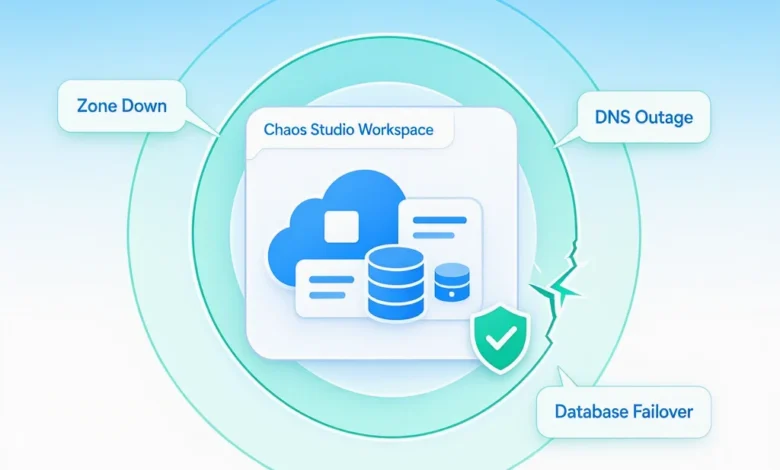
- Zone Down: Simulates the failure of an entire Azure Availability Zone, testing the application’s ability to failover to other zones.
- DNS Outage: Introduces disruptions to Domain Name System resolution, testing how applications handle name resolution failures.
- Database Failover: Triggers failover events for Azure SQL Database or other supported database services, assessing application recovery and transaction continuity.
- Cache Stampede: Simulates a sudden surge in requests to a cache, testing its ability to handle high load and prevent cascading failures.
- Event-Driven Messaging Disruption: Introduces delays or failures in message queues, evaluating the application’s resilience to asynchronous communication issues.
These curated scenarios are built upon granular, API-level fault injection actions. This allows for precise control over the types of disruptions introduced. The framework automatically composes the correct faults for each scenario. For instance, a "Zone Down" scenario combined with a "Database Failover" will automatically sequence the necessary actions, such as initiating VMSS instance shutdowns in the affected zone and then triggering the database primary failover, eliminating the need for manual orchestration.
For situations where the pre-defined scenarios do not perfectly align with an organization’s specific workload or failure tolerance, the new Scenario Designer offers a powerful, user-friendly solution. This drag-and-drop interface within the Azure portal allows users to compose custom scenarios by combining any of the available faults. It provides the same flexibility as the classic Chaos Studio experiments, enabling users to define steps, branches, and fault sequences with granular control. Customers can either start with a curated template and modify it, or build entirely new scenarios from the ground up using the comprehensive fault library.

Beyond these core infrastructure and service-level disruptions, Chaos Studio Workspaces also supports VM agent faults, such as inducing CPU and memory pressure. The platform’s fault library is expected to expand continuously throughout the public preview phase and into general availability, with plans to introduce scenarios addressing emerging challenges.
Addressing the Unique Resilience Challenges of AI Applications
The rapid adoption of Artificial Intelligence (AI) technologies, including Copilots, intelligent agents, retrieval-augmented generation (RAG) pipelines, and inference endpoints, presents a new frontier of resilience testing. While these AI-powered applications introduce novel failure modes specific to machine learning models and data processing, they fundamentally rely on the same core Azure building blocks as traditional distributed applications. These include compute resources, databases, caching mechanisms, search indexes, identity management, networking infrastructure, messaging queues, and storage solutions.
Azure Chaos Studio Workspaces is well-positioned to validate this underlying foundation for AI workloads. Through scenarios like "Zone Down," "Database Failover," "DNS Outage," "Cache Stampede," and "Event-Driven Messaging Disruption," organizations can ensure the robustness of the foundational infrastructure supporting their AI applications. As the catalog evolves, Microsoft plans to incorporate AI-specific failure behaviors, such as simulating retrieval drift, token throttling, and model performance degradation under load. This proactive approach is being developed in close collaboration with customers building cutting-edge AI solutions on Azure, ensuring the toolset remains relevant and effective.
Streamlining Resilience Testing with AI-Powered Operations
Recognizing that engineers increasingly rely on integrated tooling, Microsoft is launching Chaos Studio with two key integrations designed to embed resilience testing directly into existing workflows.
The first is the Chaos Studio Skill for GitHub Copilot. This feature guides users through the entire resilience testing loop via a conversational interface. Users can point Copilot to a specific Workspace, review the recommended scenarios, initiate a test drill, and receive a detailed report of the observed outcomes, correlated with Azure Monitor signals. This conversational approach simplifies the process of setting up, running, and analyzing chaos experiments.
The second integration involves a Model Context Protocol (MCP) server that exposes Chaos Studio operations as typed tools. This allows other AI assistants and autonomous agents, such as Claude, Cursor, Codex, or custom-built agents, to provision Workspaces, execute scenarios, and query associated signals without direct human intervention. Both integrations leverage the same robust Chaos Studio APIs and Azure authentication, providing a seamless and secure experience. These integrations are available immediately, underscoring Microsoft’s commitment to shaping the user experience for chaos engineering within the tools that developers and operators already use. The company’s experience indicates that a significant hurdle in resilience testing is often the decision to initiate a drill, a decision that is increasingly being made within chat-based tools. Therefore, embedding Chaos Studio capabilities within these environments is a strategic imperative.
Looking ahead, the Chaos Studio Skill is envisioned to become an integral part of automated operations flows within platforms like Microsoft Foundry. It is also slated to be a critical component for Azure SRE (Site Reliability Engineering) agents, enabling them to autonomously validate their assumptions about how workloads might fail. Microsoft encourages users to explore these new capabilities and provide feedback, as this input will be crucial in refining the service through its public preview phase and beyond.
Comprehensive Scenario Reporting for Post-Incident Analysis
A crucial output of any chaos engineering exercise is the analysis of its results. Upon completion of a run, Azure Chaos Studio Workspaces generates a structured drill report. This report provides a detailed account of the scenario that was injected, the specific resources affected, the timeline of recovery events, and the correlation between observed signals and the experimental drill versus normal operational baselines. It also highlights any deviations from expected workload behavior.
This report is designed to resemble an internal post-incident review, making it highly valuable for both the team that executed the drill and for leadership seeking assurance of ongoing resilience validation. The reports can be exported and appended to change tickets, used as audit evidence, or incorporated into service health reviews, providing a clear, data-driven record of resilience testing efforts.
Getting Started with Azure Chaos Studio Workspaces
Azure Chaos Studio Workspaces is available in public preview as of today. General availability is currently targeted for late 2026, though this timeline is subject to change based on ongoing development and customer feedback.
To begin using Azure Chaos Studio Workspaces:
- Access the Azure Portal: Navigate to the Azure portal and search for "Chaos Studio."
- Create a Workspace: Select the "Workspaces" option and click "Create."
- Configure and Run Scenarios: Define the scope of your Workspace, discover recommended scenarios, customize them, and initiate your first resilience test drill.
The Discipline of Verification in Modern Application Development
Resilience is not an outcome achieved through a single feature, a solitary redundancy mechanism, or a solitary architectural decision. It is, fundamentally, an engineering discipline that demands continuous verification. Azure Chaos Studio Workspaces represents Microsoft’s commitment to making this verification process a standard practice for all Azure workloads, including the rapidly growing portfolio of AI-powered applications being deployed into production environments. By providing a powerful, scenario-driven, and increasingly integrated platform, Azure Chaos Studio is poised to become an indispensable tool for organizations striving for robust, reliable, and resilient cloud-native applications.
Related posts: