AWS Pioneers End-to-End Automated Incident Remediation with DevOps Agent and Kiro CLI Integration, Revolutionizing Cloud Operations.

The landscape of cloud operations is undergoing a profound transformation as Amazon Web Services (AWS) unveils a groundbreaking integration designed to automate incident remediation from detection to deployment, significantly reducing manual toil and accelerating recovery times. This innovative solution marries the autonomous investigation capabilities of AWS DevOps Agent with the automated code remediation prowess of Kiro CLI, culminating in a closed-loop system where human intervention is primarily limited to a critical pull request approval. This development marks a significant leap towards truly autonomous operations, promising unparalleled efficiency and resilience for organizations managing complex distributed workloads on AWS.
The Escalating Challenge of Incident Management in Cloud Environments
For years, the conventional approach to incident response in distributed cloud environments has been a labor-intensive and often agonizing process. When an incident strikes, particularly during off-hours, on-call engineers face the daunting task of sifting through vast amounts of telemetry data from disparate sources—Amazon CloudWatch metrics, deployment pipelines, application logs—to diagnose the root cause. This investigative phase, crucial as it is, frequently consumes hours. Once identified, the next hurdle involves manually writing, testing, and deploying a fix, further prolonging downtime and escalating operational costs. The sheer complexity of modern microservices architectures, serverless functions, and diverse AWS service integrations means that incidents are not only frequent but also increasingly difficult to pinpoint and resolve, leading to extended Mean Time To Resolution (MTTR) and substantial business impact. Industry reports consistently highlight the financial repercussions of downtime, with even minutes of service disruption costing enterprises millions of dollars in lost revenue, customer dissatisfaction, and reputational damage. The pressure on Site Reliability Engineering (SRE) and operations teams to maintain high availability and performance has never been greater.
Introducing Agentic AI for Autonomous Incident Investigation
Recognizing this critical pain point, AWS introduced the AWS DevOps Agent, an innovative solution designed to address the first half of the incident remediation challenge: autonomous investigation and root cause analysis. Launched with the promise of transforming incident response, the AWS DevOps Agent leverages advanced agentic AI capabilities to automatically correlate telemetry data, identify anomalies, and deduce the underlying causes of operational issues. During its preview phase, customers and partners reported remarkable improvements: up to 75% lower MTTR, 80% faster investigations, and an impressive 94% root cause accuracy. These figures underscore the agent’s effectiveness in drastically cutting down the diagnostic phase, freeing up engineers from the laborious detective work that typically consumes a significant portion of their time during an incident. The agent’s ability to generate precise mitigation plans in minutes represents a paradigm shift from reactive firefighting to intelligent, automated problem identification.
However, even with these advancements, a critical gap remained. While the AWS DevOps Agent excelled at identifying the problem and proposing a solution, the actual implementation of that solution—writing the code, testing it, and deploying it—still fell to human hands. This manual "second half" of the remediation process continued to introduce delays and potential for human error, preventing a truly end-to-end automated workflow. The question then became: could this final mile of incident remediation also be automated?
Closing the Remediation Loop: The Kiro CLI Integration
The answer lies in the strategic integration of AWS DevOps Agent’s mitigation plan outputs with Kiro CLI, running in a headless mode within AWS CodeBuild. This powerful synergy creates a fully automated, event-driven pipeline that extends the benefits of AI from mere investigation to tangible code remediation and deployment. When the AWS DevOps Agent successfully completes a mitigation analysis, generating a comprehensive plan, an event-driven mechanism automatically routes these findings to Kiro CLI. Operating within a secure and scalable AWS CodeBuild environment, Kiro CLI then takes the reins, applying the necessary fixes directly to the codebase, generating a pull request for human review, and, upon approval, triggering the deployment pipeline. This innovative workflow transforms L1/L2 incidents—typically high-volume, repetitive issues—from detection to deployed fix with minimal manual intervention. The only human touchpoint in this streamlined process is the crucial pull request approval, ensuring oversight and control while maximizing automation.
Architecture of Autonomy: A Technical Deep Dive
To illustrate this groundbreaking solution, consider a common web application hosted on AWS, comprising a frontend served via an Application Load Balancer, backend compute on Amazon EC2 instances, and an Amazon RDS database, with its source code and CloudFormation templates residing in AWS CodeCommit. When an operational anomaly is detected within this environment, the automated remediation solution orchestrates a seamless chain of events leveraging several core AWS services:
-
Incident Detection and Investigation Trigger: The journey begins with anomaly detection. A critical metric deviation in Amazon CloudWatch, for instance, triggers an alarm. This alarm is configured to automatically initiate an autonomous investigation by the AWS DevOps Agent. Previous demonstrations and code samples have outlined how to wire CloudWatch alarms directly to trigger these investigations.
-
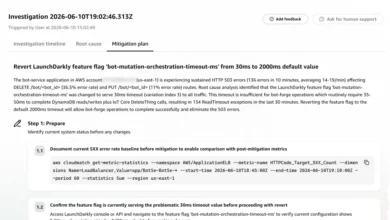
Autonomous Investigation and Mitigation Planning: The AWS DevOps Agent springs into action, autonomously correlating telemetry data across all relevant AWS services and application logs. It rapidly identifies the root cause of the incident and formulates a detailed mitigation plan, outlining the precise steps required to resolve the issue.
-
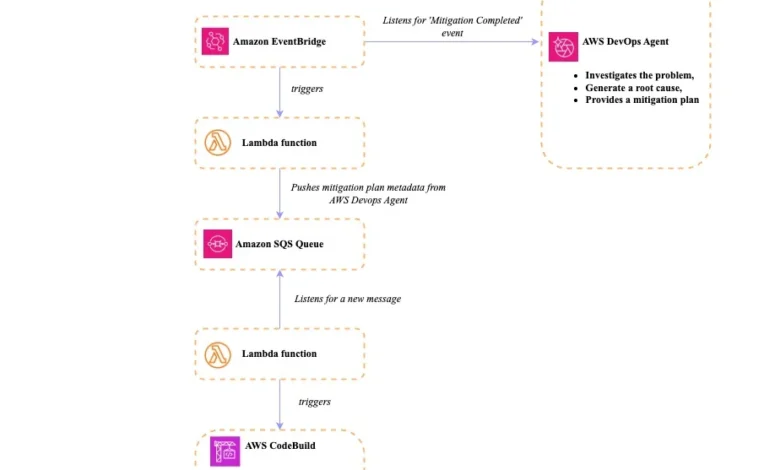
Capturing Mitigation Events with Amazon EventBridge: Upon successful completion of a mitigation analysis, the AWS DevOps Agent publishes a lifecycle event to the Amazon EventBridge default event bus. These events, sourced from
aws.aidevops, carry specific detail-types such asMitigation Completed,Investigation Completed, orMitigation Failed. For this specific solution, the focus is on theMitigation Completedsignal, indicating a successful plan generation. -
EventBridge Rule and Lambda Extraction: An Amazon EventBridge rule is configured to specifically match the
Mitigation Completeddetail-type. When triggered, this rule invokes a dedicated AWS Lambda function. The Lambda function receives the event payload, which contains essential metadata likeagent_space_id,task_id, andexecution_id. Using this information, the Lambda function makes API calls back to the AWS DevOps Agent to extract two critical objects: themitigation summary(describing the intended action and its rationale) and theexecution plan(detailing step-by-step instructions for the fix). This structured payload is then published to an Amazon SQS queue, serving as a reliable buffer for downstream processing.
-
Headless Remediation with Kiro CLI on AWS CodeBuild: The Amazon SQS queue acts as the entry point for the remediation phase. A trigger AWS Lambda function monitors this queue. When a new message (containing the structured mitigation payload) arrives, it initiates an AWS CodeBuild execution. AWS CodeBuild is an ideal environment for this task, offering on-demand compute, native integration with AWS CodeCommit, and eliminating the need for persistent infrastructure. Kiro CLI 2.0’s headless mode is pivotal here, enabling programmatic execution within CI/CD pipelines without requiring an interactive terminal. Authenticated via an API key securely stored in AWS Secrets Manager, Kiro CLI receives the mitigation prompt from the SQS message (passed as an environment variable to CodeBuild). It then executes its agents, applying the necessary code changes.
-
CodeBuild Orchestration and Pull Request Generation: The AWS CodeBuild
buildspecdefines a precise sequence of actions:- Checkout Repository: The CodeBuild environment checks out the application and infrastructure source code from AWS CodeCommit.
- Install Kiro CLI: Kiro CLI is installed within the build environment.
- Configure Kiro CLI: The API key for Kiro CLI is retrieved from AWS Secrets Manager and configured.
- Execute Kiro CLI: Kiro CLI is invoked in headless mode, receiving the mitigation plan details as its prompt. It analyzes the plan and intelligently modifies the codebase according to the instructions.
- Commit and Push Changes: Kiro CLI commits the changes to a new feature branch within AWS CodeCommit.
- Create Pull Request: Finally, Kiro CLI automatically creates a pull request, proposing the changes for human review.
The Indispensable Role of the Steering File
A critical component that elevates Kiro CLI beyond generic code generation to targeted, effective remediation is the "steering file." Committed directly to the project repository, this steering file provides Kiro CLI with persistent knowledge about the project’s specific context, including repository structure, established coding conventions, and decision frameworks. For this automated remediation solution, the steering file acts as the guardrails, ensuring that Kiro CLI makes predictable, relevant changes. It explicitly defines:
- Project Structure: How files are organized and where specific types of changes should occur.
- Coding Standards: Adherence to established coding styles and best practices.
- Remediation Policies: Rules for how certain types of incidents should be addressed (e.g., preference for configuration changes over code rewrites, or specific rollback strategies).
- Contextual Information: Any other project-specific details that guide Kiro CLI’s modifications.
By embedding this domain-specific knowledge, the steering file ensures that the automated fixes are not only technically correct but also align with organizational standards, promoting maintainability and consistency.
The Human Touchpoint: Pull Request for Assurance and Control
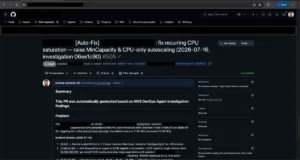
At this juncture, the automated pipeline has executed its full course: AWS DevOps Agent has investigated and planned, and Kiro CLI has implemented the fix and generated a pull request on a new feature branch. This is where the human-in-the-loop gate becomes paramount. The pull request description is meticulously crafted, detailing precisely what was changed, the rationale behind the change (directly derived from the AWS DevOps Agent’s reasoning), and full traceability information including the agent space and execution IDs, linking the fix back to the original incident.
A developer or SRE engineer then reviews this pull request. This approval step is a deliberate and crucial decision point. While the AI agents are trusted to autonomously investigate, analyze, and propose fixes, the ultimate decision to deploy remains with a human. This ensures that the proposed changes are thoroughly vetted for correctness, appropriate scope, and safety before being merged into the main branch. Once the pull request receives approval and is merged, the organization’s existing deployment pipelines are automatically triggered, implementing the approved changes in the target environment. This entire cycle—from a CloudWatch alarm to a deployed fix—can now complete in minutes, rather than hours, with the only manual intervention being a quick, informed pull request review.
Transforming Incident Response: Impact and Implications
This integration of AWS DevOps Agent and Kiro CLI represents a significant milestone in the evolution of DevOps and Site Reliability Engineering, delivering profound impacts across several dimensions:
- Unprecedented Operational Efficiency: By automating the vast majority of L1/L2 incident remediation, SRE and operations teams are liberated from repetitive, low-value tasks. This allows highly skilled engineers to redirect their focus towards strategic initiatives, complex architectural improvements, innovation, and proactive system enhancements, rather than reactive firefighting.
- Drastically Reduced MTTR and Improved System Reliability: The reported 75% reduction in MTTR translates directly into significantly less downtime and service disruption. For businesses, this means enhanced customer experience, minimized financial losses due to outages, and improved brand reputation. The ability to resolve incidents within minutes rather than hours fundamentally elevates the reliability and resilience of cloud-native applications.
- Enhanced Root Cause Accuracy and Faster Investigations: The 94% root cause accuracy and 80% faster investigations provided by AWS DevOps Agent ensure that problems are not only resolved quickly but also correctly, preventing recurrence and contributing to long-term system stability.
- The Future of DevOps and SRE Roles: This automation trend signals a shift in the skill sets required for operations engineers. The focus moves from manual execution to oversight, policy definition (e.g., crafting effective steering files), system design, and complex problem-solving that still requires human intuition. It paves the way for a more "NoOps" future where operational tasks are increasingly handled by intelligent agents.
- Scalability and Consistency: For organizations managing hundreds or thousands of microservices, manual incident response becomes a monumental and error-prone undertaking. This automated solution provides a consistent, scalable, and reproducible approach to incident remediation, ensuring uniform application of fixes across diverse environments.
Chronology of an Incident (Automated): A Hypothetical Scenario
Let’s envision a typical incident:
- T=0 minutes: A sudden spike in database connection errors is detected by Amazon CloudWatch, triggering an alarm.
- T=1 minute: The CloudWatch alarm automatically invokes the AWS DevOps Agent to initiate an investigation.
- T=3 minutes: AWS DevOps Agent rapidly analyzes logs, metrics, and configuration data, identifying a misconfigured database connection pool size as the root cause. It generates a mitigation plan to increase the
max_connectionsparameter in the RDS instance. - T=4 minutes: The
Mitigation Completedevent is published to Amazon EventBridge. An EventBridge rule triggers a Lambda function. - T=5 minutes: The Lambda function extracts the mitigation summary and execution plan from DevOps Agent and places it into an Amazon SQS queue.
- T=6 minutes: A second Lambda function, triggered by the SQS message, starts an AWS CodeBuild job.
- T=8 minutes: Inside CodeBuild, Kiro CLI (in headless mode, guided by its steering file) checks out the CloudFormation template for the RDS instance, modifies the
DBInstanceresource to update theMaxConnectionsproperty. - T=9 minutes: Kiro CLI commits the changes to a new feature branch in AWS CodeCommit and automatically creates a pull request. The pull request description includes the DevOps Agent’s reasoning and traceability IDs.
- T=10 minutes: The on-call engineer receives a notification for the new pull request.
- T=11 minutes: The engineer quickly reviews the proposed change, verifies its alignment with the incident, and approves the pull request.
- T=12 minutes: The merge to the main branch triggers the CI/CD pipeline, which automatically applies the updated CloudFormation template.
- T=15 minutes: The
max_connectionsparameter is updated in RDS, and the database connection errors subside. The incident is resolved and automatically closed.
This rapid, almost entirely automated sequence contrasts sharply with the hours, or even days, that similar incidents might have previously consumed, showcasing the immense value proposition of this new integrated approach.
Getting Started: Implementation and Resources
Organizations eager to embrace this new frontier of automated incident remediation can readily explore the provided resources. The AWS samples repository offers the complete source code for the infrastructure, anomaly generation scripts, event routing, and the crucial Kiro CLI steering configuration. Further details on setting up the AWS DevOps Agent and configuring Agent Spaces can be found in the official AWS documentation, while Kiro CLI documentation provides comprehensive guidance on leveraging its capabilities, particularly its steering-file-driven code generation. This powerful combination of tools and methodologies is poised to redefine operational excellence in the cloud.
In conclusion, the integration of AWS DevOps Agent and Kiro CLI represents a monumental step forward in cloud operations. By creating a closed-loop incident remediation pipeline, AWS empowers organizations to transition from reactive, manual processes to a proactive, automated, and highly efficient incident response framework. This innovation not only drastically reduces MTTR, operational toil, and recovery times but also enhances system reliability, freeing up valuable engineering talent to focus on innovation. As distributed cloud environments continue to grow in complexity, such intelligent automation will become not just a competitive advantage, but a fundamental necessity for maintaining peak operational performance and business continuity.
Related posts: