AWS CloudFormation Elevates Infrastructure as Code Reliability with Automated Pre-Deployment Validation Across All Stack Operations


Amazon Web Services (AWS) has announced a significant enhancement to its CloudFormation service, integrating pre-deployment validation automatically into all CreateStack and UpdateStack operations. This update dramatically accelerates infrastructure development by catching common template errors, resource name conflicts, and adherence to service quotas before any resources are provisioned, thereby minimizing failed deployments and costly rollback cycles. The enhancement also introduces three new validation checks, a DisableValidation parameter for operational control, and deep integration with the AWS Cloud Development Kit (CDK) via the cdk validate command.
The Evolving Landscape of Infrastructure as Code
Cloud infrastructure management has been revolutionized by Infrastructure as Code (IaC), with tools like AWS CloudFormation at the forefront. CloudFormation empowers developers and operations teams to model and provision AWS resources using declarative JSON or YAML templates, or programmatically through the AWS CDK. This paradigm shift has brought immense benefits, including version control, repeatability, and automation of infrastructure deployments. However, even with IaC, errors can arise from incorrect syntax, misconfigurations, or conflicts with existing resources. Traditionally, discovering these errors often required a full deployment attempt, which could take minutes or even hours, followed by a time-consuming rollback process if validation failed during provisioning. This slow feedback loop was a significant bottleneck in development velocity, particularly for complex environments or rapid iteration cycles.
A Chronology of Validation Improvements
Recognizing the critical need for faster feedback, CloudFormation previously introduced pre-deployment validation during CreateChangeSet operations. This initial step allowed users to preview changes and catch certain errors, such as property syntax issues, resource name conflicts, and S3 bucket emptiness constraints, before committing to a full deployment. While a substantial improvement, this still required an explicit CreateChangeSet step, and direct CreateStack or UpdateStack operations remained vulnerable to late-stage validation failures.
The latest announcement marks a pivotal moment in CloudFormation’s "shift-left" validation strategy. By embedding these critical checks directly into every CreateStack and UpdateStack operation, AWS ensures that all deployment paths – whether direct stack creation, CI/CD pipeline automation, or even AI-driven infrastructure provisioning – benefit from immediate feedback without any additional configuration. This move transforms error detection from a reactive, post-deployment activity into a proactive, pre-execution safeguard.
Deep Dive into Enhanced Validation Capabilities
The core of this update is the ubiquitous application of pre-deployment validation. Now, regardless of how a CloudFormation stack is created or updated, the service automatically performs a series of checks before initiating any resource provisioning. This means that common mistakes, which previously led to lengthy failure and rollback cycles, are now identified in seconds.
Automatic Validation Everywhere:
The most significant change is the automatic execution of validation checks on CreateStack and UpdateStack operations. This ensures a consistent and robust error-checking mechanism across all CloudFormation interactions. For developers, this translates into:
- Faster Iteration: Errors are flagged almost instantly, allowing for quick corrections and re-attempts.
- Reduced Costs: Eliminating failed deployments minimizes the consumption of compute resources during failed provisioning attempts and the operational overhead associated with rollbacks.
- Improved Reliability: Infrastructure deployments become inherently more reliable as a broader range of potential issues are caught proactively.
New Guardrails for Robust Deployments:
In addition to the existing property syntax and resource name conflict checks, AWS has introduced three new validation checks, primarily operating in a "WARN" mode during change set creation to provide actionable insights without blocking deployment outright:
- Service Quota Limit Exceeded: This vital check identifies if creating or updating resources would push an account beyond its established AWS Service Quotas. For example, attempting to create a sixth VPC when the default limit is five would trigger a warning. This proactive notification allows users to request quota increases or adjust their templates before encountering hard limits during provisioning, preventing deployment failures and potential service disruptions.
- AWS Config Recorder Conflicts: This validation detects potential conflicts if a template attempts to deploy an AWS Config recorder when one already exists in the region. AWS Config is crucial for compliance and auditing, and multiple recorders can lead to unexpected behavior or increased costs. This warning helps maintain the integrity of governance setups.
- ECR Repository Delete Readiness: This check assesses whether an Amazon Elastic Container Registry (ECR) repository slated for deletion in a template is empty. ECR repositories containing images cannot be deleted without first emptying them, a common pitfall that leads to deployment failures. This warning ensures a smoother deletion process.
These new checks underscore AWS’s commitment to providing comprehensive guardrails, moving beyond basic syntax validation to encompass operational and governance best practices.
Understanding Validation Failure Modes:
CloudFormation pre-deployment validation operates in two distinct modes, determining how validation failures are handled:
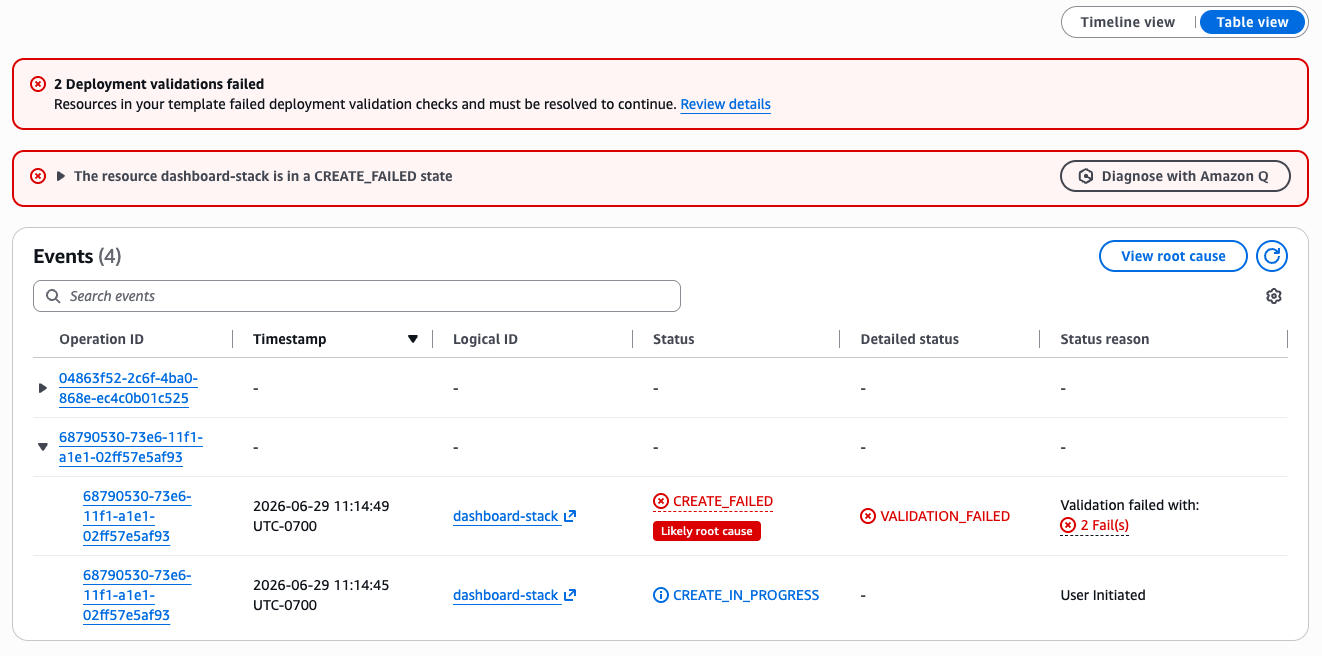
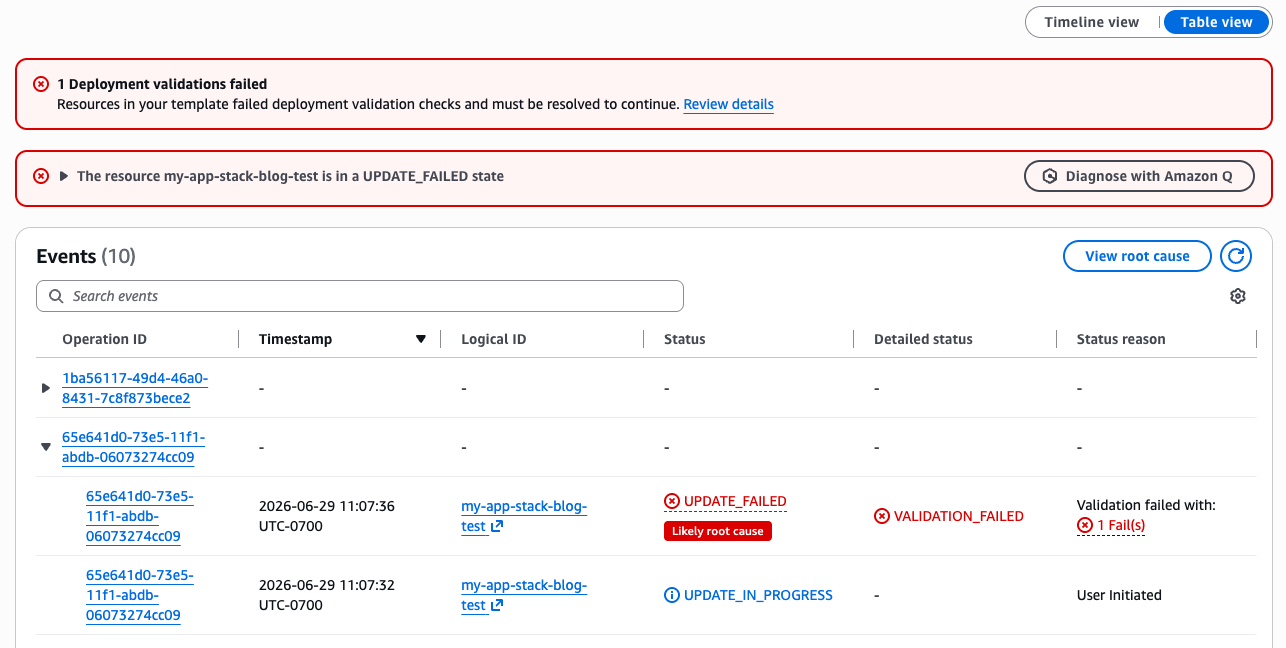
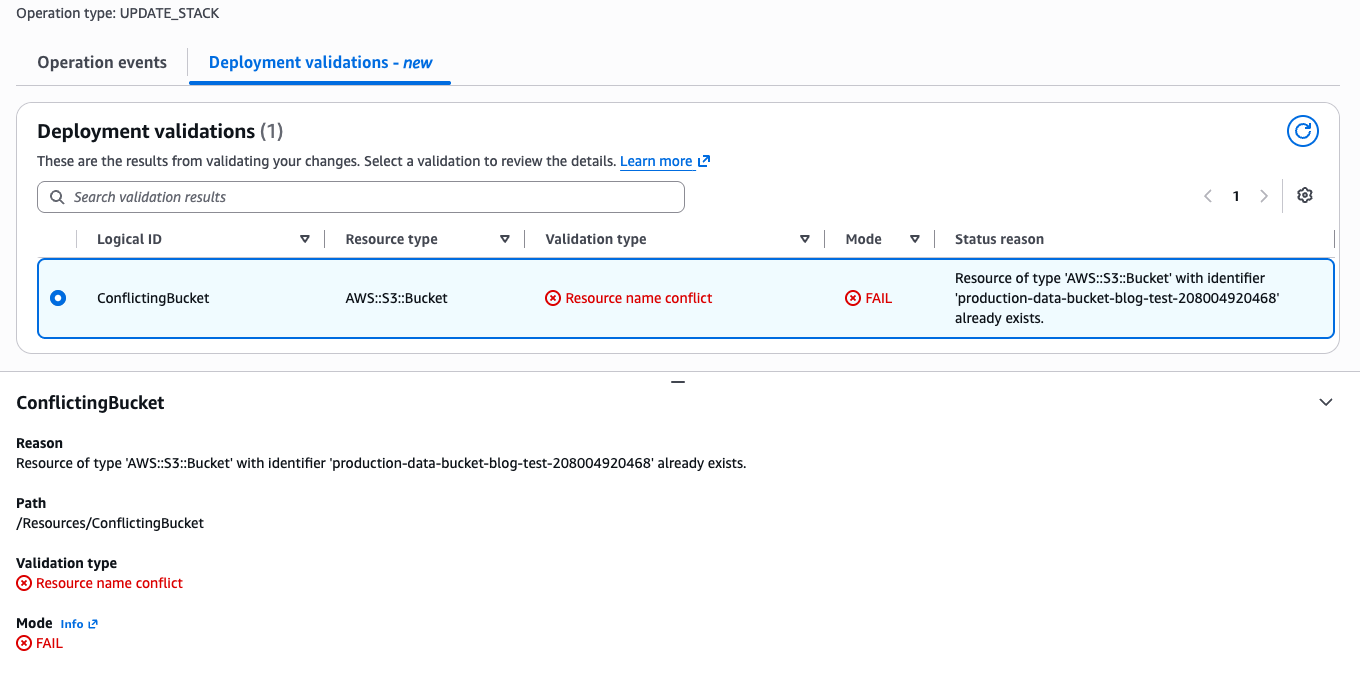
- FAIL Mode: When validation fails in this mode, the stack operation is immediately halted, and no resources are provisioned or modified. This mode is typically used for critical errors that would inevitably lead to a failed deployment, such as invalid resource properties or direct resource name conflicts. The stack status will transition to
FAILEDorUPDATE_FAILED, providing clear feedback on the immediate cessation of the operation. - WARN Mode: In contrast, WARN mode allows the stack operation to proceed despite detected issues. The system raises a warning, providing the user with information about potential problems, but does not block the deployment. This mode is ideal for issues like exceeding service quotas or minor conflicts that might be acceptable under specific circumstances or can be addressed post-deployment. The change set, for example, would still be created, but with associated warnings visible to the user.
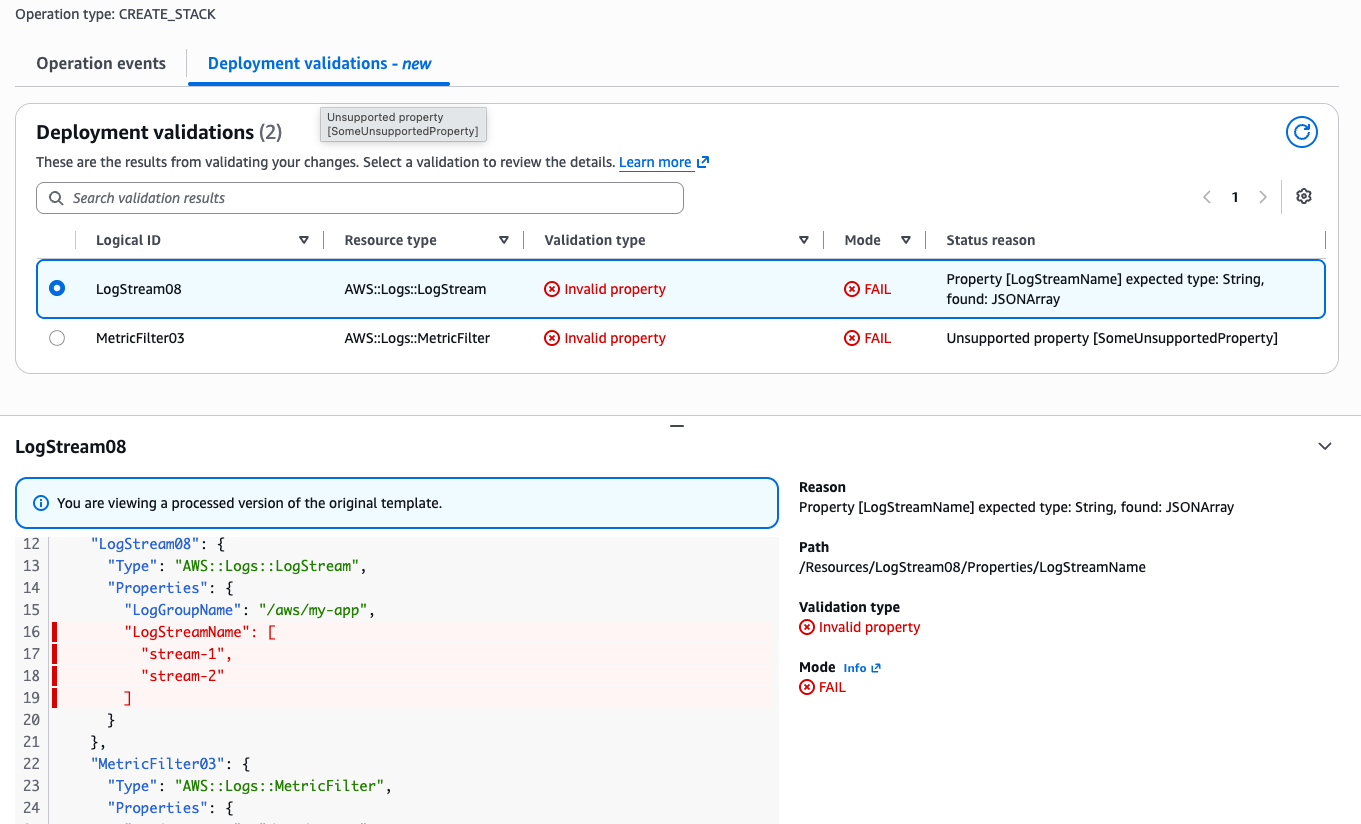
When validation fails, detailed information is provided through the describe-events API, showing EventType: VALIDATION_ERROR, the ValidationFailureMode, ValidationName, ValidationStatus, and a precise ValidationStatusReason, often including a ValidationPath to pinpoint the exact location of the issue within the template. The AWS CloudFormation console also offers a dedicated "Deployment validations" tab within the Operation view, presenting a clear, tabular summary of all validation results.
Streamlining Developer Experience with AWS CDK
For developers leveraging the AWS Cloud Development Kit (CDK), the new cdk validate command offers an unparalleled validation experience. The CDK allows developers to define cloud infrastructure using familiar programming languages like TypeScript, Python, and Java. While powerful, translating high-level CDK constructs into low-level CloudFormation templates can sometimes introduce subtle errors.
The cdk validate command addresses this by providing a unified validation report. Under the hood, it synthesizes the CDK application into a CloudFormation template, creates a change set to trigger server-side pre-deployment validation, collects the results, and then intelligently maps these errors back to the original CDK source code. This "construct-level source tracing" is a game-changer. Instead of merely seeing a CloudFormation logical resource ID, developers are presented with the exact construct and line number in their CDK code that needs attention. This significantly reduces debugging time and allows for immediate, precise corrections within the developer’s preferred programming environment.
Granular Control: The DisableValidation Parameter
While automatic validation is beneficial in most scenarios, there might be specific edge cases where bypassing it is necessary. AWS has introduced the DisableValidation parameter for CreateStack and UpdateStack operations to provide this granular control.
Use cases for disabling validation might include:
- Temporary Workarounds: When deploying a known-problematic template as part of a temporary fix or during an emergency, and immediate provisioning is prioritized over full validation.
- Advanced Scenarios: In highly specific, complex deployment pipelines where custom pre-checks are already implemented, and CloudFormation’s built-in validation might cause redundant delays or conflicts.
It is crucial to note that disabling validation should be an exception rather than the norm. Bypassing these checks means that common errors will not be caught until resource provisioning is attempted, potentially leading to lengthy failed deployments and rollbacks. Developers and operations teams must understand this trade-off between deployment speed and early error detection before utilizing this parameter.
Empowering Automated Workflows and AI Agents
The enhancement of pre-deployment validation is particularly impactful for automated workflows and the burgeoning field of AI agents for infrastructure management. CI/CD pipelines, which are the backbone of modern DevOps practices, rely heavily on fast feedback loops. Previously, a template error in a CI/CD pipeline could result in a multi-minute deployment attempt, followed by a rollback, consuming valuable pipeline execution time and delaying subsequent stages. With instant validation feedback, these pipelines can fail fast, allowing for immediate re-execution after an automated or manual fix.
For AI agents, which are increasingly being developed to self-correct and manage cloud infrastructure, this structured, machine-readable validation output is invaluable. When an AI agent attempts to provision infrastructure and encounters an error, the detailed VALIDATION_ERROR event provides precise information – including the resource type, logical ID, reason, and path – that the agent can parse. This enables the agent to autonomously identify the problem, modify the template (or CDK code), and retry the deployment, turning what were once multi-minute debugging cycles into near real-time iteration loops. AWS supports this through its Agent Toolkit, providing CloudFormation skills that leverage this validation feedback for smarter automation.
Operationalizing Enhanced Validation: Getting Started and Permissions
Users can immediately begin benefiting from pre-deployment validation as it runs automatically on all CreateStack, UpdateStack, and CreateChangeSet operations without any configuration or opt-in required. To leverage the full suite of validation checks, users should:
- Review Existing Workflows: Understand where current deployments might be failing and how the new validation can mitigate those issues.
- Utilize the Console and CLI: Familiarize themselves with the detailed error messages available via
describe-eventsand the CloudFormation console’s "Deployment validations" tab. - Adopt
cdk validate: For CDK users, integratecdk validateinto their development and CI/CD workflows to benefit from construct-level tracing.
Required IAM Permissions for Validation Checks:
While property syntax validation and resource name conflict detection on CreateStack and UpdateStack operations require no additional IAM permissions beyond what is necessary for the stack operation itself, the new warning-mode validation checks during change set creation do require specific permissions. If these permissions are not granted, the corresponding validation checks will be skipped without blocking the operation.
- Service Quota Check: Requires permissions for
servicequotas:GetServiceQuotaandservicequotas:ListServiceQuotas. - AWS Config Recorder Check: Requires
config:DescribeConfigurationRecorderspermission. - ECR Repository Delete Readiness Check: Requires
ecr:DescribeRepositoriesandecr:ListImagespermissions. - S3 Bucket Empty Check: Requires
s3:ListBucketpermission.
These permissions allow CloudFormation to inspect the state of the AWS account and specific resources to perform the necessary pre-checks.
Best Practices for Maximizing Validation Benefits
To fully capitalize on these enhancements, AWS recommends several best practices:
- Integrate
cdk validateEarly: For CDK users, makecdk validatea mandatory step in local development and CI/CD pipelines to catch errors as early as possible. - Monitor Validation Events: Regularly review CloudFormation events, especially
VALIDATION_ERRORmessages, to understand common issues and refine templates or CDK code. - Educate Teams: Ensure all developers and operations personnel are aware of the new validation capabilities and how to interpret error messages.
- Leverage Warning Mode: Pay close attention to warnings, especially those related to service quotas, and address them proactively to prevent future deployment blockers.
- Use
DisableValidationSparingly: Reserve theDisableValidationparameter for highly specific, justified scenarios where the trade-off is well understood and managed. - Automate Fixes for AI Agents: For AI-driven infrastructure, design agents to parse structured validation errors and attempt automated corrections.
The Broader Implications: A Shift-Left Strategy for Cloud Infrastructure
The automatic integration of pre-deployment validation across all CloudFormation stack operations represents a significant stride in AWS’s commitment to a "shift-left" validation strategy for cloud infrastructure. This approach, borrowed from traditional software development, emphasizes detecting and addressing issues as early as possible in the development lifecycle. By moving error detection from post-deployment (when resources are being provisioned) to pre-deployment (before any resources are touched), AWS empowers users to build more reliable, efficient, and cost-effective cloud solutions.
This enhancement directly addresses some of the most persistent pain points in IaC: the time and cost associated with failed deployments. A spokesperson from AWS, speaking on the importance of developer experience, would likely emphasize how this update significantly reduces friction, allowing teams to iterate faster and focus on innovation rather than debugging infrastructure failures. The reduction in operational overhead from fewer failed deployments and rollbacks is substantial, contributing to better resource utilization and lower operational costs for organizations.
Furthermore, this move strengthens the overall reliability of AWS infrastructure deployments. By catching issues like service quota excesses or resource conflicts proactively, it helps prevent potential cascading failures or unexpected behaviors in production environments. It aligns with the growing trend of embedding more intelligence and guardrails directly into cloud services, making cloud adoption safer and more manageable for enterprises of all sizes.
Conclusion
AWS CloudFormation’s automatic pre-deployment validation across all stack operations, coupled with new validation checks, the DisableValidation parameter, and deep CDK integration, marks a substantial advancement in the field of Infrastructure as Code. This enhancement directly addresses the critical need for faster feedback loops in cloud infrastructure development, significantly accelerating developer velocity and reducing operational overhead. By embracing a comprehensive "shift-left" validation strategy, AWS is empowering its users to build more robust, reliable, and efficient cloud environments. This new capability is available in all AWS Regions where CloudFormation is supported, requiring no configuration, and is set to become an indispensable tool for anyone managing infrastructure on AWS. For more information, users are encouraged to consult the official AWS CloudFormation User Guide on validating stack deployments.
Related posts: