Revolutionizing CSS Layouts and Animations: The Arrival of sibling-index() and sibling-count()

A significant advancement in web development has arrived with the introduction of sibling-index() and sibling-count() to the CSS Values and Units Module Level 5 specification. These new intrinsic functions empower developers to create dynamic, data-driven layouts and animations directly within CSS, eliminating the need for complex JavaScript workarounds or cumbersome pre-processor loops that have long complicated common design patterns. This development marks a pivotal moment, allowing CSS to access information about an element’s position within the DOM tree—a capability previously confined largely to JavaScript.
The Long-Awaited Solution to a Persistent Problem
For years, achieving a simple staggered cascade effect—where elements fade or slide into view sequentially—has presented an ironically complex challenge for front-end developers. While visually appealing and common across modern user interfaces, its implementation often felt fundamentally inefficient. Prior to these new functions, developers typically resorted to one of two primary methods, both fraught with their own set of limitations:
-
Sass Loops and
:nth-child()Rules: This approach involved using CSS pre-processors like Sass to generate a series of:nth-child()rules. For instance, a list of ten items requiring staggered animation delays would necessitate ten distinct rules, each hardcoding a custom property (--idx) corresponding to its position:/* One rule per item. Hope the list never grows. */ li:nth-child(1) --idx: 1; li:nth-child(2) --idx: 2; /* ... eight more of these ... */ li:nth-child(10) --idx: 10; li animation-delay: calc(var(--idx) * 100ms);This method was highly rigid. If the list grew to 50 items, the stylesheet would balloon with 50 individual rules, or hundreds if covering a wider range. While clever strategies like Roman Komarov’s O(√N) counting hacks emerged to reduce the rule count for large sets, even these could still require dozens of rules to cover over a thousand elements, fundamentally hardcoding values that should ideally be dynamic. This approach became a maintenance nightmare, coupling styling directly to the exact count of elements.
-
JavaScript-Managed Inline Styles: The alternative involved JavaScript iterating through elements and injecting inline styles, such as
style="--index: 3", directly into the DOM. While this offered dynamic flexibility, it blurred the lines between concerns, spreading layout logic across JavaScript files. This created a fragile dependency where CSS relied on a variable injected by a script, often leading to unexpected breakage months later when component refactors inadvertently removed or altered the JavaScript responsible for setting these crucial variables. This method also introduced potential performance overhead due to DOM manipulation and re-renders, especially on large, frequently updated lists.
The core frustration underlying both methods was the undeniable fact that the browser already possessed this information. It had constructed the DOM tree, it knew the exact position of every child element, yet CSS lacked a direct, declarative mechanism to access this inherent data. The introduction of sibling-index() and sibling-count() directly addresses this long-standing deficiency.
Genesis and Standardization: A Collaborative Effort
The journey of sibling-index() and sibling-count() from proposal to standard is a testament to the collaborative nature of web standards development. These functions are formally part of the CSS Values and Units Module Level 5 specification, specifically detailed in Section 9, which focuses on tree-counting. The proposal gained significant traction and was ultimately approved via CSS Working Group (CSSWG) issue #4559 after extensive discussion and refinement among browser vendors, web developers, and standards experts.
Web standards bodies, including the W3C, constantly evaluate proposals to enhance the capabilities of CSS, aiming to make it more powerful, expressive, and efficient. The need for intrinsic tree-counting functions was a recurring theme in developer feedback, highlighting a common pain point that the CSSWG was keen to address. The approval of these functions signifies a recognition that core layout and animation logic should, where possible, reside within CSS, leveraging the browser’s native rendering engine for optimal performance and maintainability.
Unlike counter(), which yields a string and is primarily used with the content property for pseudo-elements, sibling-index() and sibling-count() resolve to <integer> values. This crucial distinction means they can be directly integrated into mathematical expressions within calc(), min(), max(), round(), mod(), and even advanced trigonometric functions like sin() and cos(). This capability transforms CSS from a purely descriptive language to one capable of dynamic, mathematical calculations based on the DOM structure, handling type coercion seamlessly to produce valid values like <time> or <length>.
It is important to clarify that these functions are distinct from selectors like :nth-child(). While :nth-child() selects elements based on their position, it does not produce a value that can be used in declarations. Attempts to use calc(:nth-child() * 10px) are invalid CSS. sibling-index() and sibling-count(), conversely, are designed to sit within declarations, providing numerical values for computation. This distinction is critical, as it highlights that developers were previously misusing :nth-child() in ways it was never intended, trying to coerce it into a value-producing role.
Unlocking New Design Paradigms: Practical Applications
The immediate and profound impact of these functions is evident in the elegance and conciseness they bring to previously complex CSS patterns. A staggered animation, once requiring multiple lines of code, now collapses into a single, highly adaptable declaration:
li
  animation-delay: calc(sibling-index() * 100ms);
This single line offers unparalleled scalability, functioning identically for a list of 5 items or 5,000, without any JavaScript listeners, mutation observers, or re-renders. This declarative approach significantly reduces code complexity, improves maintainability, and enhances performance.
Beyond simple staggering, the integer output of these functions opens a spectrum of dynamic possibilities:
-
Reverse Stagger: To animate elements from last to first, a simple subtraction reverses the order:
.card
  animation: fade-in 0.4s ease both;
  animation-delay: calc((sibling-count() - sibling-index()) * 80ms);
This ensures the animation begins instantly with the last item, preventing awkward initial pauses.
-
Automatic Equal Widths: Responsive layouts that dynamically adjust based on the number of items can now be achieved without JavaScript or media queries:
.tab
  width: calc(100% / sibling-count());
This automatically distributes width equally, whether there are three, five, or ten tabs, adapting instantly to DOM changes. While powerful, developers should consider fallback strategies (like Flexbox wrapping) for scenarios where too many items might lead to excessively narrow elements.
-
Dynamic Hue Distribution: Creating harmonious color palettes that adapt to content count is simplified:
.swatch
  background-color: hsl(
    calc((360deg / sibling-count()) * sibling-index()) 70% 50%
  );
This generates a palette where colors are evenly spread across the color wheel, a task previously requiring JavaScript color libraries.
-
Circular and Radial Layouts: Combining
sibling-index()andsibling-count()with native CSS trigonometric functions (sin()andcos()) enables the creation of complex radial layouts entirely in CSS:.radial-item --angle: calc((360deg / sibling-count()) * sibling-index()); --radius: 120px; position: absolute; left: calc(50% + var(--radius) * cos(var(--angle))); top: calc(50% + var(--radius) * sin(var(--angle))); transform: rotate(calc(var(--angle) * -1));This allows elements to arrange themselves dynamically in a circle or polygon, adapting to the number of siblings without any JavaScript coordinate computations.
-
Z-Index Stacking: Building layered card effects or fan layouts becomes a single line of CSS:
.card
  z-index: calc(sibling-count() - sibling-index());
This automatically assigns
z-indexvalues, ensuring correct stacking order based on position.
Navigating the Nuances: Key Considerations for Developers
While transformative, developers must understand certain behaviors of these functions to avoid unexpected results:
-
Shadow DOM Scoping:
sibling-index()andsibling-count()operate strictly on the immediate DOM tree. In the context of Web Components and Shadow DOM, these functions will only count siblings within the shadow tree, ignoring any projected light DOM content. For instance, if a custom element’s shadow DOM contains<slot>and<div>elements,sibling-index()applied to the<div>will always return2, regardless of how many elements are projected through the<slot>. Furthermore, external CSS attempting to use these functions via::part()to probe a component’s internal structure will receive0, acting as a security barrier.
-
Pseudo-Elements Don’t Count (but can use them):
::beforeand::afterpseudo-elements are not considered real DOM nodes and thus do not have their ownsibling-index()or contribute tosibling-count(). However, these functions can be used within pseudo-element declarations. In such cases,sibling-index()will evaluate against the pseudo-element’s originating element. For example,#target::before width: calc(sibling-index() * 10px);will use#target‘s index, not the pseudo-element’s. -
display: noneStill Counts: This is a critical distinction. While elements withdisplay: noneare removed from the visual layout tree and are inaccessible to screen readers, they remain part of the DOM tree. Consequently,sibling-index()will still count these hidden elements, preserving their position in the sequence. This can lead to visual "gaps" in staggered animations or circular layouts if continuous indexing is assumed for visible elements. For scenarios like search filters that hide non-matching items, developers might need to dynamically remove elements from the DOM rather than just hiding them, or revert to JavaScript-managed indexes for continuous visual counting.visibility: hiddenandopacity: 0also count, which is generally more intuitive as these elements still occupy space. -
Custom Properties Evaluate Immediately: A common pitfall is attempting to centralize
sibling-index()within a parent’s custom property, e.g.,.parent --idx: sibling-index();. This will cause--idxto resolve to the parent’s own sibling index, and all children will inherit this single, fixed value, which is rarely the desired outcome. The correct approach is to apply the function directly on the elements that need it:.child --idx: sibling-index(); animation-delay: calc(var(--idx) * 100ms);. While the CSSWG has discussedinherits: declarationfor@propertyas a potential future solution, it remains in early conceptual stages. -
Performance at Scale: While significantly more performant than JavaScript-based DOM manipulation, changing the DOM (adding, removing, or reordering children) will trigger style recalculations for affected siblings. For typical use cases like navigation, card grids, or tab bars, this cost is negligible. However, in highly dynamic scenarios with thousands of constantly churning nodes, such as live stock tickers or infinite-scroll feeds, developers should still consider JavaScript-managed indexes within virtualization windows to optimize performance. These functions are fast, but not entirely without computational cost.
Current Adoption and Future Outlook
Browser support for sibling-index() and sibling-count() is rapidly solidifying. As of June 2025, Chrome/Edge 138 and Safari 26.2 have shipped these functions in their stable releases, collectively covering a substantial majority (approximately 75-80%) of global browser traffic. Firefox, while not yet having shipped in stable, has a positive standards position (Mozilla’s standards-positions issue #1194) and active implementation work underway (Bugzilla issue #1953973). Developers can consult caniuse.com/wf-sibling-count for the most up-to-date support information.
For immediate production deployment, progressive enhancement via @supports is the recommended strategy:
/* Baseline that works everywhere */
.item
  width: 25%;
  animation-delay: 0ms;


/* Progressively enhance where supported */
@supports (z-index: sibling-index())
  .item
    width: calc(100% / sibling-count());
    animation-delay: calc(sibling-index() * 80ms);
This ensures a functional, albeit less dynamic, baseline experience for unsupported browsers like Firefox, while providing the enhanced, mathematical layouts for those with native support. For more advanced fallback scenarios, techniques like those outlined by Juan Diego Rodríguez, which leverage existing CSS hacks as a bridge, can be employed rather than resorting to full JavaScript polyfills that negate the benefits of these new functions.
Looking ahead, the CSSWG is already exploring extensions to these capabilities. Issue #9572 documents a planned of <selector> argument, mirroring :nth-child(), which would allow developers to count only siblings matching a specific selector (e.g., sibling-index(of .active)). This would be invaluable for dynamic UIs where filtering or toggling visibility needs to maintain sequential indexing without altering the DOM structure. Further discussions around children-count() (counting direct children) and descendant-count() (recursively counting all descendants) are also underway (issues #11068 and #11069, respectively), promising a more comprehensive suite of tree-counting functions that provide both horizontal (sibling) and vertical (parent-child) structural awareness to CSS.
Accessibility and Best Practices: Ensuring Inclusive Design
It is imperative to remember that sibling-index() and sibling-count() are purely visual tools. They dictate how elements appear, not what they mean or how they are interacted with by assistive technologies. Developers must exercise caution when using these functions to visually reorder elements (e.g., via order in Flexbox or Grid placement). Screen readers and keyboard navigation still follow the DOM’s source order. A visual reordering without corresponding semantic adjustments creates a critical accessibility barrier, where the visual and semantic structures contradict each other.
For interactive components—such as dynamic data grids, radial menus, or custom listboxes—that leverage tree-counting for layout, JavaScript remains essential for synchronizing ARIA attributes like aria-posinset and aria-setsize. These attributes communicate an element’s position within a set to assistive technologies, and they have no inherent awareness of CSS calculations. Failure to keep ARIA attributes aligned with the visual presentation will lead to a broken experience for users relying on assistive technology.
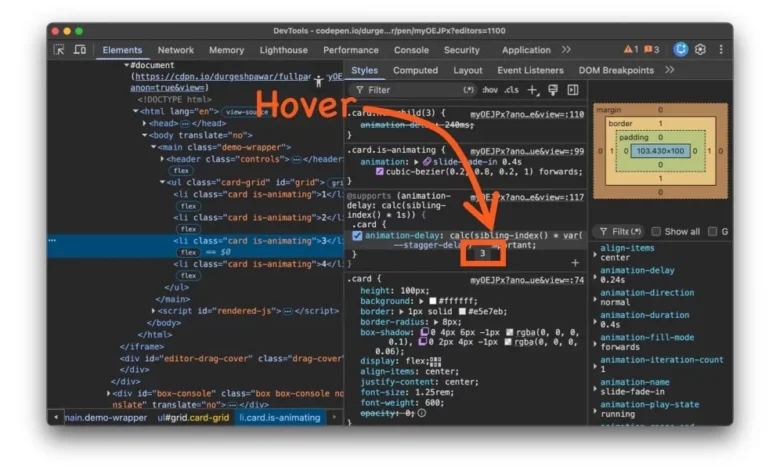
Debugging these new functions is facilitated by modern browser developer tools. Recent versions of Chrome DevTools, for instance, allow developers to inspect the computed values of sibling-index() and sibling-count() directly within the Elements panel, aiding in troubleshooting when calculations do not yield expected results.
Conclusion
The introduction of sibling-index() and sibling-count() represents a significant leap forward for CSS, empowering developers with unprecedented control over dynamic layouts and animations directly within stylesheets. By allowing CSS to access intrinsic DOM tree information, these functions address a long-standing developer pain point, reducing reliance on JavaScript for common UI patterns and fostering cleaner, more maintainable codebases. While requiring careful consideration of their nuances and a commitment to accessibility best practices, these new capabilities promise to unlock a new era of expressive and performant web design, marking another step in CSS’s evolution into a robust and versatile application styling language.