Automating the Future of Automotive Navigation: How HERE Technologies and AWS Orchestrated Agentic AI to Revolutionize Map Data Standards

The rapid evolution of the automotive industry toward autonomous driving and real-time connectivity has placed unprecedented pressure on map data infrastructure. For HERE Technologies, the global leader in location data and mapping services, this transition is exemplified by the shift from the static Navigation Data Standard (NDS) Classic to the dynamic, streaming-first NDS.Live. This paradigm shift requires the synchronization of dozens of interdependent schema definitions with rigorous customer requirements. To meet this challenge, HERE Technologies has successfully integrated an orchestrated, multi-agent AI system powered by AWS Kiro, marking a significant milestone in software engineering productivity and architectural consistency.
The Technological Crossroads: NDS.Live and the SDLC Burden
The Navigation Data Standard (NDS) serves as the industry backbone for automotive manufacturers, including giants like BMW and Volkswagen. It ensures that navigation systems, Advanced Driver Assistance Systems (ADAS), and autonomous driving modules operate on a unified data language. While NDS Classic served the industry well for batch-based, offline updates, the modern connected vehicle requires real-time, high-definition streaming—the core of NDS.Live.
This transition has fundamentally altered the Software Development Life Cycle (SDLC) at HERE. Previously, engineers focused on delivering comprehensive map snapshots. Today, they must manage continuous API-driven updates, requiring 100 percent architectural consistency across an increasingly complex matrix of schema definitions. Compounding this technical challenge is the regulatory landscape of the automotive sector. Automotive SPICE (ASPICE), the industry’s rigorous process assessment model, mandates bidirectional traceability between system requirements, software architecture, and final implementation. Manually documenting this traceability has historically been a labor-intensive process, often diverting top-tier engineering talent from product innovation to bureaucratic compliance.
The Genesis of the Multi-Agent Solution
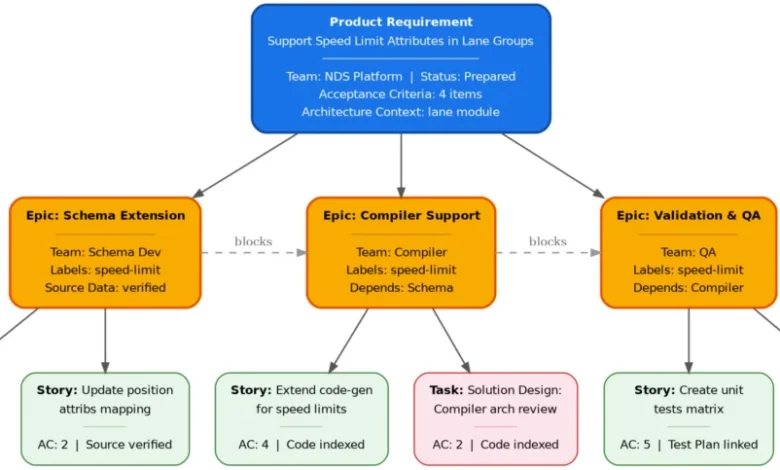
Recognizing that manual ticket decomposition—the process of breaking down high-level product features into Jira epics, stories, and tasks—was creating a bottleneck, HERE Technologies explored an agentic approach. The objective was to eliminate the "context switching" that plagued developers, where fragmented knowledge led to structural errors in project management tickets and delayed release cycles.
The solution emerged in the form of an orchestrated multi-agent framework built on Kiro, an advanced software engineering agent platform from AWS. Unlike monolithic AI models that attempt to solve every problem with a single prompt, the HERE engineering team deployed an orchestration model that mimics a high-functioning human department. By assigning specific roles to "persona agents"—including an Architect, Product Owner, Tech Lead, Developer, QA Engineer, and Data Modeler—the system ensures that each requirement is analyzed from every necessary vantage point simultaneously.
Chronology of Implementation: From Manual to Autonomous
The deployment of this AI-driven workflow occurred in distinct phases over the past 18 months. Initially, the team attempted a "always-on" context approach, loading every piece of domain knowledge into the model. While effective for small-scale demonstrations, the system struggled with performance at scale due to excessive token noise.
By late 2025, the team pivoted to a "skills-based" model. In this configuration, agents only access specialized instructions and domain knowledge when specific triggers occur. This refinement proved critical. During the first half of 2026, the team integrated the Kiro Command Line Interface (CLI) into their CI/CD pipelines. This integration allowed the system to trigger ticket creation automatically via Jira webhooks, removing the need for manual developer intervention in the project management lifecycle. By the third quarter of 2026, the system had reached a maturity level where it could maintain "persistent memory" across sessions, effectively functioning as an evolving team member that learns from past sprints.
Supporting Data and Technical Architecture
The efficiency gains reported by HERE Technologies are substantial. Historically, the decomposition of a single complex product requirement into a verified, linked Jira hierarchy could consume several days of senior engineering time. With the Kiro-orchestrated workflow, this process is now reduced to minutes.
The system utilizes a three-layer memory architecture—semantic, episodic, and procedural—which allows the AI to recall project-specific nuances with sub-second latency. Furthermore, the incorporation of "Code Intelligence" allows the agents to query the organization’s actual source code repositories. By grounding the AI in the reality of the existing codebase rather than relying solely on documentation, the system ensures that generated tickets align with current implementation patterns. This has led to a measurable reduction in revision cycles, as developers are no longer forced to correct tickets that reflect outdated or generic architectural assumptions.
The Role of Confirmation Gates
A critical component of this automated system is the implementation of human-in-the-loop "confirmation gates." Recognizing that even the most advanced AI can produce hallucinations, HERE engineers installed three distinct validation checkpoints.
- Analysis Gate: The AI presents its initial decomposition for review before any tickets are generated.
- Assignment Gate: The system identifies the appropriate team and stakeholders, allowing for human override.
- Approval Gate: The final task plan is reviewed for alignment with NDS.Live schemas before being committed to the Jira backlog.
These gates introduce a brief pause in the workflow, but they effectively eliminate the risk of systemic errors, such as mass-tagging inaccuracies, that could otherwise disrupt an entire sprint.
Industry Implications and Broader Impact
The collaboration between HERE Technologies and AWS highlights a shift in how large-scale engineering organizations approach AI. The implications for the automotive sector are clear: as vehicles become software-defined, the ability to maintain architectural integrity at scale will become a primary competitive advantage.
Analysts suggest that this "orchestrated multi-agent" approach could become the standard for industries governed by strict compliance frameworks, such as aerospace and medical devices. By automating the burden of ASPICE traceability, firms can reallocate their most valuable asset—human expertise—toward solving higher-order problems.
"This isn’t just about speed; it’s about the democratization of domain knowledge," noted a senior engineer involved in the project. "By embedding the ‘how-to’ of our architecture into the agentic workflow, we ensure that new team members can contribute at a high level much faster, while senior architects are freed from the minutiae of ticket management."
Looking Ahead: The Future of Agentic Software Engineering
As HERE Technologies continues to iterate on this model, the focus is shifting toward "recursive improvement." The team is currently using the same spec-driven development model that powers their agents to refine the agentic system itself. By treating the AI infrastructure as a product, the organization is creating a self-improving loop where the system identifies its own inefficiencies and suggests architectural adjustments.
The success of this initiative underscores a vital lesson for the technology sector: the future of AI is not found in the raw power of a single model, but in the intelligent orchestration of specialized agents. As the automotive industry accelerates toward a future of autonomous and connected mobility, the ability to treat documentation and code as a singular, machine-readable source of truth will be the difference between a stalled project and a seamless, high-definition map for the world.
For other organizations, the blueprint provided by HERE is actionable: start with a well-defined, manual workflow; ground the agents in the reality of the existing codebase; and utilize confirmation gates to maintain human oversight where it matters most. In doing so, companies can successfully navigate the transition from manual, fragile development cycles to a future defined by resilient, automated, and intelligent software engineering.