React Native 0.86 Ushers in Enhanced Android Edge-to-Edge Support and Ecosystem Consolidation

React Native 0.86 has been officially released, marking a significant step forward for the popular cross-platform development framework. This latest iteration prioritizes a more robust and predictable development experience, highlighted by comprehensive support for Android’s edge-to-edge display capabilities and notable improvements to React Native DevTools. Crucially, this release continues a trend of stability, offering no user-facing breaking changes, a testament to the project’s commitment to smoother upgrade paths for developers.
The release also signifies a pivotal moment in the React ecosystem’s organizational structure, with the core React Native repository, alongside React, Metro, and Yoga, migrating from the facebook GitHub organization to the newly established react organization. This move directly reflects the transition of React and React Native development under the umbrella of the React Foundation, an independent entity dedicated to the long-term health and evolution of the React ecosystem. While GitHub will automatically manage URL redirects, ensuring a seamless transition for existing links, issues, and pull requests, this organizational shift underscores a growing autonomy and community-driven governance for these foundational technologies.
A New Era for React Native: Ecosystem Consolidation Under the React Foundation
The relocation of the React Native repository to the react GitHub organization represents more than just a change of digital address. It is a tangible manifestation of the React Foundation’s mission to provide independent, long-term stewardship for the entire React ecosystem. This consolidation brings React Native, React, the Metro bundler, and the Yoga layout engine under a unified organizational structure, fostering closer collaboration and a more cohesive development strategy.
The React Foundation, established to ensure the continued innovation and stability of React-based technologies, aims to provide a neutral and community-focused governance model. This move is expected to further democratize the development process, allowing for broader community input and contribution. While the technical implications of this organizational change are minimal for day-to-day development, the symbolic and strategic importance is substantial, signaling a maturation of the React ecosystem towards a more sustainable and community-driven future. Developers can anticipate a more integrated experience as these core projects continue to evolve under a shared vision.
Unlocking the Full Screen: Advanced Edge-to-Edge Support on Android
A major focus of React Native 0.86 is the enhancement of the edge-to-edge display experience on Android devices. This release delivers comprehensive fixes and improvements for Android 15 and later versions, particularly addressing scenarios where the operating system enforces edge-to-edge mode even when not explicitly configured through the edgeToEdgeEnabled Gradle property.
This improved support ensures that applications can gracefully extend their content to the very edges of the screen, utilizing the full display real estate. This is particularly important for modern device designs that feature immersive displays and minimal bezels. The fixes implemented in 0.86 aim to eliminate common visual glitches and layout issues that previously arose when edge-to-edge mode was unexpectedly activated. Developers can now build applications that feel more integrated with the device’s hardware, offering a more polished and modern user interface. This is a crucial step in keeping pace with Android’s evolving design paradigms and user expectations for full-screen experiences.
Streamlining Debugging: Enhancements to React Native DevTools
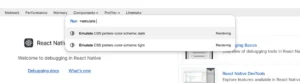
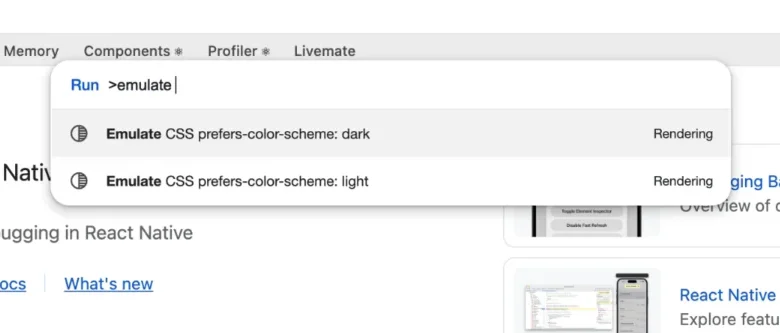
React Native DevTools has received a significant upgrade in version 0.86, with the introduction of light and dark mode emulation. This new feature allows developers to simulate different appearance modes directly within DevTools using Emulation.setEmulatedMedia. This capability bypasses the need to manually change device settings, enabling swift and efficient testing of an app’s thematic consistency across light and dark modes.
Accessing this functionality is intuitive. Developers can summon the Command Palette by pressing cmd + shift + P (or ctrl + shift + P on Windows/Linux) and then select the light or dark mode emulation option. This feature is designed as a temporary switch, resetting to the default when DevTools disconnects, ensuring that it doesn’t interfere with the user’s overall device configuration. This enhancement significantly streamlines the workflow for developers focused on UI/UX, allowing for more rapid iteration and validation of visual design elements. The ability to test appearance modes without leaving the development environment is a considerable time-saver and contributes to a more efficient debugging process.
A Commitment to Stability: No User-Facing Breaking Changes

Reinforcing its commitment to developer experience, React Native 0.86 follows in the footsteps of its predecessor, 0.83, by introducing no user-facing breaking changes. This signifies a deliberate strategy to make upgrades more predictable and less disruptive for development teams. For developers currently on React Native 0.85, upgrading to 0.86 should be a straightforward process, requiring no modifications to their existing application code.
This approach to versioning is a critical factor for the long-term adoption and maintenance of React Native applications. Frequent breaking changes can lead to significant overhead, requiring extensive code refactoring and testing. By minimizing these disruptions, the React Native core team is enabling developers to focus on building new features and improving their applications rather than constantly managing framework updates. This stability is a key selling point for enterprise adoption and for projects with long development cycles.
Deprecations and Future Considerations
While React Native 0.86 focuses on stability, it does introduce a set of deprecations, signaling upcoming changes in future releases. Developers are advised to review these deprecations and begin planning for the eventual removal of these APIs. This proactive approach allows the community to adapt to evolving standards and best practices without sudden, jarring transitions. Specific details on the deprecated APIs are available in the official release notes and documentation, enabling developers to make informed decisions about their codebase.
Broader Ecosystem Impact and Developer Experience
The release of React Native 0.86, with its emphasis on stability and enhanced platform support, is a positive development for the entire React Native ecosystem. The improved Android edge-to-edge support directly addresses the evolving design landscape of mobile devices, ensuring that React Native applications can provide a modern and immersive user experience. The DevTools enhancements, particularly the light/dark mode emulation, directly benefit developers by streamlining their debugging and testing workflows.
Furthermore, the organizational shift to the React Foundation signals a maturing of the project’s governance and a stronger commitment to community involvement. This move is likely to foster greater transparency and collaboration, ultimately leading to a more robust and sustainable framework. The continued absence of breaking changes reinforces React Native’s position as a reliable choice for building cross-platform applications, reducing the perceived risk associated with adopting and maintaining projects built with the framework.
Upgrade Path and New Project Initialization
For developers looking to leverage the latest features, upgrading to React Native 0.86 is recommended. The React Native Upgrade Helper tool, available online, provides a comprehensive guide to code changes required for existing projects. For those starting new projects, the latest version can be initialized using the command: npx @react-native-community/cli@latest init MyProject --version latest.
For users of the Expo managed workflow, React Native 0.86 will be accessible through the expo@canary releases, allowing for early testing and adoption of the new features within the Expo ecosystem.
Acknowledgements and Community Contributions
React Native 0.86 is the product of extensive community effort, incorporating over 596 commits from 97 contributors. The release notes acknowledge the significant contributions made by various community members, underscoring the collaborative nature of the React Native development process. This widespread participation is a key strength of the open-source project, ensuring that it continues to evolve in response to the needs of its diverse user base. The ongoing dedication of these contributors is instrumental in maintaining the framework’s momentum and its position as a leading cross-platform development solution.