React Native 0.86 Official Release Brings Android 15 Edge-to-Edge Support and Community Governance Transition

The cross-platform mobile development landscape achieved another milestone today with the official rollout of React Native 0.86. Developed by Meta and supported by a vast ecosystem of open-source contributors, this latest iteration focuses heavily on modernization, platform alignment, and developer ergonomics. Most notably, version 0.86 introduces comprehensive edge-to-edge layout support tailored for Android 15 and newer operating system environments, alongside sophisticated toolchain enhancements designed to streamline debugging.
Following closely on the heels of version 0.83, this release marks the second consecutive major deployment to ship without any user-facing breaking changes. This deliberate engineering milestone highlights the core maintainer team’s dedication to making version transitions increasingly predictable, seamless, and frictionless for enterprise teams and indie developers alike. As mobile applications grow in complexity, reducing migration friction remains a top priority for the framework’s stewards, allowing organizations to adopt cutting-edge platform capabilities without incurring massive technical debt or requiring exhaustive refactoring cycles.
Beyond technical enhancements under the hood, this release arrives during a period of profound institutional transition for the framework. The core repository ecosystem has officially migrated out of Meta’s corporate GitHub footprint into an independent organizational home, signaling a new chapter in the lifecycle of one of the world’s most widely utilized JavaScript-based mobile frameworks.
A Historic Governance Transition: The React Foundation
The most significant structural shift accompanying the release of React Native 0.86 is the relocation of the core source code repository. Alongside auxiliary projects such as React, Metro, Yoga, and the official React Native documentation website, the main GitHub repository has officially transitioned from the facebook organization to the react organization.
This move is far more than a simple URL change; it reflects the formal transition of React and React Native to the React Foundation. Established as an independent, vendor-neutral entity, the React Foundation is dedicated to securing the long-term sustainability, stewardship, and decentralized governance of the broader React ecosystem. By separating the project from a single corporate entity, the foundation aims to foster broader industry collaboration, encourage diverse contributions from competing tech enterprises, and ensure that the framework’s roadmap remains aligned with the global developer community’s needs.
For everyday developers and large-scale engineering teams, the transition has been engineered to be entirely transparent. GitHub’s robust redirection infrastructure automatically routes all existing URLs, open issues, and pull requests to their new locations within the react organization. Consequently, maintainers report that developers do not need to update their local remotes, CI/CD pipelines, or bookmark links manually, though updating references over time is encouraged as best practice.
Seamless Android 15 Edge-to-Edge Compliance
As mobile operating systems evolve, visual design paradigms shift to maximize screen real estate and deliver immersive user experiences. Google’s Android 15 has accelerated this trend by enforcing edge-to-edge layouts natively, rendering applications behind the system status and navigation bars by default. React Native 0.86 meets this challenge head-on by shipping comprehensive fixes and native integrations for Android 15+ edge-to-edge rendering.
Historically, managing edge-to-edge display states required developers to explicitly configure the edgeToEdgeEnabled Gradle property within their native Android build files. However, with Android 15 aggressively enforcing these UI constraints at the OS level—often regardless of whether legacy Gradle properties are explicitly toggled—many existing applications experienced visual clipping, overlapping status bars, or improper padding.
React Native 0.86 resolves these discrepancies by introducing robust, out-of-the-box layout stabilization fixes. These updates ensure that safe-area insets are calculated accurately, touch targets remain accessible, and custom navigation bars do not obscure critical user interface elements. By automating these adjustments, the framework relieves developers of the burden of writing custom native bridging code to handle modern Android windowInsets, ensuring that cross-platform applications look native, polished, and fully compliant with modern Android design guidelines right out of the box.
Developer Tooling Upgrades: Emulation via DevTools
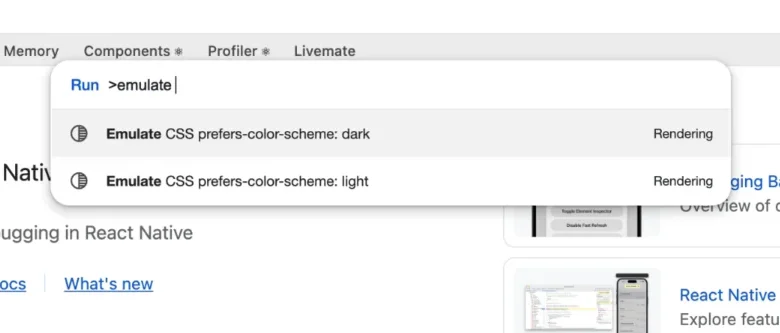
Debugging complex mobile layouts and state management has always been a central pillar of the React Native developer experience. Version 0.86 introduces a powerful addition to React Native DevTools: direct light and dark mode emulation.
Previously, testing how a React Native application responded to system
-wide theme changes required developers to manually navigate deep into their physical device or emulator settings, toggle the appearance mode, and return to the application to observe the results. This repetitive workflow introduced unnecessary friction during the UI/UX auditing phase.
With the integration of the Emulation.setEmulatedMedia API, developers can now test and debug light and dark mode appearance handling directly from the React Native DevTools interface. By utilizing the Command Palette—accessible via the familiar cmd + shift + P shortcut on macOS or ctrl + shift + P on Windows and Linux—engineers can instantly cycle through color schemes to verify contrast ratios, theme tokens, and dynamic styling logic.
Mirroring standard web browser developer tools, this emulation state is designed to be transient. The emulated color scheme automatically resets to match the actual host device settings as soon as the DevTools session is disconnected, preventing accidental persistence of test states.

Zero Breaking Changes and Deprecation Pathways
Maintaining backward compatibility while pushing the boundaries of mobile performance is a delicate balancing act. React Native 0.86 achieves this by keeping its record clean of user-facing breaking changes. Teams operating codebases on version 0.85 can plan their migration to 0.86 with high confidence, knowing that standard upgrade pathways will not necessitate application-level code rewrites.
To maintain clarity around what constitutes a breaking change, the core team continues to enforce strict versioning policies. While user-facing code remains unaffected, the release does outline a strategic set of deprecations across legacy APIs. These targeted interfaces have been flagged for eventual removal in future major iterations, providing maintainers and library authors ample runway to refactor dependent packages.
Under the Hood: Runtime, JSI, and Performance Improvements
While the surface-level API remains stable, React Native 0.86 is packed with over 596 commits contributed by 97 developers worldwide, delivering deep architectural enhancements across runtime specifications, layout engines, and native interfaces.
Runtime and Web Specification Alignment: The framework continues its ongoing convergence with modern JavaScript runtime standards and web platform specifications, ensuring predictable execution across diverse JavaScript engines (such as Hermes and JavaScriptCore).
Rendering, Layout, and Animation: Building upon the foundation of the New Architecture (Fabric renderer and TurboModules), version 0.86 refines layout calculation mechanics powered by Yoga. Performance optimizations target memory allocation during complex gesture-driven animations, reducing frame drops and jank on lower-end Android and iOS hardware.
JSI (Native Interface) Expansions: The JavaScript Interface (JSI) receives several new APIs in this release. These additions expand the capabilities of the C++ layer bridging native platform modules with the JavaScript runtime, enabling more efficient synchronous data transfer and reducing serialization overhead for performance-critical modules like computer vision, encryption, and local database management.
Android Networking, Input, and Navigation: Beyond edge-to-edge support, Android-specific subsystems saw targeted hardening. Updates to input focus management, navigation gesture handling, and image caching pipelines resolve edge cases related to high-density bitmap rendering and asynchronous network requests over unstable cellular connections.
Community Collaboration and Acknowledgments
The breadth of React Native 0.86 is a testament to the vitality of its open-source community. The core team formally extended gratitude to the 97 independent contributors whose pull requests, bug reports, and code reviews shaped the final release. This collaborative model underscores the philosophy of the newly formed React Foundation, proving that distributed global engineering can produce enterprise-grade infrastructure capable of powering millions of commercial applications.
Support Policy Updates and Upgrade Instructions
With the official launch of version 0.86, the support lifecycle shifts accordingly. Version 0.86 is now designated as the latest stable release of React Native, while version 0.83.x officially transitions into unsupported status in accordance with the project’s official version support policy.
For existing projects looking to make the leap, developers are advised to utilize the community-driven React Native Upgrade Helper web tool to review precise file-by-file diffs between their current version and 0.86. Standard upgrade documentation remains accessible via the official React Native portal.
Teams initializing brand-new projects can instantiate the latest stable environment using the official command-line interface:
npx @react-native-community/cli@latest init MyProject –version latest
Meanwhile, developers leveraging the Expo ecosystem can anticipate React Native 0.86 integration rolling out natively as part of upcoming expo@canary and stable SDK releases, ensuring that the wider tooling ecosystem remains synchronized with core framework advancements.