The global landscape of open-source innovation has long been perceived as a Western-centric endeavor, anchored primarily by major hubs in the United States and Europe. However, the recent conclusion of the LEAP East 2026 conference has solidified the shifting tides of the technology sector, highlighting the rapid advancement of Eastern-developed ecosystems. Central to these developments is openEuler, an open-source project incubated by the OpenAtom Foundation, which utilized the event to unveil significant breakthroughs in high-performance computing (HPC) and Agentic AI. By introducing the SuperPoD OS and integrating native AI agents into its desktop environment, openEuler is signaling a departure from traditional operating system models toward a future defined by unified, intelligence-driven infrastructure.
The Evolution of High-Performance Computing: The SuperPoD Architecture
At the heart of the LEAP East 2026 announcements was the introduction of the SuperPoD OS, an operating system specifically engineered to support UnifiedBus-based computing environments. As AI workloads grow increasingly complex, the industry has faced a bottleneck: the inability of disparate hardware nodes to function as a singular, cohesive entity. Conventional clusters often struggle with high latency, memory fragmentation, and inefficient data transfer when scaling to hundreds or thousands of nodes.
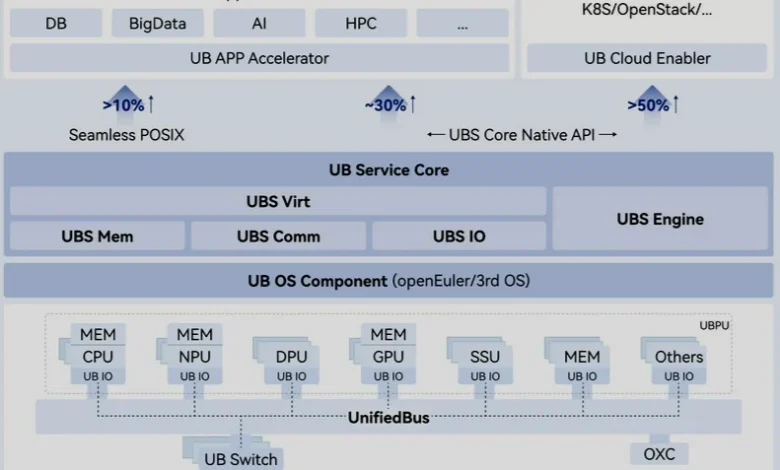
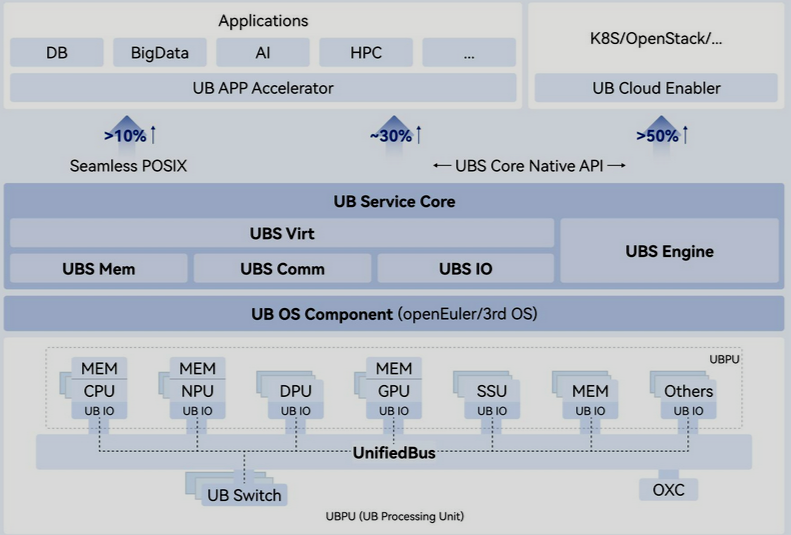
The SuperPoD architecture addresses this by treating a cluster of high-performance computers as a single, massive virtual machine. To facilitate this, openEuler introduced the UB Service Core, a software-defined layer that manages the complexities of distributed resource allocation. The architecture relies on five fundamental services: Engine, Memory, Communication, I/O, and Virtualization.
The Engine service acts as the central nervous system, pooling memory and Data Processing Unit (DPU) resources while enabling dynamic scheduling and automated failover. The Memory component allows for unified-memory programming, effectively masking the physical boundaries between machines and allowing applications to interact with a massive, shared address space. Furthermore, the Communication service maintains compatibility with standard Socket and Verbs interfaces, ensuring that legacy applications can benefit from the enhanced performance of the UnifiedBus interconnect without requiring extensive refactoring.

According to preliminary benchmarks provided by openEuler, this integration yields a 30% to 50% performance increase compared to traditional architectures. This efficiency is largely attributed to the reduction in overhead typically associated with inter-node communication and data synchronization. By optimizing the path between the I/O cache and the underlying hardware, the system significantly accelerates AI inference tasks, which rely heavily on the rapid retrieval of large datasets.
Chronology of the openEuler Ecosystem Growth
The emergence of these technologies is not an overnight development but the result of a deliberate, multi-year strategic trajectory. Since its inception, openEuler has focused on building a community-driven ecosystem that bridges the gap between hardware manufacturers and software developers.
- 2020-2022: Initial foundation and rapid adoption in the server and cloud markets, establishing the project as a viable alternative for enterprise-grade Linux.
- 2023: Expansion into edge computing and embedded systems, diversifying the platform’s utility beyond traditional data centers.
- 2024: Introduction of the 24.03 LTS branch, marking a shift toward long-term stability for large-scale enterprise deployments.
- 2025: Increased focus on AI-readiness and the development of specialized drivers for emerging AI accelerators.
- 2026 (LEAP East): The unveiling of the SuperPoD OS and the integration of the openEuler Intelligence agent, signaling the transition to an "AgentOS" model.
The launch of the openEuler Hong Kong User Group, concurrent with the conference, reflects this commitment to global expansion. By fostering local hubs, the project aims to cultivate a talent pool that can contribute to the core infrastructure while addressing regional technical requirements. This community-based model is essential for maintaining the project’s long-term sustainability and neutrality under the OpenAtom Foundation.
Agentic AI: The Future of Desktop Interaction
Beyond the data center, openEuler is fundamentally rethinking the relationship between the end-user and the operating system. With the release of openEuler 24.03 LTS SP4 and the DevStation desktop variant, the project has introduced "openEuler Intelligence." This feature is not merely a chatbot or a helper application; it is an agent-based runtime environment that utilizes Model Context Protocol (MCP) tools to interact directly with the OS.
Historically, Linux desktop environments have been configured through manual interaction—mouse clicks, terminal commands, and configuration file editing. The AgentOS model seeks to abstract these tasks. A user can now interact with the system using natural language to perform complex sequences, such as adjusting system-wide display settings, managing power profiles, or orchestrating background services within the UKUI desktop environment.

While still in its developmental stages, the implications of this shift are profound. By embedding agentic capabilities at the OS level, openEuler is creating a platform that is proactive rather than reactive. Instead of the user searching for system settings, the system anticipates the need and manages the environment to optimize for the user’s current workload. As the ecosystem matures, these agents are expected to integrate further with third-party software, effectively turning the operating system into an intelligent orchestrator of the user’s digital workspace.
Technical Analysis and Industry Implications
The integration of the UB Service Core and Agentic AI highlights a broader industry trend toward "hardware-software co-design." In an era where Moore’s Law is slowing, the industry is increasingly looking toward software-defined infrastructure to extract maximum performance from existing hardware.
The 30-50% performance boost claimed by the openEuler team underscores the importance of interconnect technology. As AI models transition from training to large-scale inference, the limiting factor is rarely the compute power of the GPU itself, but rather the bandwidth and latency of the data movement. By creating a unified memory and I/O pool that spans across nodes, openEuler is effectively creating a "supercomputer-in-a-box" experience for enterprise AI users.
Furthermore, the open-source nature of the UB Service Core is a significant differentiator. By providing these tools under an open-source license, openEuler is democratizing access to high-performance clustering technology that was previously the domain of proprietary, vendor-locked hardware solutions. This approach is likely to lower the barrier to entry for small-to-medium enterprises looking to deploy large-scale AI models without the prohibitive costs associated with proprietary HPC infrastructure.
Broader Impact and Conclusion
The advancements presented at LEAP East 2026 suggest that the influence of the Eastern open-source ecosystem is expanding rapidly. The focus on high-performance computing, coupled with a user-centric approach to AI integration, positions openEuler as a significant player in the global technology race.
For the international developer community, the growth of openEuler represents a broader shift toward collaborative innovation. The establishment of local user groups in regions like Hong Kong serves as a blueprint for how open-source projects can scale globally while respecting local market nuances. As these technologies mature, they will likely influence the direction of other Linux distributions and operating system architectures worldwide.
In conclusion, openEuler’s recent announcements mark a pivotal moment for both infrastructure and consumer-facing technology. By tackling the architectural challenges of distributed AI and the interface challenges of modern computing, the project is not just following current trends but is actively shaping the future of operating systems. As the community continues to refine these technologies, the focus will undoubtedly shift toward real-world adoption and the continued integration of AI into the core fabric of digital infrastructure. The industry will be closely monitoring how these innovations translate into measurable productivity gains for the organizations and users who choose to adopt the openEuler ecosystem.