OpenAI GPT-6 Astra is Now Generally Available on Amazon Bedrock, Marking a Major Milestone in Enterprise Cloud Intelligence

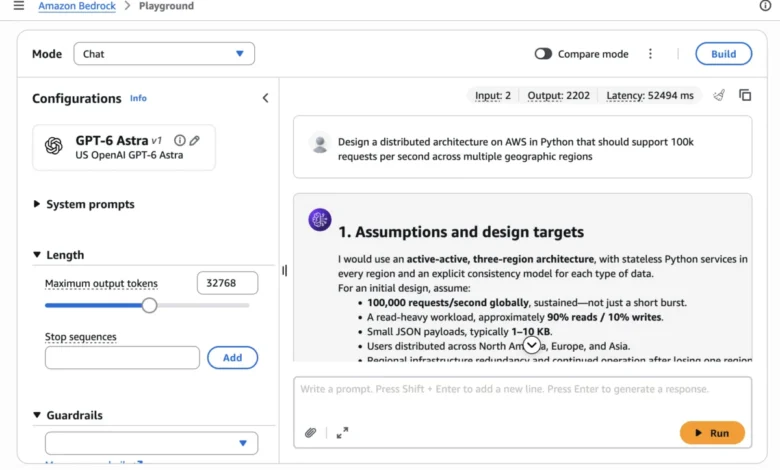
The crisp autumn air of mid-September in New York City has historically signaled a renewed period of activity across the technology sector, and Amazon Web Services (AWS) is proving no exception to this seasonal tradition. As corporate development cycles shift into high gear following the summer lull, the cloud computing giant has announced a significant expansion of its flagship artificial intelligence portfolio. The centerpiece of this week’s announcements is the general availability of OpenAI’s most advanced foundation model to date, GPT-6 Astra, directly within the Amazon Bedrock managed service ecosystem.
This strategic integration bridges two of the most influential entities in the modern artificial intelligence landscape. By bringing GPT-6 Astra to Amazon Bedrock, AWS is providing enterprise clients with immediate, secure access to a frontier model capable of handling unprecedented computational and cognitive workloads. The release arrives alongside a wave of auxiliary developer tools, desktop applications, and architectural frameworks designed to redefine how organizations deploy automated agents at scale.
Main Facts of the Integration and Capabilities
At its core, the arrival of GPT-6 Astra on Amazon Bedrock introduces a paradigm shift in what businesses can achieve with generative artificial intelligence. Unlike previous iterations of large language models that primarily functioned as sophisticated text predictors, GPT-6 Astra has been engineered from the ground up to exhibit advanced reasoning, contextual judgment, and native execution of computer and browser-based tasks.
One of the most notable technical specifications of the new model is its massive context window, which supports up to 1 million input tokens. This expansive capacity allows developers and enterprise users to upload entire software codebases, multi-thousand-page legal contracts, or extensive corporate document repositories into a single session. The model can subsequently analyze, cross-reference, and reconcile competing inputs across these vast datasets with minimal latency.
Furthermore, GPT-6 Astra delivers professional-grade writing and visual design capabilities, making it suitable for complex marketing, engineering, and administrative workflows. Enterprise organizations can invoke the model through standard, supported Amazon Bedrock APIs or configure existing enterprise workspaces, such as ChatGPT Work and Codex, to route queries through the secure AWS infrastructure.
To facilitate seamless adoption across standard business operations, OpenAI has simultaneously introduced a suite of new enterprise plugins for ChatGPT Work. These plugins effectively extend Astra’s advanced browser-use capabilities across ubiquitous corporate software applications, allowing autonomous agents to interact directly with web-based enterprise resource planning (ERP) systems, customer relationship management (CRM) platforms, and collaborative document suites.
Chronology and Background Context

The integration of cutting-edge frontier models into managed cloud services represents the culmination of years of rapid iteration within the artificial intelligence sector. To understand the significance of the GPT-6 Astra release on Amazon Bedrock, it is necessary to examine the trajectory of generative AI deployment over the preceding half-decade.
In the early phases of the generative AI boom, organizations seeking to leverage powerful models faced severe infrastructure bottlenecks. Deploying large language models required substantial capital expenditure on specialized hardware, complex MLOps pipelines, and intricate security frameworks to prevent data leakage. The introduction of managed services like Amazon Bedrock in 2023 sought to democratize this access by offering a serverless architecture where multiple foundation models from leading providers could be accessed through a unified, standardized API.
Throughout 2024 and 2025, the market saw a steady escalation in model capabilities, moving from basic text generation to multimodal processing, and eventually to autonomous agentic workflows. As models grew more powerful, enterprise customers voiced increasing concerns regarding data privacy, compliance, and governance. AWS responded by fortifying Amazon Bedrock with enterprise-grade security controls, ensuring that customer inference data is strictly isolated and never utilized for underlying model training.
The development of GPT-6 Astra marks the next logical step in this chronological evolution. By combining OpenAI’s most sophisticated reasoning engine with the robust compliance framework of AWS, the partnership addresses the dual enterprise demands for maximum computational intelligence and ironclad data security.
Supporting Data and Security Architecture
In the modern enterprise environment, the adoption of generative artificial intelligence is inextricably linked to data governance. The deployment of GPT-6 Astra on Amazon Bedrock leverages the comprehensive security architecture that AWS has refined over decades of enterprise cloud service provision.
When deploying GPT-6 Astra, organizations retain absolute sovereignty over their data. AWS has reiterated that all inference data processed through Amazon Bedrock remains strictly confidential to the customer. Under no circumstances is customer data utilized to train or fine-tune OpenAI’s foundation models, a critical guarantee for financial institutions, healthcare providers, and government agencies bound by stringent regulatory frameworks such as HIPAA, GDPR, and SOC 2.
Additionally, administrators can utilize established AWS Identity and Access Management (IAM) policies, AWS CloudTrail auditing, and Virtual Private Cloud (VPC) configurations to govern precisely who within an organization can invoke the model. This granular level of control mitigates the risk of unauthorized data exposure and ensures that corporate compliance officers maintain complete visibility over AI-driven workflows.
Official Responses and Industry Implications

While explicit, direct quotations from corporate executives regarding this specific mid-September release remain part of the broader promotional discourse, industry analysts and technology leaders have widely interpreted the move as a defining moment for enterprise software architecture.
Independent technology strategists note that the integration of a 1-million-token context window within a managed cloud environment effectively removes the memory limitations that have historically hindered automated code refactoring and deep document analysis. By allowing an AI model to ingest an entire software repository or corporate archive at once, organizations can bypass the fragmented Retrieval-Augmented Generation (RAG) architectures that often introduced latency and hallucination risks in earlier deployments.
Furthermore, the emphasis on "working differently"—a theme heavily emphasized by platform architects during the launch week—underscores a broader cultural shift in software development. Industry observers point out that the greatest productivity gains are no longer being realized simply by writing code faster, but by deploying autonomous AI agents capable of orchestrating complex, multi-step business processes across disparate software tools without human intervention at every intermediate step.
Broader Impact on the Enterprise Software Ecosystem
The general availability of GPT-6 Astra on Amazon Bedrock is expected to exert a profound ripple effect across the entire enterprise software ecosystem. As businesses increasingly migrate their mission-critical workloads to cloud-native AI platforms, software vendors will be compelled to ensure their applications are compatible with advanced agentic workflows.
The ability of GPT-6 Astra to utilize web browsers and interact directly with business applications signals a transition away from traditional graphical user interfaces (GUIs) designed exclusively for human operators. In the near future, software interactions may increasingly be mediated by intelligent agents acting on behalf of human users, executing complex chains of commands across multiple enterprise systems in seconds rather than hours.
For developers and IT leaders, this development necessitates a strategic re-evaluation of their cloud architecture. Organizations must now consider how to safely integrate autonomous agents into their existing operational pipelines while maintaining rigorous oversight and security protocols.
As the AWS launch calendar continues to unfold through the autumn season, the broader technology community will be closely monitoring how enterprises adopt these advanced capabilities. The successful deployment of GPT-6 Astra on Amazon Bedrock serves as a clear indicator that the era of theoretical artificial intelligence experimentation has officially given way to practical, large-scale industrial implementation.