The Evolution of Localized AI Infrastructure
The shift toward local AI agents is part of a broader industry trend emphasizing "edge computing" and decentralized machine learning. For years, the development of sophisticated AI agents—systems capable of executing terminal commands, navigating the web, and manipulating local file systems—was tethered to expensive cloud endpoints. The introduction of tools like Hermes Agent and Ollama marks a maturation point in open-source development, where the barrier between desktop applications and high-level reasoning capabilities has been effectively dismantled.
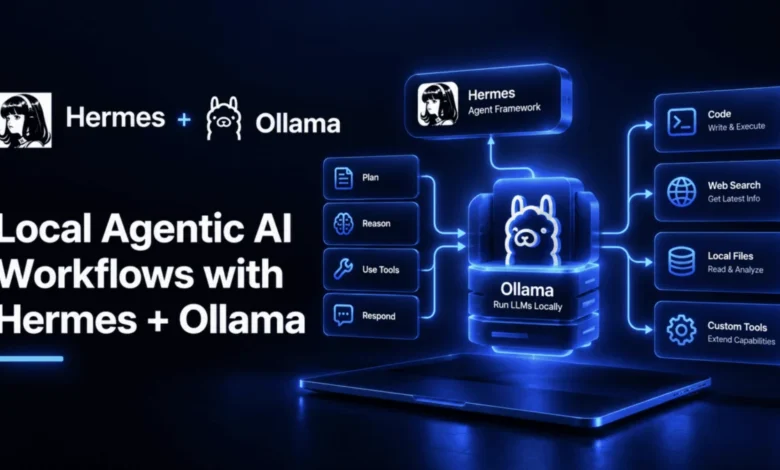
Hermes Agent, currently in version 0.21.1, represents a significant leap forward under the MIT license. Unlike standard conversational interfaces, it is designed as a functional agent capable of autonomous task execution. Its architecture includes features such as persistent memory, which allows the system to build a repository of "skills" tailored to a user’s specific workflow, and a robust messaging gateway that facilitates integration with platforms like Slack, Discord, and Telegram. Furthermore, its sandboxing capabilities—supporting Docker, SSH, and Modal—ensure that autonomous agents operate within strictly defined parameters, mitigating the risks associated with executing AI-generated commands.
The Role of Ollama in Model Serving
The efficacy of a local agent depends entirely on the model serving layer. Ollama has emerged as the industry standard for this purpose, providing an intuitive interface for downloading and managing open-weight models. Its primary advantage is its compatibility with the OpenAI /v1/chat/completions API structure. By emulating this standard, Ollama allows developers to swap out cloud-based models for local ones with minimal configuration changes.
In the ecosystem, the division of labor is precise: Ollama functions as the inference engine, processing tokens and managing hardware resource allocation, while Hermes Agent serves as the "brain," managing the logic of when to initiate tool calls, how to interpret file structures, and when to synthesize web search results. This separation allows users to optimize their hardware usage, running lightweight models for simple queries and scaling to larger, more capable models for complex architectural tasks.
Technical Requirements and Hardware Calibration
Transitioning to a local workflow requires a clear understanding of hardware constraints. The performance of an agentic workflow is dictated by the model’s parameter count and the user’s available VRAM (Video Random Access Memory) or system RAM. For users operating on modest hardware, a 3B-parameter model can function on 8GB of RAM, though these models lack the reasoning depth required for complex coding tasks. Conversely, for high-level agentic work, 31B-parameter models like Gemma 4 are recommended, requiring at least 32GB of RAM and, ideally, an NVIDIA GPU with 8GB or more of VRAM to ensure acceptable token generation speeds.
Performance benchmarks suggest that running a 9B-parameter model on a modern 8-core CPU yields approximately 10 tokens per second. While this is sufficient for asynchronous background tasks, it may result in latency during interactive sessions. The use of GPU offloading—automatically delegating layers of the neural network to the graphics card—can significantly reduce this latency, transforming the user experience from functional to seamless.
Implementation and Configuration
To establish this workflow, the first step involves the installation of the Ollama binary, followed by the acquisition of a model that supports "tool calling." This capability is the fundamental requirement for agentic behavior. Without native tool-calling support, an AI model may generate text but remain incapable of interacting with the host system’s shell or file system.
Once the model is active, configuration involves pointing the Hermes Agent to the local Ollama API. By editing the ~/.hermes/config.yaml file to define the base_url as http://localhost:11434/v1, users create a persistent bridge between the agent and the inference engine. This setup allows for granular control over the agent’s behavior, including the ability to set fallbacks. In a hybrid configuration, users can route the vast majority of their interactions through a local model while delegating exceptionally complex queries to a cloud-based provider like Anthropic’s Claude 3.5 Sonnet. This ensures that the system remains cost-effective for 90% of use cases while maintaining high-quality outputs for critical tasks.
Security and Data Sovereignty Implications
The move to local agentic workflows has profound implications for corporate and individual data security. In traditional cloud-based setups, every interaction—including the submission of intellectual property or private keys—is logged on remote servers. This creates a "data surface" that is vulnerable to breaches, regulatory non-compliance, and data-mining by the service provider.
By keeping the entire stack on local hardware, the user ensures that no telemetry or document data leaves the local machine. This is particularly vital for developers working in highly regulated industries or on proprietary codebases where exposure to third-party training sets is strictly prohibited. The integration of sandboxing features within the Hermes Agent provides an additional layer of protection, ensuring that even if an AI agent is instructed to perform a potentially dangerous operation, the scope of that operation is restricted to a containerized environment.
Future Outlook and Scalability
The current trajectory of local AI suggests a shift toward increasingly smaller, more efficient models that perform at the level of larger, monolithic counterparts. As model quantization techniques improve, it is likely that the hardware requirements for high-performance agentic workflows will decrease, allowing for powerful assistants to run on consumer-grade laptops with even greater efficiency.
The ability to interface these agents with mobile platforms—such as the Telegram gateway—indicates that the "desk-bound" nature of computing is also changing. By creating a personal, private AI infrastructure, users are effectively reclaiming their digital autonomy. This shift is not merely about cost-saving; it is about building a sustainable and secure model for the future of human-computer interaction, where the AI serves as a localized, private utility rather than a remote, subscription-based service.
As developers continue to refine the integration between inference engines like Ollama and agentic frameworks like Hermes, the distinction between a local computer and an intelligent workspace will continue to blur. The result is a robust, transparent, and private ecosystem that empowers users to harness the full potential of artificial intelligence without the baggage of cloud-based surveillance or the unpredictability of recurring operational costs. This model represents the next logical step in the democratization of machine learning technology, placing the power of advanced agents directly into the hands of the end-user.