Federated learning on the battlefield: Scaleout Systems deploys decentralized AI-driven learning to military bases and drones

As the landscape of modern warfare undergoes a rapid transformation driven by autonomous systems and artificial intelligence, a NATO-backed startup, Scaleout Systems, is pioneering a new approach to tactical edge computing. By enabling drones and field command posts to process and refine AI models locally—without the need for constant connectivity to centralized data centers—the company is providing a blueprint for the future of resilient military operations. This shift toward "federated intelligence" addresses a critical vulnerability in current defense strategies: the reliance on fragile, high-bandwidth communication links in contested electronic warfare environments.
The Origins and Strategic Pivot of Scaleout Systems
Founded in 2018 by researchers from Uppsala University in Sweden, Scaleout Systems initially established its reputation by developing machine learning frameworks for commercial sectors, specifically focusing on training models on hardware embedded within heavy logistics vehicles. The core mission was to leverage distributed data without compromising privacy or network bandwidth.
However, the 2022 full-scale Russian invasion of Ukraine fundamentally altered the company’s trajectory. Recognizing the urgent requirement for decentralized AI in high-intensity conflict zones, Scaleout pivoted its focus toward defense applications. CEO Andreas Hellander noted that the shifting geopolitical reality necessitated a departure from traditional "cloud-first" AI models—which rely on massive, centralized computing clusters—in favor of leaner, highly portable algorithms capable of operating at the extreme edge of the battlefield.
The core challenge, according to Hellander, is that high-end AI models developed by firms like OpenAI or Anthropic are largely unsuitable for the tactical environment. These models are designed for data-rich, high-power environments. Conversely, military hardware—ranging from small tactical drones to ruggedized tablets used by infantry—has limited processing power and memory. Furthermore, these devices often operate in "denied" or degraded electromagnetic environments where satellite or cellular connectivity is unreliable or nonexistent.
The Federated Intelligence Paradigm
Scaleout’s solution lies in the principles of federated learning. In a traditional centralized AI model, all sensor data from drones would need to be transmitted to a backend server for training and refinement. In a battlefield scenario, this is a fatal flaw; it exposes units to electronic direction-finding and requires a constant, high-bandwidth data pipe that can be easily jammed.
Under the Scaleout framework, individual devices—such as a swarm of drones or a local command post—perform "inference" locally. They use pre-loaded, optimized models to identify targets, navigate terrain, or conduct surveillance. When the device captures new, unique data—such as an encounter with an unfamiliar enemy camouflage pattern or a new type of armored vehicle—the system performs a selective update. Only the "lessons learned" or model weight adjustments are shared with a local computing node, such as a field command center, rather than the raw, high-resolution video feed.
This local command node aggregates updates from multiple assets, retrains the model on the fresh data, and redistributes the improved AI capability back to the frontline units. This creates a self-improving loop that operates entirely within a localized network, independent of global cloud servers.
Chronology of Development and NATO Integration
The maturation of this technology has been accelerated by international collaboration and rigorous testing:
- 2018: Scaleout Systems is established in Uppsala, Sweden, focusing on federated learning for commercial logistics.
- 2022: Following the onset of the war in Ukraine, the company shifts its R&D focus to defense, emphasizing edge-computing for surveillance and target acquisition.
- January 2026: The company participates in the Winter Demo 2026 event in Sweden, showcasing the ALMA (Affordable Loitering Modular Ammunition) project alongside BAE Systems Bofors.
- June 2026: A successful field test is conducted at a Swedish Air Force base in Uppsala. The exercise demonstrates that a forward-deployed node can continue to function and learn even after losing its connection to a central server, synchronizing updates once the connection is restored.
- 2025–2026: Scaleout is selected for the NATO Defence Innovator Accelerator for the North Atlantic (DIANA) program. Through the Federated Aerial Intelligence for Recon project, the company works to standardize these AI capabilities for interoperability across NATO assets.
Testing the Limits: The ALMA Project
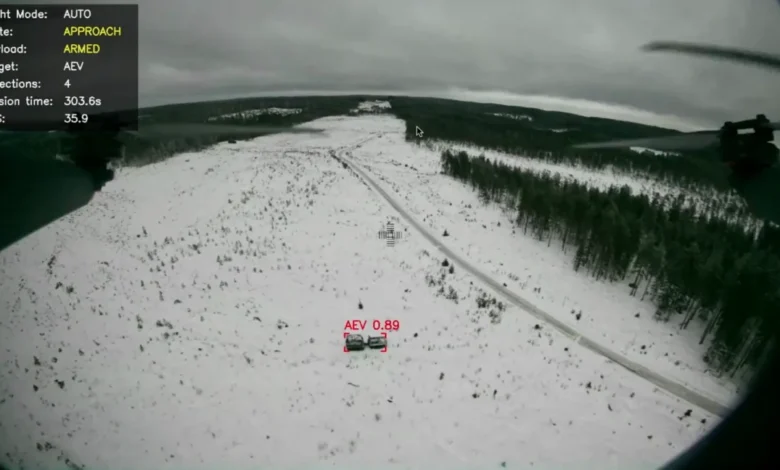
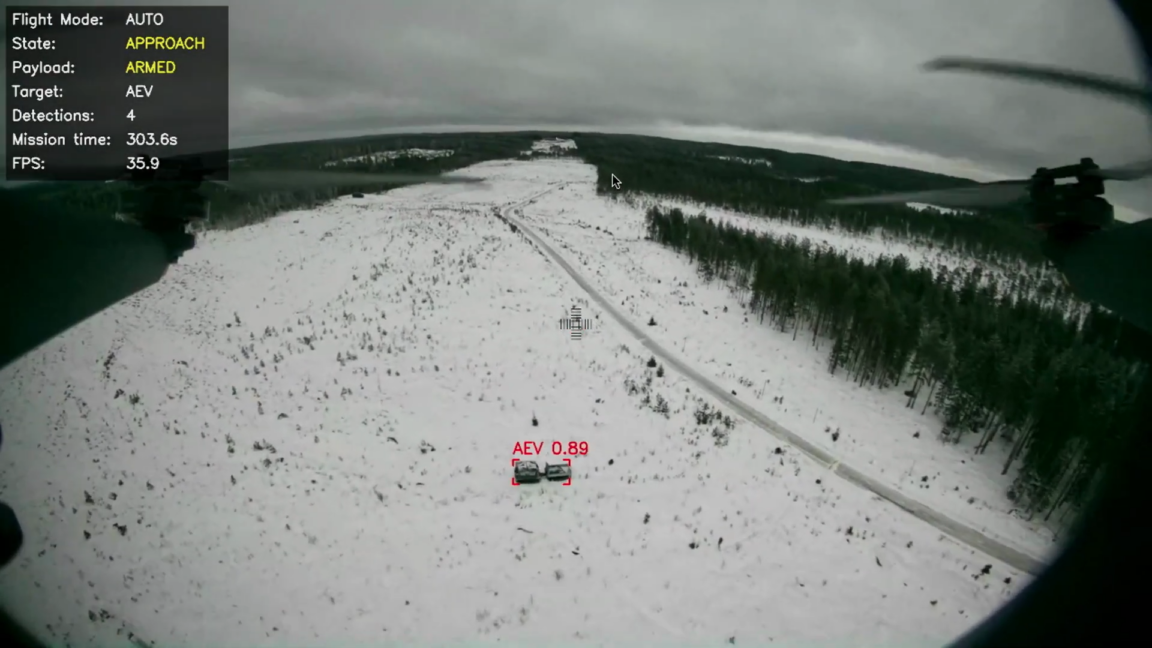
The ALMA project stands as a primary example of Scaleout’s operational success. By integrating AI into low-cost, loitering munitions, the system allows for autonomous engagement. In live-fire demonstrations, the drone was tasked with identifying, geolocating, and neutralizing specific threats, such as armored engineering vehicles, without continuous human input.
The onboard computing handles the entire decision-making chain: object detection, prioritization, and terminal guidance. While a human operator retains the ability to intervene or abort, the system is designed to operate autonomously during the terminal phase, ensuring that the drone remains effective even if the signal between the pilot and the drone is severed by enemy jamming.
Implications for Electronic Warfare and Infrastructure Security

The tactical necessity of this technology has been underscored by recent global events. The 2026 conflict between the United States and Iran saw the destruction of major data centers, which led to significant data loss and service outages for military and civilian networks alike. This incident served as a wake-up call for defense ministries worldwide: relying on centralized, "always-on" cloud architecture is a strategic liability.
In contrast, the Scaleout approach provides "resilient edge AI." If a command node is destroyed or a drone is isolated, the local AI intelligence does not vanish; it remains embedded in the hardware. Furthermore, this method addresses the problem of environmental bias. A model trained in a desert environment will naturally fail in a snow-covered forest. By using federated learning, the system can adapt to new environments in real-time, effectively retraining itself as it traverses different terrains throughout an operation.
Broader Strategic Analysis
The move toward distributed, autonomous AI carries profound implications for the nature of future military engagements.
- Standardization and Interoperability: As part of the NATO DIANA program, Scaleout is not just building a product; it is helping to define a standard for how NATO nations will exchange tactical AI updates. This could eventually allow for a "federated alliance" where a drone operated by one nation contributes to the AI model used by another, creating a collective intelligence that is significantly more robust than the sum of its parts.
- The Cost-Benefit Ratio: The focus on "affordable" munitions like those in the ALMA project signals a shift away from high-cost, multi-million-dollar systems toward "attritable" drones. If the AI is sophisticated enough to operate on cheap, mass-produced hardware, the economic balance of power shifts in favor of the side that can field the largest, smartest swarm.
- Human-in-the-Loop Constraints: While the technology allows for high degrees of autonomy, it raises ongoing legal and ethical questions regarding the delegation of lethal force to algorithms. NATO’s involvement suggests that these systems are being developed with strict oversight frameworks, prioritizing human-defined parameters for high-value targets while minimizing collateral risks.
Conclusion
Scaleout Systems’ integration into the defense sector represents a broader trend in military technology: the transition from centralized, high-power AI to localized, decentralized, and resilient edge intelligence. By enabling drones to "learn" in real-time and operate in environments where communication is compromised, Scaleout is providing a critical edge for modern forces. As these technologies move from experimental projects like ALMA to widespread adoption within the NATO alliance, the battlefield of the future will be defined not by the size of a central computer, but by the intelligence distributed across the network.
The successful demonstration of these capabilities at Swedish military installations confirms that the era of decentralized, federated AI in combat is no longer a theoretical concept. It is an operational reality that will likely dictate the outcome of future conflicts, where the most agile and locally adaptive machine learning models will provide the decisive strategic advantage.