The Evolution of Semantic Representation
The history of text representation in machine learning has evolved from simple frequency-based methods to sophisticated neural architectures. Early techniques, such as "bag-of-words" and TF-IDF (Term Frequency-Inverse Document Frequency), relied on statistical occurrences of words, failing to capture the nuance of synonyms or context. The paradigm shifted significantly with the introduction of Word2Vec and GloVe, which mapped words into continuous vector spaces. Today, the industry has transitioned to transformer-based models that generate context-aware embeddings, accounting for the surrounding environment of a term to create dense, high-dimensional vectors.
These modern models are the backbone of the generative AI revolution. By mapping human language into a vector space, they allow systems to measure the "distance" between ideas using metrics like cosine similarity. This capability is what allows a RAG-enabled chatbot to retrieve relevant documents from a vast knowledge base, effectively bridging the gap between raw data and actionable intelligence.
Understanding Model Architecture and Selection
Selecting the appropriate embedding model is a multi-dimensional engineering challenge. Practitioners must weigh performance against infrastructure requirements. While the sheer variety of available models—ranging from open-weight solutions like BGE and E5 to proprietary APIs from providers like OpenAI and Cohere—can be overwhelming, the decision-making process typically hinges on four core differentiators:
- Dimensionality: The size of the output vector. Higher dimensions theoretically hold more information but impose a linear increase in storage costs and computational latency.
- Context Window: The maximum number of tokens a model can process at once. For long-form document retrieval, a model with a larger context window is mandatory.
- Training Objective: Models are optimized for different tasks. Some are trained for general semantic similarity, while others are "retrieval-specialists," fine-tuned specifically to rank documents based on query relevance.
- Hardware Efficiency: The model’s footprint, which dictates whether it can run locally on CPUs or requires dedicated GPU resources.
The Economic Reality: Memory and Quantization
The scalability of embedding-based systems is often hindered by memory overhead. Consider the practical scenario of an enterprise-level search index containing one million documents. If each document is represented by a 1536-dimensional vector using 32-bit floating-point precision, the raw data alone would consume approximately 6 gigabytes of RAM. When accounting for index overhead, metadata, and concurrent query processing, the infrastructure costs can escalate rapidly.
To mitigate this, the field has widely adopted quantization. By reducing the precision of the numerical representations, developers can significantly shrink the memory footprint without a catastrophic loss in retrieval accuracy.
- Scalar Quantization: This process compresses 32-bit floats into 8-bit integers, reducing memory usage by 75 percent.
- Binary Quantization: A more aggressive approach that converts floats into single bits. While this offers a 32x reduction in size, it requires the model to be specifically trained to handle binary output to maintain search effectiveness.
Empirical Benchmarking: A Practical Framework
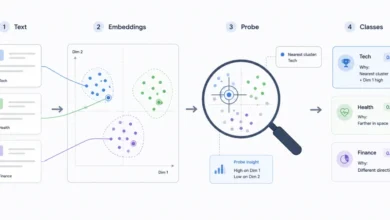
To determine which model is truly suited for a specific dataset, practitioners must move beyond generic leaderboards and conduct internal benchmarking. A common, efficient method involves using the Silhouette Score, a metric that measures how well an object fits into its own cluster compared to others.
Using the scikit-learn and sentence-transformers libraries, engineers can perform a comparative analysis on their own data. For instance, testing a generalist model like all-MiniLM-L6-v2 against a retrieval-specialist like BAAI/bge-small-en-v1.5 on a corpus of technical and recreational newsgroup posts reveals stark performance differences. In recent tests, the BGE model consistently outperformed the MiniLM model by a significant margin in cluster separation. This disparity highlights a crucial truth: models trained as "retrieval specialists" are often less distracted by common, boilerplate language, making them more effective at distinguishing between nuanced, domain-specific categories.
Industry Implications and Future Outlook
The rise of local, open-weight models is fundamentally altering the cost-benefit analysis of AI deployment. Previously, companies were forced to rely on expensive, opaque cloud-based embedding APIs. Today, the ability to run high-performing models on local hardware—or within a private cloud—offers superior data privacy and predictable, lower operational costs.
However, the rapid pace of development presents its own risks. As models become more specialized, the "model rot" phenomenon—where a model optimized for one type of data performs poorly on another—becomes a concern. Furthermore, the reliance on proprietary benchmarks can often mislead developers into choosing models that perform well on public datasets but fail on messy, real-world enterprise data.
Strategic Recommendations for Implementation
For organizations looking to integrate embedding models, the following strategy is recommended:
- Start Small: Begin by benchmarking a small subset of your data (e.g., 500 to 1,000 documents) using established open-source models.
- Prioritize Domain Alignment: If your data is highly technical (e.g., medical or legal), prioritize models trained on domain-specific corpora over general-purpose models.
- Factor in Quantization from Day One: Do not wait for the system to reach production scale to consider memory costs. Build the quantization pipeline into the architecture from the beginning to ensure long-term sustainability.
- Monitor Search Quality: Use metrics like Reciprocal Rank or Hit Rate to evaluate how well the embeddings serve the end-user, rather than relying solely on abstract statistical scores like Silhouette or Cosine Similarity.
As AI infrastructure matures, the embedding model will continue to be the unsung hero of the technology stack. While Large Language Models (LLMs) grab the headlines, the effectiveness of these systems remains strictly bounded by the quality and efficiency of the underlying vector representations. By mastering the nuances of selection, quantization, and benchmarking, engineers can ensure that their AI systems are not only accurate but also scalable, cost-effective, and deeply aligned with the unique characteristics of their data. In this landscape, the winner is not necessarily the model with the highest theoretical capability, but the one that best understands the specific context of the user’s world.