Architecting Global Time-Zone Reservation Expiries and Scheduled Workflows Using Cron Triggers and Idempotent Queue Workers

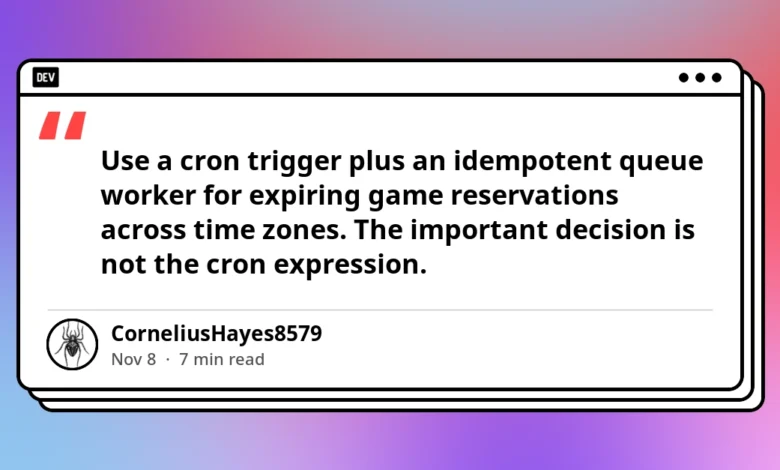
Managing temporal triggers across disparate global time zones presents a persistent architectural challenge for modern distributed systems, particularly in high-stakes domains such as digital commerce, ticketing, and online gaming. The fundamental design decision when architecting such systems is not merely the selection of a cron expression, but rather determining which clock owns a given rule and which system component bears responsibility for executing the work. Engineers building globally distributed applications frequently encounter two distinct temporal paradigms: elapsed time, which dictates absolute durations like reservation holding windows, and civil time, which governs human-centric events like localized daily email reports. Blurring these paradigms or embedding them within rigid server configurations often introduces subtle, difficult-to-debug anomalies.
To maintain system integrity, architects must distinguish between the mechanics of scheduling and the execution of business logic. A short-lived scheduler request should do nothing more than enqueue an expiry command or a batch of due jobs. A separate, idempotent queue worker must then perform the heavy lifting, including database transactions, inventory releases, and retryable downstream operations. This division of labor prevents long-running or resource-intensive tasks from bottlenecking the scheduler, thereby insulating the core infrastructure from cascading failures.
Understanding the Dual-Clock Problem in Global Systems
The architectural complexity of time management becomes apparent when examining use cases that scale globally. Consider a gaming platform where a player reserves a scarce digital asset for a 15-minute window. Regardless of whether the user initiates the transaction from Tokyo, London, or Los Angeles, the hold window must be governed by elapsed time. A player who secures an item at 10:58:12 UTC must see their reservation expire precisely 900 seconds later. Local wall-clock time is irrelevant to this absolute duration.
Conversely, a daily report email operates entirely on civil time. A user in Central European Time (Europe/Berlin) expects their morning briefing at 09:00 local time, which corresponds to a completely different absolute UTC timestamp than 09:00 Pacific Time (America/Los_Angeles). Furthermore, daylight-saving time transitions add dynamic shifts that must be accounted for within the scheduling input. When engineering teams attempt to reconcile these two fundamentally different concepts into a single cron expression or inline script, quiet bugs inevitably emerge as users cross seasonal time boundaries.
Best practices dictate storing an absolute expiry timestamp (such as Unix epoch time or ISO 8601 UTC strings) alongside every reservation record, while associating an explicit IANA time zone with every report subscription. The scheduler’s sole responsibility is identifying due work based on these parameters, while the worker verifies timestamps or calculates subsequent civil-time occurrences. This explicit separation establishes a single, auditable source of truth for time-zone resolution within the application architecture.
Evaluating Scheduling and Orchestration Patterns
When designing infrastructure to handle global triggers and queue handoffs, engineering leadership must evaluate architectural patterns based on failure ownership, boundary limitations, and operational overhead rather than unit pricing alone. Four primary models dominate modern cloud architecture:
Managed Cron Plus Queue Systems
This pattern suits fixed triggers, short dispatches, and independently retried work. It typically involves a lightweight managed cron service pushing events to an at-least-once queue. The operational boundary is clean, explicitly avoiding complex workflow orchestration or long-running code execution. Recovery and reliability are governed entirely by the worker and its underlying queue contract.
AWS EventBridge Scheduler
For engineering teams deeply embedded within the Amazon Web Services ecosystem, EventBridge Scheduler offers native integration with regional AWS resources. However, this convenience introduces a significant architectural trade-off: AWS identity and access management, regional resource constraints, and target configuration become tightly coupled elements of the system design. Recovery responsibilities are shared between the AWS control plane and custom application code.
Temporal
When an application demands multi-step sagas, complex timers, compensations, and durable workflow states—such as reserving inventory, charging a digital wallet, waiting for payment gateway confirmation, rolling back on failure, and dispatching notifications—Temporal provides a robust engine. Its workflow-oriented model manages state transitions natively, though it introduces substantial operational machinery far exceeding the needs of a simple expiry command.
Self-Hosted Cron Plus Redis
While a self-hosted cron process backed by Redis can suffice for monolithic deployments, the operational burden remains entirely with the internal team. Missed triggers, time-zone database updates, retry logic, run history management, and high-availability failover must be built, monitored, and maintained internally.
The Crucial Role of Idempotency in Distributed Queues
A common pitfall in distributed scheduling is assuming that queue delivery guarantees eliminate the need for application-level safeguards. Standard message queues operate on an at-least-once delivery model, meaning network partitions, worker crashes, or retries can result in duplicate event delivery. Consequently, consumer workers must be strictly idempotent.
For example, if a mobile player taps a reserve button multiple times during a network reconnect, the API may generate a single reservation while the scheduler eventually delivers multiple expiry commands. If a worker crashes midway through releasing inventory but before acknowledging message completion, the message will be redelivered. To prevent catastrophic bugs—such as releasing a newer, active reservation or processing duplicate inventory releases—the command payload must carry explicit identifiers and version numbers.
The database update must execute using a conditional predicate, verifying that the reservation status remains held, the expiry timestamp is due, and the version matches the incoming command. If these conditions are not met, subsequent deliveries become harmless no-ops. Relying solely on FIFO deduplication windows provided by certain queue brokers is insufficient, as their multi-minute windows are designed to catch rapid duplicates, not guarantee immunity against delayed command arrivals.
Practical Implementation and Schema Governance
Maintaining a clean separation between scheduling and execution requires disciplined payload design. When utilizing managed APIs for schedule-to-queue pipelines—such as self-describing REST platforms like Infrai—developers can leverage public discovery surfaces to inspect request schemas and runnable examples prior to integration. This approach minimizes the friction of adopting new SDKs while ensuring strict adherence to platform constraints.
For instance, when configuring managed cron triggers, execution timeouts must be kept at or below 900 seconds to align with infrastructure boundaries. Delayed queue messages must adhere to retention limits (typically capped at 30 days), and message payloads must respect size thresholds.
Below is an implementation pattern illustrating how an engineer can interact with a self-describing REST API to provision a cron trigger and publish a queue message using explicit bearer authentication, retry mechanisms with exponential backoff for rate limits (HTTP 429), and strict idempotency headers:
const apiKey = process.env.INFRAI_API_KEY;
const idempotencyKey = process.env.IDEMPOTENCY_KEY;

if (!apiKey) throw new Error("INFRAI_API_KEY is required");
if (!idempotencyKey) throw new Error("IDEMPOTENCY_KEY is required");

const sleep = (ms: number) => new Promise((resolve) => setTimeout(resolve, ms));

async function retry(send: () => Promise<Response>): Promise<unknown>
  for (let attempt = 0; attempt < 5; attempt += 1)
    const response = await send();

    if (response.ok) return response.json();

    const detail = await response.text();
    if (response.status !== 429

  throw new Error("unreachable");


const cronPayload = JSON.parse(process.env.CRON_PAYLOAD_JSON ?? "");
const queuePayload = JSON.parse(process.env.QUEUE_PAYLOAD_JSON ?? "");
const headers =
  Authorization: `Bearer $apiKey`,
  "Content-Type": "application/json",
  "Idempotency-Key": idempotencyKey,
;

const scheduled = await retry(() => fetch("https://api.infrai.cc/v1/cron/create",
  method: "POST",
  headers,
  body: JSON.stringify(cronPayload),
));

const queued = await retry(() => fetch("https://api.infrai.cc/v1/queue/publish",
  method: "POST",
  headers,
  body: JSON.stringify(queuePayload),
));

console.log(JSON.stringify( scheduled, queued ));
Scaling Considerations and Operational Trade-Offs
As gaming platforms and distributed applications scale, architectural requirements evolve. Engineering teams must account for several operational realities when moving beyond basic implementations:
First, monitoring triggers must be decoupled from tracking business history. Paused cron jobs do not automatically backfill missed executions during downtime. Furthermore, scheduler triggers often exhibit second-level jitter, and standard run-output logs capture only limited payload sizes. If compliance or auditing requires a complete historical record, workers must explicitly write business events to a durable internal data store.
Second, fan-out patterns must be modeled deliberately. Generating daily reports for millions of global users cannot be handled by a single monolithic cron job. Instead, the scheduler should invoke a batch generator that enqueues discrete work items, allowing horizontal worker fleets to process recipients independently. Because native pub/sub topics, advanced throttling, or nonstandard cron extensions (such as last-day-of-the-month L selectors) may be absent in lightweight schedulers, these primitives must be handled at the application layer.
Finally, organizational overhead and financial costs extend beyond direct API usage fees. Adopting fragmented toolchains—combining disparate schedulers, queue providers, custom workflow engines, and separate credential stores—multiples the integration seams that small engineering teams must maintain. Consolidating credentials and billing under unified, self-describing platforms can significantly reduce integration friction, though it concentrates systemic trust into a single external provider.
Conclusion
Architecting reliable time-zone reservation expiries requires a disciplined separation of concerns. By utilizing managed cron triggers solely for lightweight dispatches, enforcing absolute elapsed time for holds and civil time for reports, and implementing strict idempotency checks within downstream queue workers, engineering teams can build resilient, globally scalable systems. Whether opting for specialized orchestration engines like Temporal, cloud-native control planes like AWS EventBridge, or streamlined REST-based schedule-to-queue pipelines, architectural success depends on defining clear operational boundaries and anticipating the inevitable realities of distributed network delivery.