GitHub Unveils Revolutionary Git Storage Architecture to Support Thousands of Concurrent AI Coding Agents

The landscape of software development is undergoing a seismic shift, driven largely by the exponential rise of autonomous AI coding agents. To accommodate this new paradigm, code hosting giant GitHub has officially unveiled its next-generation Git storage architecture—codenamed "Project Rubicon"—designed to handle thousands of concurrent writes per second while scaling read operations effortlessly on demand. Announced at the recent GitHub Universe conference, the new infrastructure marks a monumental departure from traditional Git server designs, successfully demonstrating an unprecedented capacity to support 5,000 concurrent agents working on a single repository and processing 7,200 pushes per second.
The architectural overhaul is engineered to serve hundreds of millions of developers as autonomous workflows transition from sporadic bursts to continuous, around-the-clock operations. Built underneath a running GitHub platform without service interruption, Rubicon solves long-standing bottlenecks in version control systems by fundamentally rethinking how data, compute, and reference states interact at scale.

The Agentic Revolution and the Limits of Legacy Git
For nearly two decades, Git was architected for human developers. Humans type relatively slowly, commit code in deliberate intervals, and rarely attempt to push to the exact same repository branch simultaneously. However, the introduction of automated, parallelized AI agents has entirely rewritten traffic patterns on version control platforms.
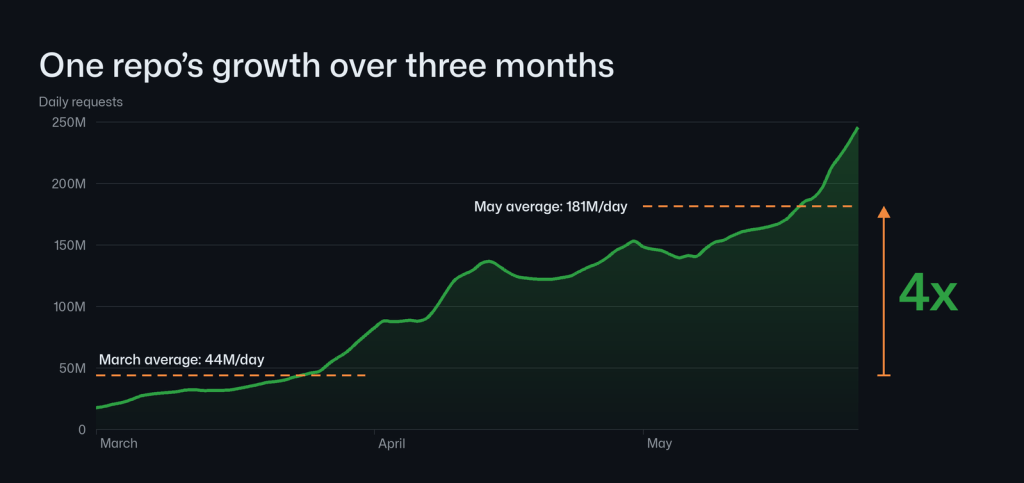
During internal stress testing over the past year, GitHub engineers observed staggering spikes in platform utilization. Data from early 2026 highlights the urgency of this transition: a single prominent repository on GitHub experienced an astonishing fourfold increase in daily requests between March and May, jumping from an average of 44 million requests per day to 181 million, with exponential growth continuing thereafter.
Each push initiated by an agent triggers a massive cascade of downstream read operations, including Continuous Integration (CI) pipeline runs, deployment system pulls, and context-gathering fetches by other companion agents. Traditional monolithic Git storage models, which tightly couple data storage, request servicing, and repository maintenance on single servers, quickly hit ceilings under this kind of high-frequency pressure. Recognizing that agentic development will only accelerate, GitHub’s engineering team set a target to scale their infrastructure by at least two orders of magnitude, ensuring that side projects and massive enterprise monorepos alike can absorb heavy agent traffic without specialized manual interventions or disruptive migrations.
The Principles of Project Rubicon: Decoupling and Minimal Coordination
Project Rubicon rests upon two core architectural principles established by GitHub over the past year: minimizing coordination and decoupling storage from compute.
The breakthrough insight behind Rubicon is simple yet profound: very little of a write operation in Git actually requires global synchronization or strict ordering. Git objects (such as blobs, trees, and commits) are strictly immutable and uniquely named by cryptographic hashes of their contents. Consequently, multiple writers can store identical or distinct objects simultaneously without needing to coordinate or negotiate. The only component of a push that strictly requires agreement and transactional safety is the reference update (e.g., pointing a branch to a new commit hash), and a reference update is exceptionally small in comparison to the underlying pack data.
Building on this, GitHub structured Rubicon around a modernized data plane while preserving familiar interfaces for developers. Clients continue to push, fetch, and branch using standard Git workflows, maintaining all existing security protections.
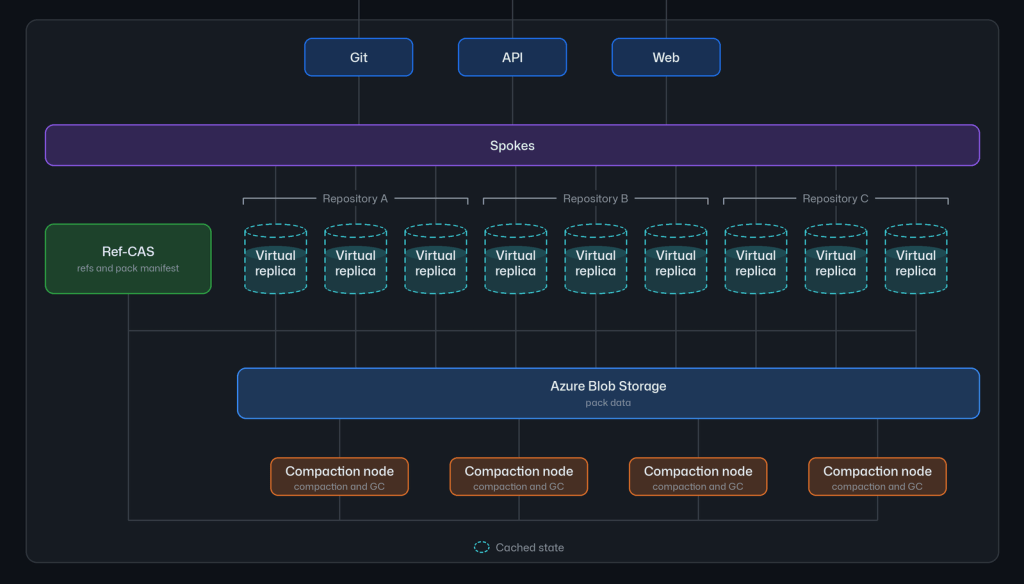
Anatomy of the New Architecture: Virtual Replicas and Ref-CAS
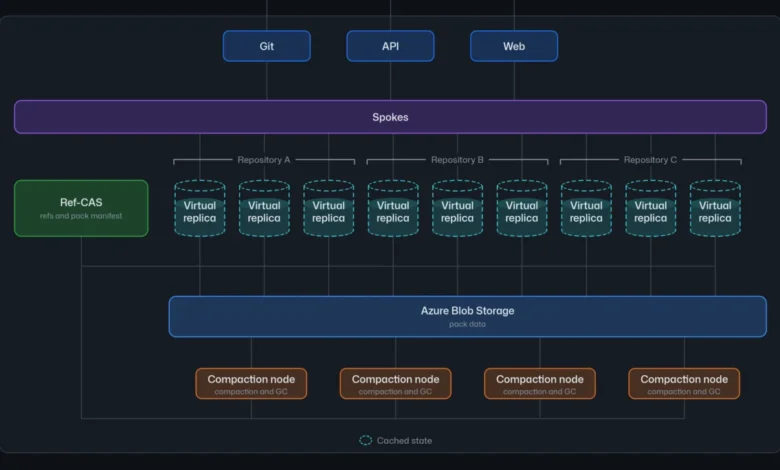
The request lifecycle under Project Rubicon begins at Spokes, GitHub’s established routing and load-balancing layer, which continues to handle tenant partitioning, isolation, and horizontal scale. However, rather than routing requests to traditional, static server instances, Spokes directs incoming traffic to a dynamic group of ephemeral compute nodes known as virtual replicas.
Virtual replicas maintain only cached state on local disks, which can be wiped and rebuilt instantly as traffic shifts. Because correctness does not rely on any single virtual replica, if one node drops offline, others seamlessly absorb the traffic while replacements rebuild their caches on the fly.
Durable state is bifurcated and distributed across specialized services:
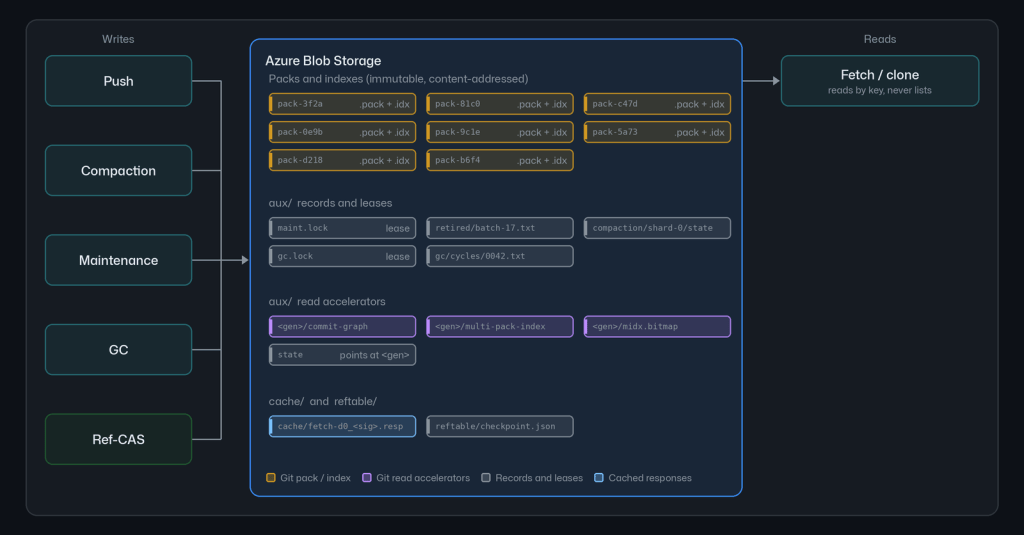
- Azure Blob Storage: Houses heavy, immutable data assets, including pack files, multi-pack indexes, reachability bitmaps, and reference checkpoints. Azure Blob Storage provides infinite scale, high durability, and exceptional aggregate throughput for static assets.
- Ref-CAS (Reference Compare-And-Swap): A dedicated, highly optimized replicated log service built to handle high-throughput reference mutations.
Unlike legacy consensus groups that bogged down by handling both object data and reference states concurrently, Ref-CAS deals exclusively with reference pointers. Using compare-and-swap quorums, Ref-CAS locks only the specific references touched by a transaction, allowing parallelized updates for independent branches. Because AI agents typically push to isolated feature branches, the vast majority of updates experience zero contention, enabling reference mutations to process at a rate of tens of thousands of operations per second.
Scaling Maintenance Through Dedicated Compaction Nodes
A secondary challenge of sustaining thousands of writes per second is preventing performance degradation caused by pack file proliferation. Every push appends a new pack to blob storage. While Git can aggregate multiple packs, an excessive count degrades lookup speeds.
In legacy architectures, compaction tasks executed locally on the same servers handling live traffic, consuming critical CPU and memory resources. Under Project Rubicon, compaction is entirely decoupled from user-facing compute. A separate, horizontal fleet of compaction nodes operates in the background directly against Azure Blob Storage and Ref-CAS.

These compaction nodes claim shards via lease mechanisms, merging fragmented packs into larger, optimized structures while validating that object sets remain mathematically identical. Garbage collection runs similarly via dedicated background workers, safely purging unreachable objects orphaned by deleted branches and force-pushes without impacting user-facing latency.
Industry Implications and Future Roadmap
The introduction of Project Rubicon represents a watershed moment for enterprise software engineering and cloud infrastructure. As organizations increasingly adopt autonomous multi-agent development frameworks—where teams of AI agents write, test, review, and iterate on code autonomously—version control systems have emerged as the primary computational bottleneck. GitHub’s preemptive architectural redesign ensures that cloud infrastructure will not impede the rapid maturation of AI-driven software engineering.
Looking ahead, GitHub plans to roll out Project Rubicon broadly following its current limited private preview phase slated for early next year. The company’s engineering leadership emphasizes that this foundational work opens the door to further optimizations, including enhanced caching mechanisms, reduced byte-transfer overhead for agent operations, and direct contributions to the open-source Git project to better natively support agentic workflows. By removing infrastructural friction, GitHub aims to ensure that the limits of software development are dictated solely by human imagination rather than the throughput constraints of version control.