Accelerating Map Data Infrastructure Through Agentic AI Orchestration at HERE Technologies

The digital transformation of the automotive industry has placed unprecedented demands on navigation data providers, as the transition from static, batch-processed maps to real-time, high-definition streaming data creates significant bottlenecks in software development. At HERE Technologies, the challenge of maintaining architectural consistency across dozens of interdependent schema definitions for NDS.Live—the next-generation streaming map standard—has necessitated a paradigm shift. By adopting an orchestrated multi-agent AI framework powered by AWS Kiro, the company has successfully transitioned from manual, labor-intensive ticket decomposition to an automated, high-precision workflow that ensures compliance with Automotive SPICE (ASPICE) standards.
The Evolution of Navigation Data Standards
The automotive industry is currently undergoing a pivotal migration from NDS Classic to NDS.Live. Historically, NDS Classic operated on a batch-delivery model, where vehicles were updated through physical storage or offline data packages. While this served the basic needs of legacy navigation, the rise of Advanced Driver Assistance Systems (ADAS) and the push toward full autonomy have rendered the batch model obsolete. NDS.Live introduces a streaming-first architecture, allowing vehicles to pull high-definition map updates in real-time through cloud-based APIs.
This transition, however, has imposed a massive burden on the Software Development Life Cycle (SDLC). Managing the lifecycle of these map updates requires the synchronization of hundreds of interdependent schema definitions. For engineers at HERE Technologies, translating high-level customer requirements into granular, architecturally consistent Jira ticket hierarchies—ranging from epics to specific technical tasks—became a major obstacle. Manual processes often led to fragmentation, where domain knowledge remained siloed among senior architects, and structural inconsistencies caused quality bottlenecks just weeks before product releases.
The Agentic Solution: Orchestration via Kiro
To mitigate these risks, HERE Technologies initiated a pilot program utilizing Kiro, a sophisticated software engineering agent platform from AWS. Unlike traditional single-agent AI assistants, which often suffer from "context window saturation"—the tendency for models to hallucinate or lose detail when overloaded with information—the team opted for an orchestrated, multi-agent approach.
This model functions as a virtualized, high-performing engineering department. The workflow sequences specialized agents, each acting as a specific persona: an Architect, a Product Owner, a Tech Lead, a Developer, a QA Engineer, and a Data Modeler. These agents operate in parallel, analyzing requirements through the lens of their specific expertise. By routing work to purpose-built agents, the system ensures that each step is performed with the exact context required, minimizing the risk of error and enhancing the overall quality of the output.
Bridging the Compliance Gap: ASPICE and Traceability
A critical driver for this digital transformation is the automotive industry’s adherence to ASPICE. This process assessment model requires rigorous, bidirectional traceability between system requirements, software requirements, and final implementation artifacts. In a traditional manual environment, demonstrating this traceability during audits is a costly and time-consuming endeavor.
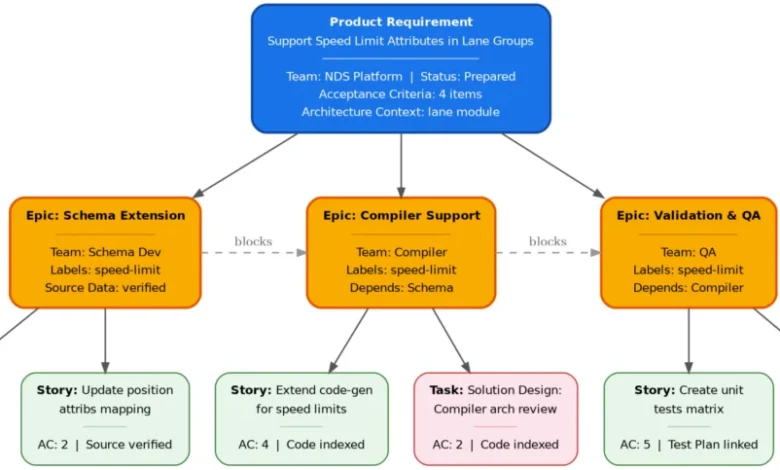
By integrating the Kiro Command Line Interface (CLI) into their CI/CD pipelines, HERE Technologies has automated the creation of these audit trails. When a product requirement arrives, a system event—triggered by a Jira webhook—initiates the agentic workflow. The agents decompose the requirement into a structured hierarchy where every task, story, and epic is inherently linked to its parent requirement. This automated linking provides a granular audit trail that satisfies ASPICE compliance requirements without requiring engineers to manually map dependencies, effectively freeing up significant time for product innovation.
Memory Systems and Code Intelligence
One of the most persistent hurdles in agentic development is the "amnesia" effect, where AI agents fail to retain context between sessions. To solve this, the HERE engineering team implemented a three-layer memory system based on cognitive science principles: semantic, episodic, and procedural memory.
The system utilizes "record-episode" hooks at the end of each session to distill interactions into structured knowledge, which is then reloaded through "recall-memory" hooks at the start of new interactions. This allows the AI to compound its expertise over time, learning project-specific nuances and user preferences.
Furthermore, the integration of Code Intelligence allows agents to move beyond static documentation. By indexing the actual source code repositories, the AI can query the existing implementation before proposing new tasks. For instance, if an agent is tasked with adding error handling to a registry service, it first scans the repository to identify the current error-handling patterns. This ensures that the generated acceptance criteria align with the existing architectural conventions, significantly reducing the number of revision cycles during code review.
Strategic Impact and Performance Data
The transition to an orchestrated AI workflow has resulted in measurable gains for HERE Technologies. Internal data indicates that tasks previously requiring days of manual decomposition are now completed in minutes. Beyond mere speed, the qualitative improvements are stark:
- Architectural Consistency: Every ticket generated inherits the parent’s context, ensuring that downstream implementation strictly adheres to the NDS.Live schema.
- Standardized Quality: By utilizing specialized agents for QA, test plans are cross-referenced with requirements from the outset, reducing late-stage bugs.
- Traceability: The automated generation of linked ticket hierarchies provides immediate compliance with ASPICE, simplifying the audit process.
- Knowledge Retention: The three-layer memory system ensures that project-specific tribal knowledge is preserved, preventing the loss of context when team compositions change.
- Efficiency Gains: The reduction in context switching and manual ticket grooming has allowed engineers to reallocate approximately 30-40% of their time toward core development tasks.
Lessons in Agentic Architecture
The deployment of this system was an iterative process that yielded several key lessons for the broader software engineering community. First, the team learned the value of "progressive disclosure" over "always-on context." By loading domain knowledge on demand rather than keeping all instructions active, the team significantly reduced token consumption and improved agent precision.
Second, the implementation of confirmation gates proved essential. While the system is highly automated, humans remain in the loop at critical decision-making points—such as final approval of the Story and Task plans. These gates prevent "hallucinated" values from propagating through the Jira hierarchy and allow for quick human intervention without halting the entire pipeline.
Finally, the team utilized "spec-driven development" to build the agents themselves. By treating the AI orchestration system as a software product, they were able to use the agents to test and refine their own logic. This recursive approach allowed the team to verify that changes to the agent architecture did not cause regressions in the ticket generation process.
Implications for the Future of Automotive Tech
The collaboration between HERE Technologies and AWS highlights a significant shift in how large-scale engineering organizations approach the complexity of modern standards. As map data grows in scale and real-time connectivity becomes the industry baseline, the reliance on manual human intervention in the SDLC is becoming unsustainable.
The success of this model suggests that the future of automotive software lies in "agentic orchestration"—a system where human expertise is augmented by specialized, persistent AI agents that understand both the documentation and the source code. For companies operating in highly regulated, high-stakes environments, the ability to automate compliance and maintain architectural purity is no longer a competitive advantage, but a prerequisite for survival.
By turning the documentation and ticket-creation process into a data-driven, automated pipeline, HERE Technologies has provided a blueprint for how complex, mission-critical systems can be developed at scale. As this technology matures, it is likely that other sectors—from aerospace to medical device manufacturing—will look to this orchestrated agentic model to solve their own challenges regarding traceability, consistency, and rapid iteration. For now, the integration of Kiro at HERE stands as a case study in how to effectively move from fragile, manual workflows to a robust, automated future.
Related posts: