Amazon ECS Gateway Launches to Simplify Container Ingress Networking and Eliminate Operational Bottlenecks at Scale

Managing containerized microservices at scale has long presented a major operational friction point for platform engineering teams operating within cloud environments. As modern enterprise architectures swell from a handful of monolithic applications to hundreds—or even thousands—of disparate container workloads, the underlying networking infrastructure required to route external traffic into these applications often transforms into a logistical labyrinth. Historically, every single time a platform or application team spun up a new service on the Amazon Elastic Container Service (Amazon ECS), they were forced to manually provision, tether, and maintain a constellation of supporting resources. This painstaking process required the continuous configuration of Application Load Balancers (ALBs), AWS Certificate Manager (ACM) SSL/TLS certificates, AWS WAF web access control lists (web ACLs), and intricate security groups.
Compounding the initial deployment burden was the ongoing lifecycle maintenance. As services scaled horizontally, underwent routine rolling updates, or were eventually decommissioned, platform teams had to ensure these ingress components remained perfectly synchronized. This persistent per-service overhead not only throttled deployment velocity—stalling the rapid delivery of features to end-users—but also dramatically increased the risk of configuration drift, security gaps, and human error across organizational cloud footprints. To permanently eradicate this recurring infrastructure bottleneck, Amazon Web Services has officially announced the launch of Amazon ECS Gateway, a transformative new account-level resource designed to fundamentally redefine and streamline ingress networking for containerized workloads.
Architecture, Core Mechanics, and the Separation of Concerns
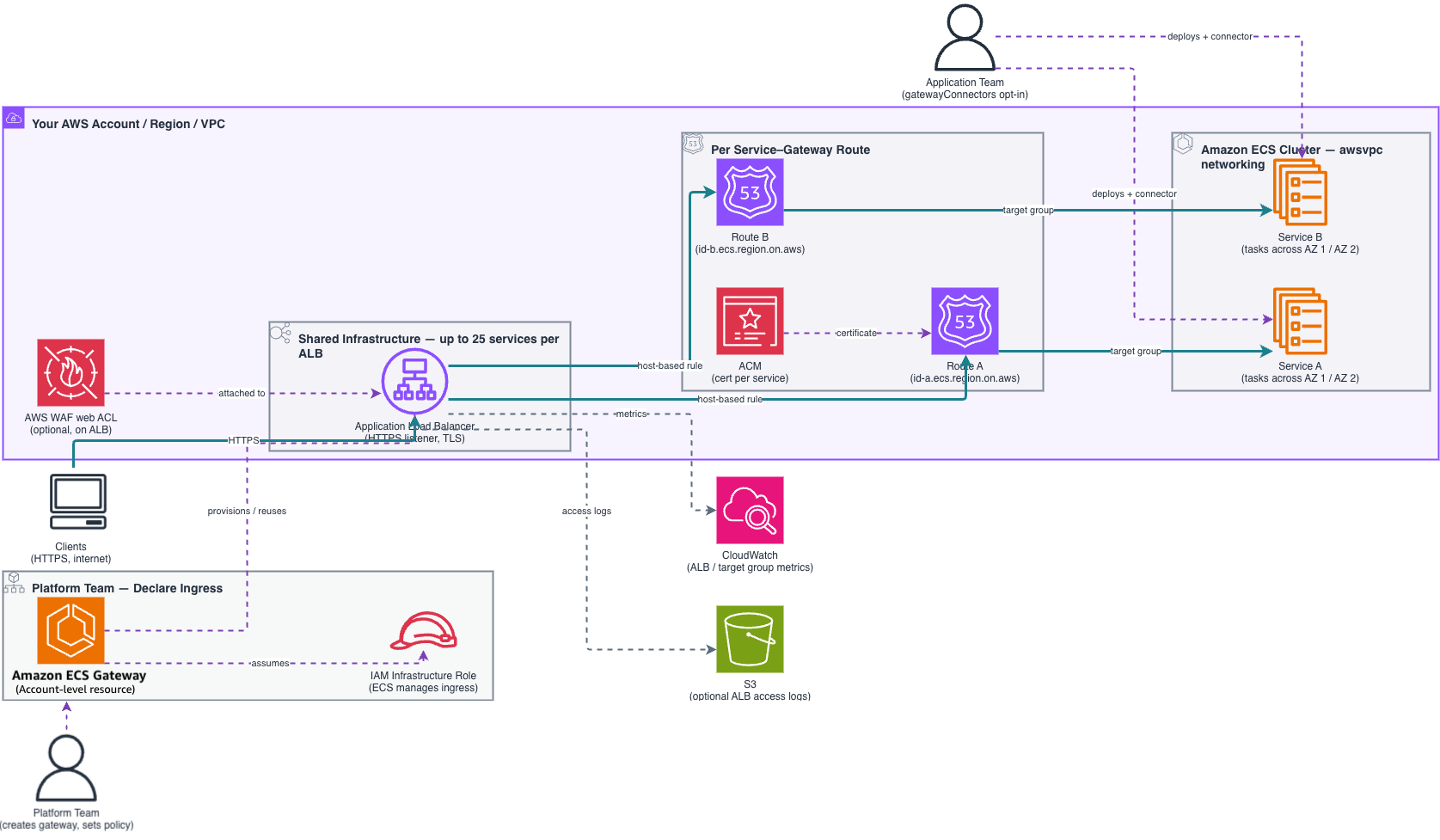
At its philosophical and structural core, Amazon ECS Gateway introduces a clean, unambiguous separation of responsibilities between centralized platform engineering teams and decentralized application developers. In a traditional workflow, application teams frequently found themselves bogged down by infrastructure intricacies, or conversely, platform teams became a bureaucratic chokepoint as they manually provisioned load balancers for every new application ticket. ECS Gateway bridges this divide by empowering platform teams to establish standardized, reusable entry points across their AWS accounts, while granting application teams the autonomy to seamlessly attach their services to these established gateways with minimal friction.

Underneath the hood, ECS Gateway leverages host-based routing via Application Load Balancers to maximize efficiency and drive down infrastructure costs. Rather than dedicating an entire, expensive Application Load Balancer to a single microservice—a practice that quickly becomes cost-prohibitive at scale—ECS Gateway allows up to 25 distinct services to safely and efficiently share a single ALB. The underlying engine automates the entire lifecycle of this supporting infrastructure. When an organization launches its very first service and connects it to a gateway, ECS automatically provisions the initial ALB. As application capacity grows and services multiply, the system intelligently provisions additional ALBs up to a predefined maximum count. Conversely, when services are scaled down or removed, the gateway prunes the underlying infrastructure, ensuring that organizations never pay for idle, unutilized networking capacity.
Furthermore, upon successful provisioning and connection, each individual service immediately receives a unique DNS hostname. This provides development teams with a fully functional, production-ready endpoint the exact moment deployment concludes, eliminating the need to wait for manual DNS record propagation or load balancer target group associations.
Setting Up and Managing ECS Gateway: A Step-by-Step Practical Look
Deploying and administering an Amazon ECS Gateway can be accomplished seamlessly via either the AWS Management Console or the AWS Command Line Interface (AWS CLI), accommodating both visual workflow preferences and Infrastructure-as-Code (IaC) automation pipelines.
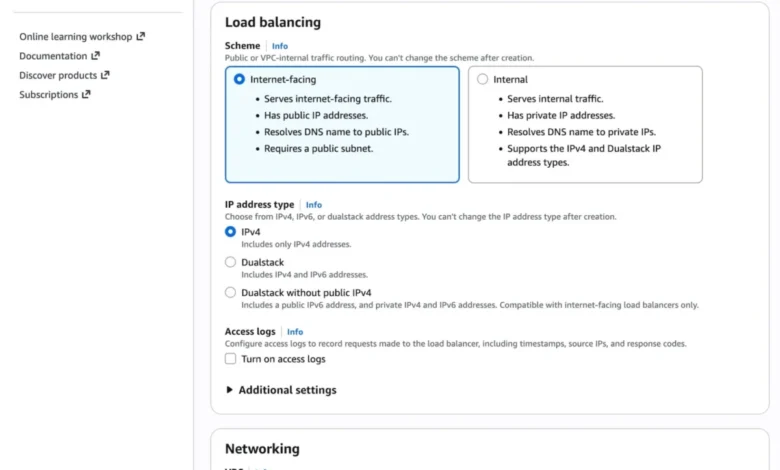
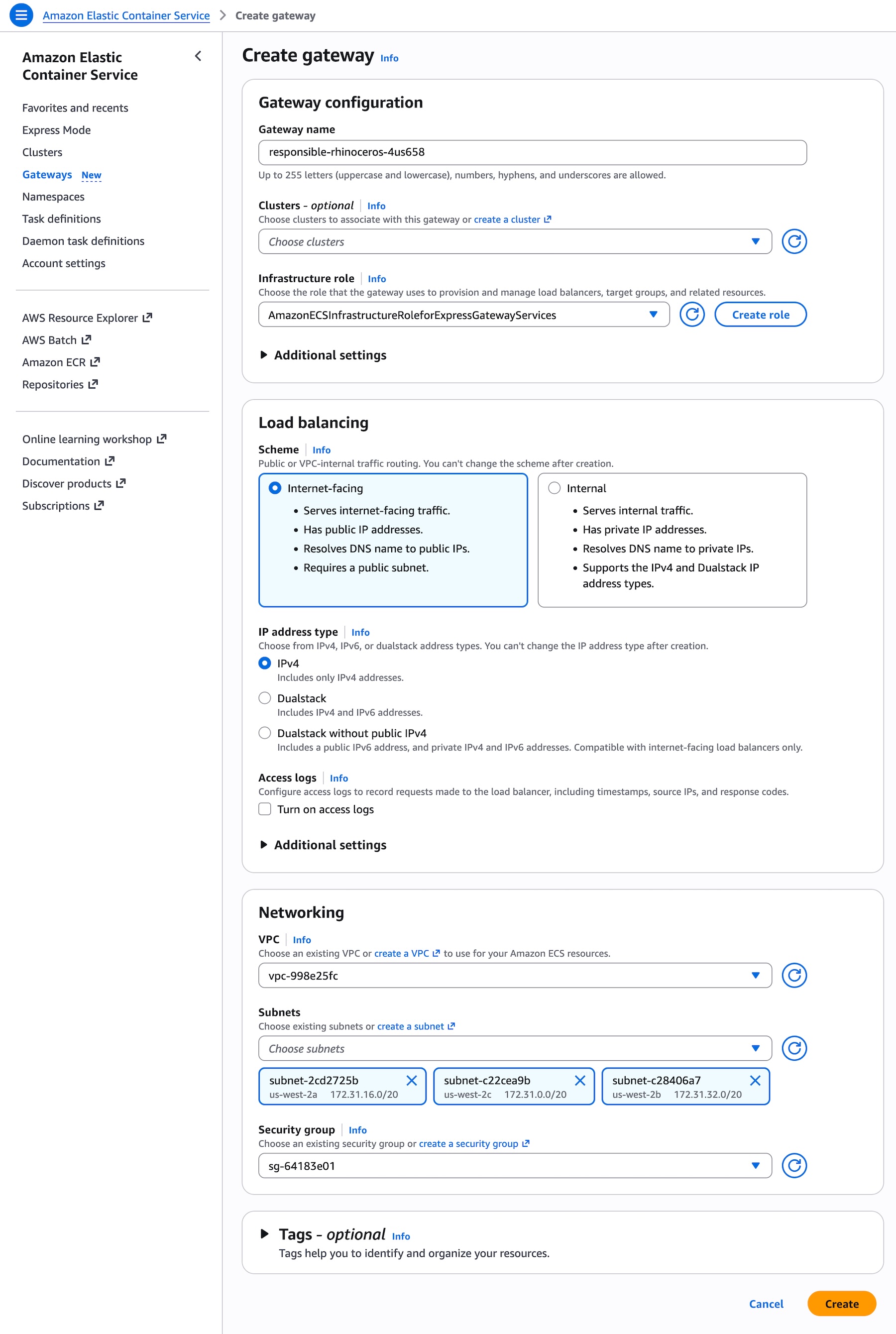
When initiating a gateway via the AWS ECS console, platform administrators begin by assigning a descriptive gateway name and selecting a designated IAM infrastructure role. This specific role grants Amazon ECS the necessary permissions to autonomously provision, configure, and manage networking primitives—such as ALBs, security groups, and ACM certificates—directly within the customer’s account. Administrators then select whether the load balancing scheme should route public, internet-facing traffic or operate securely as a VPC-internal routing mechanism.

Additional configuration parameters include setting up listeners, designated ports, the maximum ceiling of load balancers the gateway can dynamically scale to, and optional AWS WAF web ACLs to shield web applications from malicious volumetric or application-layer attacks. It is important for architects to note that certain foundational attributes—such as the gateway name, routing scheme, VPC selection, subnet allocations, IP address types, and primary listener protocols—are immutable and cannot be altered after the initial creation phase.
For organizations favoring automated deployments, the AWS CLI provides an equivalent programmatic approach via the CreateGateway API call. Administrators supply a unique name, the target infrastructure role ARN, and a detailed configuration payload specifying the target subnets and internet-facing or internal scheme:
aws ecs create-gateway
  --name my-team-gateway
  --infrastructure-role-arn arn:aws:iam::123456789012:role/ECSGatewayRole
  --configuration '
    "HostSharedAlb":
      "networkConfiguration":
        "subnets": [
          "subnet-080779f9bd887757a",
          "subnet-03d5b2fead6bc6258",
          "subnet-0861210a397d31252",
          "subnet-06539e194023cb77a"
        ],
        "ipAddressType": "ipv4"
      ,
      "scheme": "internet-facing"

  '
Once the foundational gateway resource is established, platform operators can establish a flexible many-to-many relationship by associating the gateway with one or more Amazon ECS clusters. A single gateway can span up to 10,000 distinct clusters, while an individual cluster can simultaneously interface with up to five different gateways. This robust architectural flexibility allows platform teams to segment environments cleanly—for example, deploying dedicated public-facing gateways alongside private, internal service-mesh gateways on the exact same underlying cluster infrastructure.
aws ecs associate-gateway-with-cluster
--gateway my-team-gateway
--cluster arn:aws:ecs:us-east-1:123456789012:cluster/my-cluster
To further assist modern engineering workflows, AWS has ensured that ECS Gateway can be programmatically queried, managed, and referenced using the AWS MCP Server and associated plugins within popular AI-assisted coding environments and integrated development environments (IDEs).
Adopting ECS Gateway for Existing and New Workloads
For application teams, integrating a service with an established gateway requires simply appending a gateway connector parameter to standard service definitions using the CreateService or UpdateService API operations. Organizations with mature, legacy microservices currently operating with dedicated, traditional load balancer configurations are not left behind. ECS Gateway supports an incremental adoption model. By leveraging an UpdateService call, teams can safely attach a gateway connector to an already-running service while leaving the legacy load balancer fully intact. This dual-path capability allows developers to rigorously validate the new gateway routing, inspect health checks, and verify DNS resolution in a live production environment before cleanly deprecating and removing the older load balancer infrastructure.
aws ecs create-service
  --cluster my-cluster
  --service my-api-service
  --task-definition my-api-service:1
  --gateway-connectors '[ "portName": "api", "filters": "accessTypes": ["PUBLIC"], "healthCheck": ... ]'
At the exact moment of deployment, Amazon ECS evaluates all gateways associated with the target cluster, identifying compatible gateways where access types match connector filters, network boundaries align within the same Virtual Private Cloud (VPC), and subnets fully cover the Availability Zones utilized by the service tasks.
Upon establishing a match, ECS orchestrates the provisioning of dedicated per-service resources behind the scenes: an ACM certificate for secure transport layer security, a globally unique DNS routing hostname, precise listener rules directing traffic to the correct container target groups, and targeted security groups that restrict inbound ingress exclusively to the parent ALB security group. Once these automated provisioning steps conclude, the gateway route transitions to an ACTIVE state, instantly ready to receive production traffic.
Industry Implications and Strategic Value
The introduction of Amazon ECS Gateway arrives at a critical juncture in cloud computing evolution. Over the past decade, containerization has firmly cemented itself as the gold standard for deploying scalable software applications. However, as organizations scaled their container footprints, management overhead shifted away from compute provisioning—largely abstracted away by serverless technologies like AWS Fargate and managed EC2 auto-scaling groups—and squarely onto networking and routing governance.
Industry analysts and cloud architecture experts have long pointed out that networking complexity represents one of the final remaining frontiers of operational drag in enterprise container adoption. By automating the tedious choreography of load balancers, certificates, and DNS records, AWS is directly addressing the total cost of ownership (TCO) associated with running microservices architectures. Platform engineering teams are now freed from writing and maintaining brittle, hundreds-of-lines-long infrastructure-as-code scripts just to expose a simple web API. Instead, they can codify organizational networking policies once via a gateway, and allow application teams to safely self-serve their ingress endpoints within those pre-approved guardrails.
Furthermore, this release underscores AWS’s continued commitment to cost optimization. In an economic climate where enterprises are intensely scrutinizing cloud spend, the ability to pack up to 25 disparate microservices onto a single shared Application Load Balancer—while retaining automated scaling and dynamic lifecycle management—translates into immediate, tangible financial savings on foundational cloud infrastructure.
Availability, Pricing, and Getting Started
Amazon ECS Gateway is generally available starting today across all commercial AWS Regions where Amazon ECS is natively supported. Notably, AWS has structured the feature with no additional flat management fees or licensing surcharges for utilizing the gateway resource itself. Organizations incur costs solely for the underlying AWS infrastructure that is dynamically provisioned within their accounts as services connect to a gateway. This includes standard, consumption-based charges for underlying Application Load Balancers, Amazon CloudWatch logs and metrics, AWS Certificate Manager certificates, and standard inter-region or internet data transfer fees.
Platform engineers and cloud architects looking to modernize their container networking strategies can begin experimenting with the feature immediately by provisioning their first gateway via the Amazon ECS console. For comprehensive technical specifications, API references, and advanced configuration patterns, developers are encouraged to consult the official Amazon ECS Gateway documentation or participate in discussions via the AWS re:Post community channels.
Related posts: