Tracing Kueue Job Admission in Kubernetes Clusters Becomes Seamless with New Headlamp UI Plugin

The landscape of cloud-native infrastructure management has long grappled with the operational friction of debugging distributed workloads. When a Kubernetes Job fails to materialize beyond a suspended state, platform engineers and developers are typically forced into a tedious diagnostic cycle involving raw API objects, fragmented command-line utilities, and deep dive inspections into multiple resource configurations. Addressing this persistent workflow bottleneck, the open-source community has introduced a targeted diagnostic tool: the Kueue plugin for Headlamp, version 0.1.0-alpha. Developed under the auspices of the CNCF LFX Mentorship program, this newly minted integration bridges a vital visibility gap between Kubernetes orchestration and batch queue management.
Background Context and Evolution of Kueue Workload Management
To understand the significance of this technological development, one must examine the architectural evolution of native Kubernetes batch processing. Traditional Kubernetes schedulers are engineered primarily for microservices and long-running stateless applications, optimizing for fast pod startup times and high availability. However, high-performance computing (HPC), machine learning training runs, and large-scale batch analytics require sophisticated resource sharing, fair-share queueing, and strict quota enforcement across distributed teams.
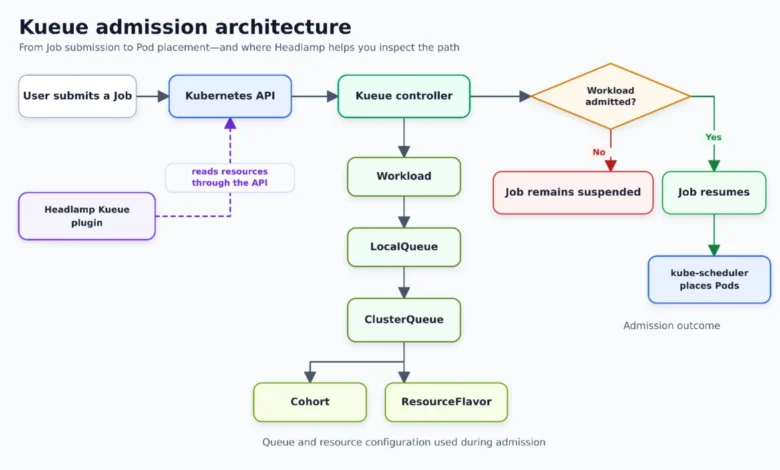
Enter Kueue, a specialized job queueing controller for Kubernetes designed to manage resource allocation before pods ever reach the standard Kubernetes scheduler. Kueue introduces a conceptual decoupling: rather than letting pods flood the cluster simultaneously and land in a perpetual pending state due to resource exhaustion, Kueue intercepts Jobs, encapsulates them into custom Workload resources, and evaluates them against predefined LocalQueues, ClusterQueues, ResourceFlavors, and Cohorts.
Despite its architectural elegance, Kueue introduced a new diagnostic challenge. When a Job remained suspended, engineers had to piece together disparate pieces of information using commands like kubectl describe workload, inspect LocalQueue mappings, query cluster-scoped quotas, and verify resource flavors. This multi-layered abstraction often meant that identifying a simple quota deficit required executing half a dozen commands and manually parsing sprawling YAML documents.
The Headlamp-First Troubleshooting Architecture
The 0.1.0-alpha release of the Kueue plugin for Headlamp fundamentally transforms this investigative workflow by bringing cluster queue topology directly into a unified graphical user interface. Headlamp, an extensible web-based UI for Kubernetes, provides a clean canvas where complex CRDs (Custom Resource Definitions) can be rendered as interconnected, human-readable pathways.
Rather than forcing operators to guess whether a delay stems from Kubernetes scheduling bottlenecks or Kueue admission control, the plugin establishes a clear troubleshooting paradigm: separate admission from scheduling. Under this methodology, an engineer’s first question when facing a delayed Job is no longer "Why is the Pod pending?" but rather "Has Kueue admitted the Workload?"
The chronological investigation follows a structured, step-by-step UI traversal:
- Workload Identification: Navigating to the Kueue Workloads view within Headlamp allows administrators to filter by namespace and locate the specific Workload associated with the suspended Job. The interface immediately surfaces critical metadata, including status conditions such as QuotaReserved and Admitted.
- Condition and Event Analysis: By inspecting the Workload’s status tab, users can read human-readable condition messages. If a ClusterQueue lacks sufficient CPU or memory quota, the exact reason is explicitly stated, eliminating guesswork.
- Queue Topology Traversal: Through interactive links embedded in the Headlamp interface, operators can seamlessly pivot from the Workload to its corresponding LocalQueue, tracking how namespaced requests feed into cluster-scoped ClusterQueues.
- Capacity and Flavor Inspection: The ClusterQueue view provides a side-by-side comparison of active workloads versus nominal capacities. If specialized hardware is required, such as GPU node pools managed via ResourceFlavors or shared dynamically through Cohorts, these relationships are clearly mapped out without requiring manual CLI queries.
Chronology and Development Timeline
The genesis of the Kueue plugin traces back to the 2026 CNCF LFX Mentorship Term 2. Spearheaded by developer Utkarsh Raj, the project was executed under the direct technical mentorship and code review of industry veterans René Dudfield and Kevin Hannon. Built using modern web technologies including TypeScript, React, and native Kubernetes API integrations, the plugin underwent rigorous community testing before its alpha deployment in October 2026.
Feedback from early adopters within both the Headlamp and Kueue ecosystems proved instrumental in refining the user experience. The development team prioritized making status messages immediately visible and ensuring that resource relationships—such as parent-child Cohort hierarchies and resource group borrowing limits—were intuitive to navigate.
Comparative Analysis: CLI Versus Headlamp Workflow
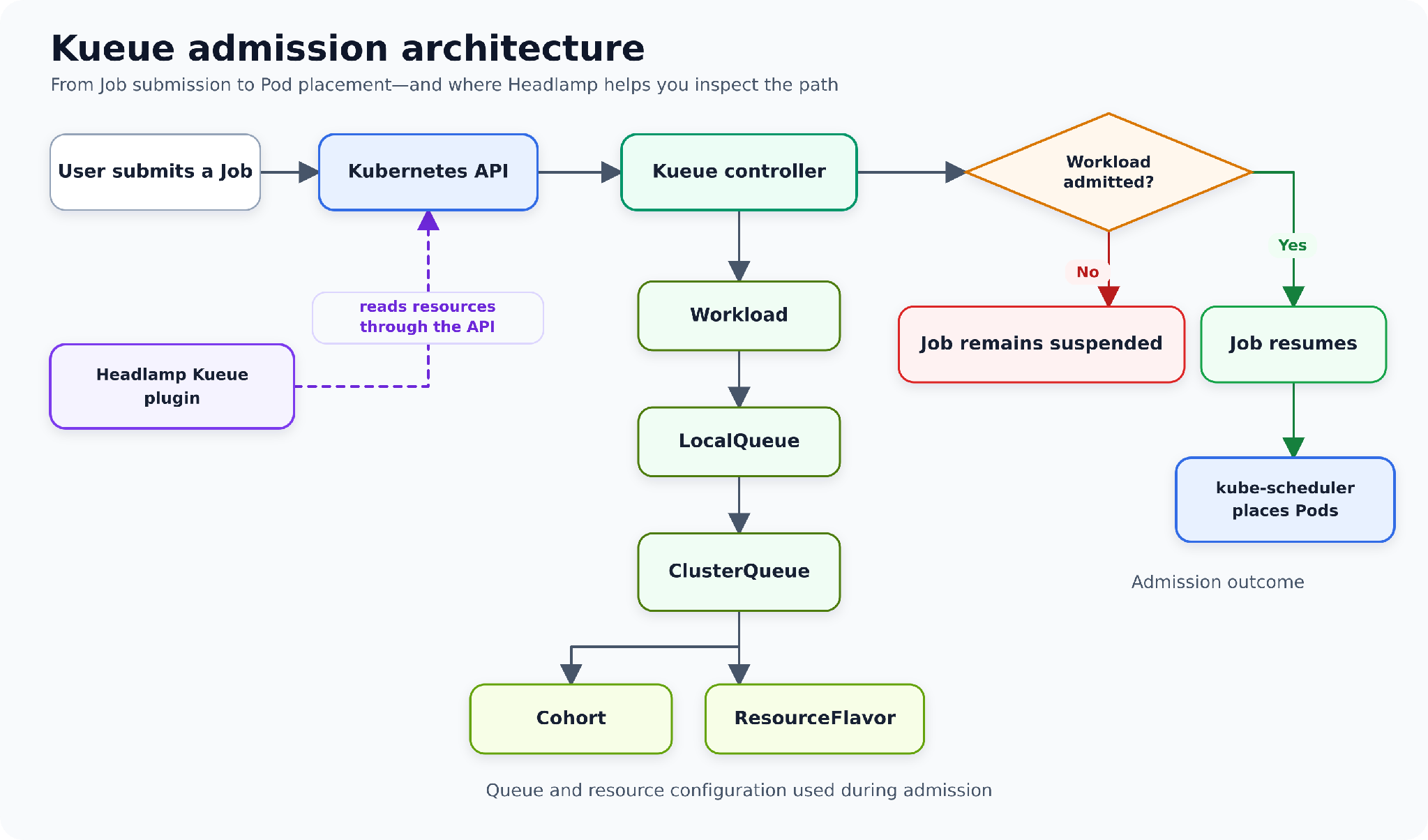
To quantify the operational impact of the new plugin, industry analysts have contrasted traditional command-line troubleshooting with the Headlamp-first approach.
Historically, verifying why a batch job was stalled required a sequential command-line audit:
- Executing
kubectl describe workload <name> -n <namespace>to check status conditions. - Running
kubectl get localqueue <name> -n <namespace> -o yamlto verify queue activity. - Querying cluster-level quotas via
kubectl get clusterqueue <name> -o yaml. - Inspecting underlying node allocations through separate ResourceFlavor and Cohort queries.
With the Headlamp Kueue plugin, this linear, text-heavy process is compressed into a single, clickable GUI session. While automated GitOps pipelines and shell scripts will continue to rely on kubectl and kueuectl, interactive debugging sessions for platform operators are streamlined significantly.
Scope and Current Alpha Limitations
As an initial 0.1.0-alpha release, the plugin maintains a strictly scoped feature set focused on observability. The current iteration provides robust read-only views for Kueue v1beta2 resources, including Cohorts, ClusterQueues, LocalQueues, ResourceFlavors, and Workloads.
Crucially, the alpha release does not introduce native creation, editing, stopping, resuming, or deletion workflows specific to Kueue objects. Instead, Headlamp falls back on its standard YAML editing and resource management capabilities wherever user permissions allow. This design choice ensures stability while gathering valuable telemetry and user experience feedback from the broader cloud-native community.
Broader Implications for Enterprise Kubernetes Operations
The introduction of the Headlamp Kueue plugin signals a broader maturation trend within the Kubernetes ecosystem. As organizations scale their usage of batch processing, artificial intelligence training workloads, and data pipelines on Kubernetes, the complexity of resource management tools naturally increases.
Tools that bridge the gap between powerful backend controllers (like Kueue) and intuitive operator interfaces (like Headlamp) are vital for lowering the cognitive load on platform engineering teams. By democratizing access to deep admission state telemetry, the plugin reduces mean time to resolution (MTTR) for stalled workloads, ultimately improving resource utilization and cluster efficiency in multi-tenant environments.
Community Reactions and Future Outlook
Early responses from cloud-native practitioners have been overwhelmingly positive, particularly regarding the clarity of admission status reporting. Organizations running heavy machine learning pipelines—where jobs frequently wait for GPU availability across shared cluster queues—stand to benefit immensely from the transparent visibility into Cohort borrowing and lending limits.
Developers and platform administrators are encouraged to test the alpha release using the sample manifests provided in the plugin’s official repository, which allow users to simulate quota mismatches and observe how Headlamp traces the admission failure path. Contributions, bug reports, and feature requests are actively being tracked via the official GitHub repository and Headlamp release issues.
As the project progresses beyond its alpha phase toward a stable release, future iterations are expected to incorporate more advanced administrative workflows, further cementing the integration between Headlamp and the Kueue ecosystem as a cornerstone of modern Kubernetes batch operations.