In an era where Large Language Models (LLMs) are increasingly integrated into critical business infrastructure, the reliance on generic, public benchmarks has become a significant liability for enterprise developers. While datasets like MMLU (Massive Multitask Language Understanding) or GSM8K provide a snapshot of general reasoning capabilities, they are largely blind to the nuances of proprietary applications—such as whether a customer support bot adheres to specific corporate refusal policies or if a Retrieval-Augmented Generation (RAG) system accurately surfaces sensitive internal documentation. To bridge this gap, engineers are shifting toward custom evaluation harnesses, modular software frameworks designed to measure model performance against domain-specific requirements.
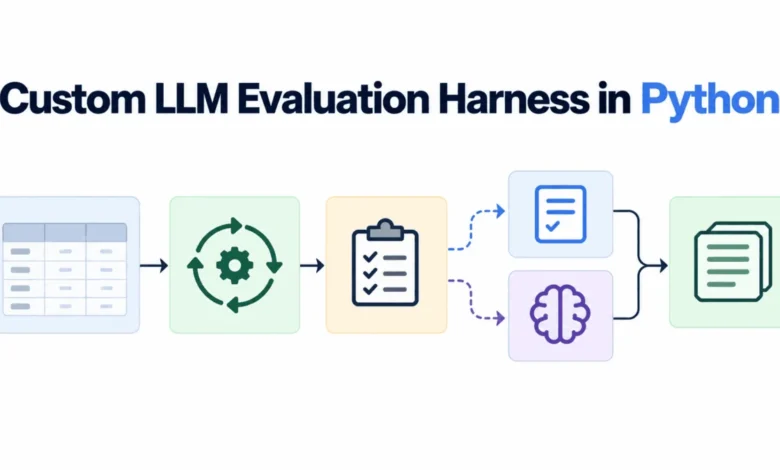
The development of a custom evaluation harness is fundamentally an exercise in software engineering discipline. By treating LLM outputs as testable artifacts, developers can move away from "vibes-based" evaluation and toward reproducible, quantitative metrics. This article outlines the architectural foundation for building such a system using Python, focusing on four decoupled components: the golden dataset, the inference runner, the judge layer, and the persistence logger.
The Evolution of Model Evaluation
The necessity for custom evaluation has grown in lockstep with the complexity of LLM deployments. In early 2023, the industry standard was largely based on manual spot-checking and simple keyword heuristics. By mid-2024, the emergence of "LLM-as-a-Judge" patterns—where a more capable model, such as GPT-4o or Claude 3.5 Sonnet, grades the outputs of smaller, specialized models—standardized the practice of automated evaluation.
The current industry standard, as supported by organizations like the Open LLM Leaderboard and various private evaluation suites, suggests that a robust pipeline must be capable of tracking not just accuracy, but also latency, token efficiency, and safety compliance. Recent data from industry benchmarks suggests that relying solely on base model performance can lead to a 30% to 40% performance degradation when the model is applied to out-of-distribution, domain-specific tasks without fine-tuning or rigid prompt engineering.
Architecture of the Evaluation Harness
A professional-grade evaluation harness requires a separation of concerns. By decoupling the inference logic from the scoring logic, developers gain the ability to adjust their grading rubrics—or even swap out the judge model entirely—without needing to incur the costs or time associated with re-running inference against the target model.
Phase 1: Curating the Golden Dataset
The "golden dataset" is the bedrock of the evaluation process. Unlike synthetic data generation, which often produces repetitive, "happy-path" examples, a high-quality golden dataset must be rooted in historical production logs. Industry best practices recommend starting with a core set of 20 to 50 adversarial examples that represent known failure modes. Each entry in the dataset should include:
- Unique Identifier (UID): Essential for tracking performance degradation over time.
- Input Prompt: The raw user-facing query.
- Expected Concept: A concise, semantic definition of the desired outcome (e.g., "Refusal to perform SQL injection").
- Metadata Tags: Categorization by difficulty, task type, or user demographic to allow for granular performance analysis.
Phase 2: The Inference Runner
The runner serves as the execution engine. By leveraging libraries like LiteLLM, developers can maintain a consistent API interface regardless of the underlying model provider. This abstraction is critical for A/B testing; it allows a team to compare the performance of an open-weights model like Llama 3 against a proprietary model like GPT-4o with minimal code changes.
Concurrency is a non-negotiable requirement for an effective harness. Using Python’s asyncio library allows the harness to fire requests in parallel, significantly reducing the duration of an evaluation run from hours to minutes. In a production environment, the runner must implement robust error handling, including exponential backoff and timeout logic, to ensure that transient API issues do not invalidate the entire test suite.
Phase 3: Implementing the Judge Layer
The judge layer is where the "evaluation" actually occurs. This component generally follows one of two paths:
- Deterministic Evaluation: Utilizing regex, string matching, or logic checks for specific formats. This is highly recommended for structured outputs, such as checking if a model returned a valid JSON object or a specific refusal string. It is cost-effective and provides binary certainty.
- LLM-as-a-Judge: Using a secondary, high-intelligence model to perform semantic analysis. This is required for nuanced tasks where a response might be correct even if it does not match a predetermined keyword. To maintain integrity, developers must use structured output enforcement (via tools like Pydantic) to ensure the judge returns a predictable format—typically a Boolean "passed" flag accompanied by a "reasoning" string.
Phase 4: Persistence and Logging
The final stage is the systematic logging of results. A line-delimited JSON (JSONL) format is the industry standard for this task. Unlike monolithic databases, JSONL is inherently crash-safe; if a long-running evaluation script fails, all results processed up to that point are safely stored. By including timestamps and raw output, organizations can build a historical ledger of their model’s behavior, which serves as a vital audit trail for safety compliance and regression testing.
Implications for Production Deployments
The shift toward custom harnesses has profound implications for AI operations (AIOps). When a company integrates an LLM into its product, the model is no longer a static asset; it becomes a dynamic component that must be maintained.
A well-structured evaluation harness allows for:
- Regression Testing: Detecting if a system prompt update has inadvertently broken a critical refusal mechanism.
- Cost-Performance Optimization: Analyzing whether a smaller, cheaper model is performing adequately on specific subsets of data, allowing for intelligent model routing.
- Compliance Documentation: Providing a clear, documented record of how the system handles safety-critical prompts—a growing requirement for AI regulation in the EU and North America.
Strategic Recommendations
For organizations looking to implement these systems, the recommendation is to start small but scale logically. Do not attempt to build a monolithic, all-encompassing evaluation suite on day one. Instead, prioritize the creation of a "Regression Suite" that covers the top 10 most critical failure cases identified by the customer support or security teams.
Furthermore, ensure that the evaluation logic remains strictly separated from the application logic. As the team grows, the evaluation harness should evolve into a CI/CD-integrated tool. In this model, every pull request that modifies a system prompt or a RAG configuration triggers a subset of the golden dataset evaluation, effectively creating a "Quality Gate" that prevents performance regressions from reaching production.
Ultimately, the goal of a custom evaluation harness is to move the organization from a reactive state—where errors are caught by customers—to a proactive state, where the system’s boundaries are rigorously tested and understood before deployment. By investing in modular, code-based evaluation, developers retain control over their AI systems, ensuring that they remain predictable, safe, and aligned with business objectives regardless of how the underlying model technology shifts.