The Foundational Role of Chunking in RAG Architecture
In a standard RAG pipeline, documents are processed into smaller segments, or "chunks," which are then converted into vector embeddings and stored in a database. When a user submits a query, the system performs a similarity search to find the most relevant chunks, which are subsequently fed into an LLM as context.
The fundamental challenge arises because embedding models and LLMs operate under strict constraints regarding context windows—the maximum amount of information a model can process at once. If a chunk is too large, it may contain "noise," diluting the signal of the answer. If it is too small, it may lack the necessary semantic context, leading to hallucinations or incomplete responses. Recent benchmarks from the RAG evaluation community suggest that optimizing chunk boundaries can improve retrieval accuracy by as much as 20–30% in complex technical domains, regardless of the quality of the underlying LLM.
A Chronological Evolution of Chunking Strategies
The evolution of data segmentation in artificial intelligence has moved from simple mechanical divisions to context-aware, intelligent parsing:
- The Early Era (Fixed-Size Chunking): During the initial phase of vector database adoption, developers relied on fixed-size sliding windows. This was computationally inexpensive but frequently severed sentences or mid-thought logical structures, leading to poor retrieval results.
- The Structural Era (Document-Based Parsing): As developers sought more precision, tools began to leverage Markdown headers, HTML tags, and code syntax. This ensured that sections remained coherent, though it often failed when document formatting was inconsistent.
- The Semantic Era (Current Standard): Modern pipelines now employ semantic chunking, where the system monitors the distance between sentence embeddings. When a topic shift is detected, a new chunk is initialized.
- The Agentic/Advanced Era (Emerging): The latest development involves using lightweight LLM agents to analyze the document’s hierarchy and content density, dynamically choosing a strategy for each document or section.
Analytical Decision-Tree for Strategy Selection
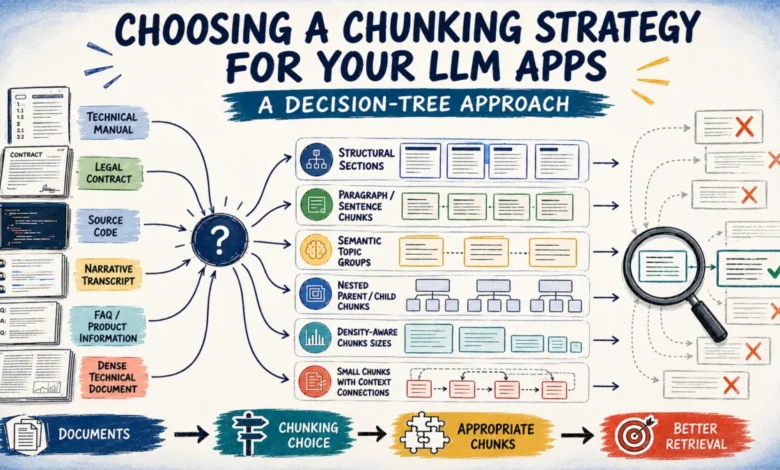
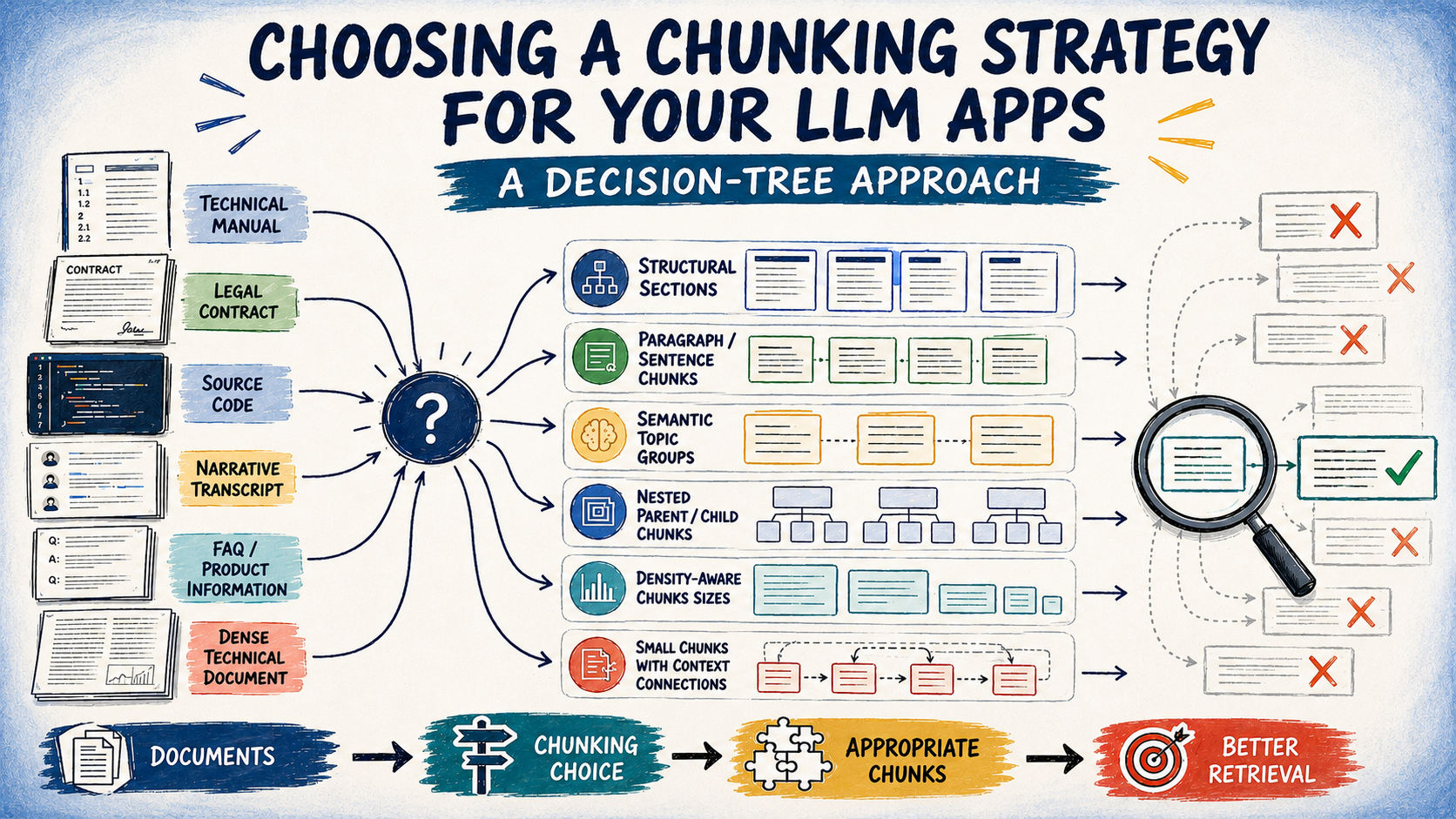
To navigate this technical landscape, architects are increasingly adopting a standardized decision-tree framework. This methodology ensures that the choice of strategy is driven by data requirements rather than arbitrary implementation convenience.
Phase 1: Contextual Assessment
The first step is determining whether the document requires splitting at all. If a document—such as a concise product specification or a single FAQ entry—fits comfortably within the context window without requiring external context, embedding the entire document is superior. Fragmenting a coherent, short document increases the risk of losing the "global" context that the model needs to provide a comprehensive answer.
Phase 2: Structural Integrity
If the document is too large, the second branch of the decision tree considers internal structure. Documents with robust, standardized formatting (e.g., technical manuals with clear headers) should utilize document-based chunking. By aligning chunks with logical units like headers or function blocks, the system ensures that the information retrieved is semantically complete.
Phase 3: The Complexity Trade-off
For documents where semantic relationships span across large sections—such as legal contracts or regulatory filings—simple boundary-based chunking is insufficient. In these cases, "late chunking" is recommended. This involves embedding the document in its entirety and deriving chunk-level embeddings from that global context. While this requires higher compute power and the use of long-context models, it maintains the logical consistency required for high-stakes information retrieval.
Supporting Data: Cost vs. Performance
The selection of a strategy inherently involves a trade-off between computational cost and retrieval quality. Industry performance metrics indicate the following tiers:
| Strategy | Compute Intensity | Retrieval Precision | Use Case |
|---|---|---|---|
| Fixed-Size | Very Low | Low | Rapid prototyping/simple datasets |
| Recursive | Low | Moderate | General-purpose/uniform documents |
| Semantic | Moderate | High | Unstructured text with topic shifts |
| LLM-Based | High | Very High | Regulatory, medical, or legal analysis |
For organizations operating at scale, the cost of running an LLM pass on every document (LLM-based chunking) can be prohibitive. However, for high-stakes industries, the cost is often justified by the reduction in "retrieval hallucinations," where the system retrieves irrelevant data because of poor chunking boundaries.
Industry Implications and Best Practices
The broader impact of these strategies on enterprise AI adoption is significant. Organizations that fail to invest in the preprocessing layer often find that their LLMs perform inconsistently. According to feedback from systems architects, the most common pitfall is "over-engineering"—applying complex, LLM-based chunking to simple, uniform datasets.
A more effective approach, as evidenced by current best practices, is the "Layered Implementation." Start with recursive chunking for the bulk of the corpus. If evaluation metrics (such as Hit Rate or Mean Reciprocal Rank) indicate poor performance in specific document types, introduce more specialized strategies—like semantic or agentic chunking—only for those specific sub-sets.
Addressing Common Technical Failures
Engineers often report specific symptoms when their chunking strategy is misaligned with their data:
- The "Mid-Sentence" Cutoff: This is a clear indicator that a structure-blind method is being applied to structured text. The fix is a transition to recursive or document-based splitting.
- Inconsistent Chunk Counts: If semantic chunking produces highly variable results on similar documents, the threshold for embedding distance is likely miscalibrated. Adjustment of the similarity threshold or reverting to LLM-based boundaries for edge cases is the standard remedy.
- Latency Spikes: When advanced methods like agentic chunking cause significant delays, the recommendation is to cache the strategy decisions. There is no need to re-analyze the optimal chunking path every time a document is indexed; once a structural pattern is identified, it should be codified in the system’s metadata.
Future Outlook
As we move toward the next generation of RAG systems, the industry is trending toward "dynamic, context-aware segmentation." Future models will likely automate the decision-tree process entirely, using pre-processing agents that analyze the document structure and automatically determine the most efficient chunking strategy without manual intervention.
For now, the most successful implementations are those that view chunking not as a "set-and-forget" configuration, but as a dynamic component of the RAG lifecycle. By matching the strategy to the document’s specific requirements—and continuously validating results against user queries—organizations can build systems that are not only accurate but also cost-efficient and scalable. The ultimate goal remains constant: providing the LLM with the most meaningful and contextually relevant information possible to ensure the highest quality of output.