Ginux: How Human-Directed Agentic Engineering Created an Operating System Kernel in Eleven Days

Gregory Kurtzer, a prominent figure in the open-source community best known for founding the CentOS project and later establishing Rocky Linux and CIQ, has unveiled a radical experiment in software development: Ginux, an independent, Rust-based operating system kernel written almost entirely by an AI agent. The project represents a significant departure from traditional software engineering methodologies, moving away from manual coding toward what Kurtzer describes as Human-Directed Agentic Engineering (HDAE).
The core of the project is a fundamental shift in how complex systems are architected. Unlike previous efforts to create kernels or operating systems, which typically require years of collaborative work from large teams of developers, Ginux was developed over a concentrated 11-day period. Despite its short gestation, the resulting kernel is functionally capable of booting enterprise-grade distributions such as Rocky Linux 10, complete with systemd support, entirely bypassing the standard Linux kernel.
The Technical Architecture of Ginux
Ginux is a clean-slate, x86-64 kernel developed primarily in the Rust programming language. It is not a fork of the existing Linux kernel, nor does it share a common codebase with Unix-like predecessors. Instead, it features an entirely self-contained set of low-level subsystems, including its own memory management, process scheduler, process model, filesystem drivers, and networking stack.
The most notable technical achievement of Ginux is its implementation of the Linux Application Binary Interface (ABI). By adhering to the standard binary interface, Ginux allows existing, pre-compiled Linux binaries to execute without modification. Within the project’s documentation, Linux is treated not as a foundational requirement, but as a "personality" or an interface that the kernel exposes to the user-space environment.
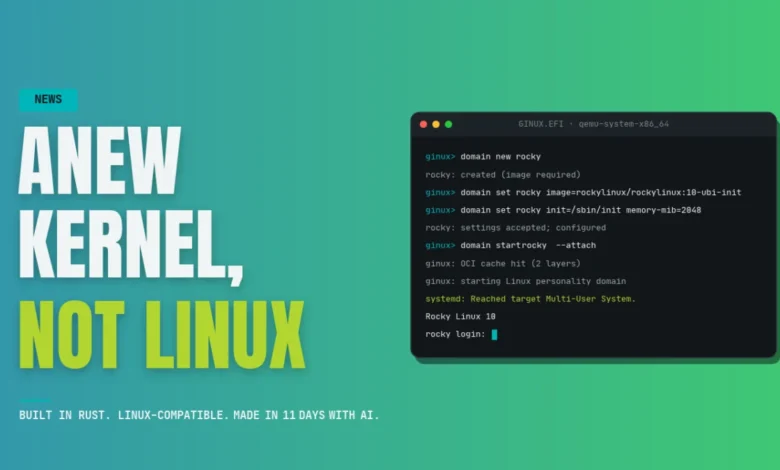
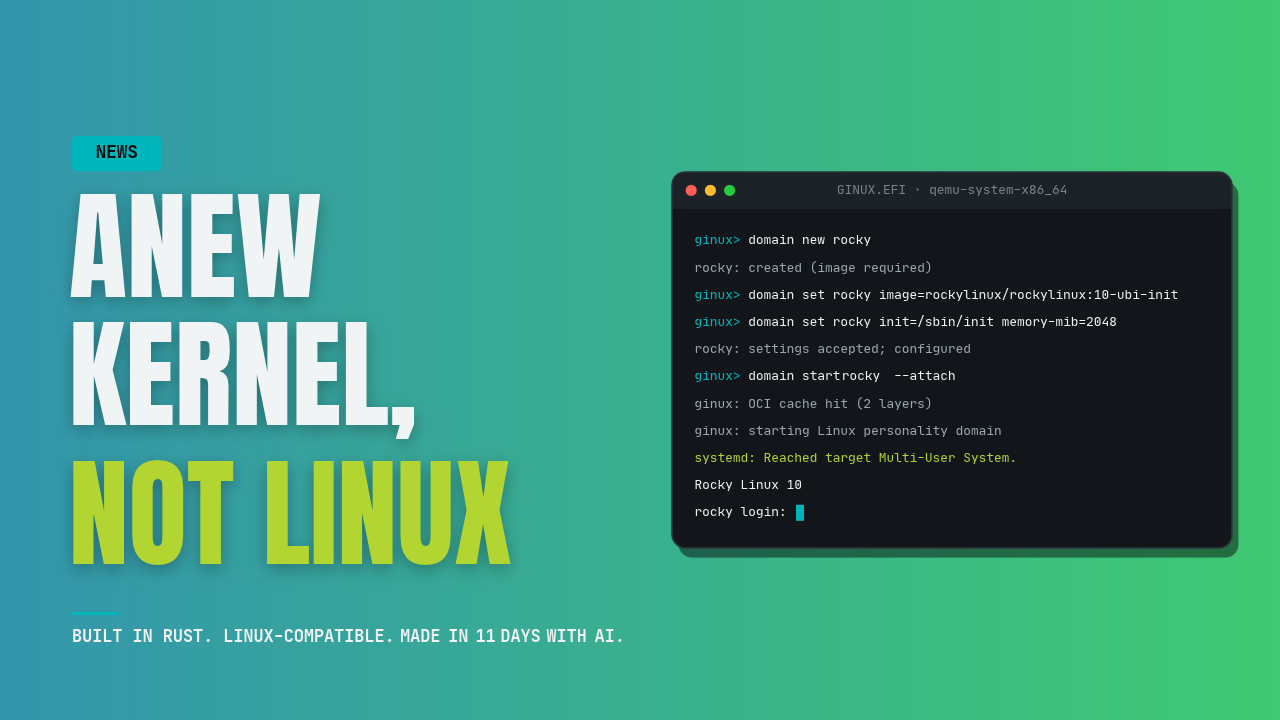
The kernel is distributed as a single EFI image (GINUX.EFI), designed to boot directly via UEFI, removing the need for a host operating system. Within this environment, Ginux manages "domains"—isolated execution environments that provide a security and abstraction layer superior to traditional OCI containers or standard Linux namespaces. These domains manage their own process lifecycles and root filesystems, pulling from existing OCI container images to assemble a bootable environment. In recent demonstrations, Ginux successfully initialized Rocky Linux 10 up to the multi-user.target, demonstrating that the kernel is capable of handling complex system initialization processes.
Chronology of the 11-Day Development Cycle
The development of Ginux was characterized by a rapid, iterative loop facilitated by the GPT-5.6 Sol model. According to technical documentation provided by Kurtzer, the process was divided into clearly defined phases:
- Days 1–2: Conceptualization and Scoping. The human operator defined the architectural boundaries, the requirement for Rust-based safety, and the necessity of ABI compatibility.
- Days 3–7: Core Subsystem Implementation. The AI agent focused on writing the memory management unit, the boot loader, and the scheduler. During this phase, the agent was tasked with constant compilation and verification against executable tests.
- Days 8–10: System Integration. The agent integrated the filesystem drivers and the networking stack. It also configured the kernel to parse and execute OCI images, allowing for the successful boot of Rocky Linux.
- Day 11: Stabilization and Final Review. The final day was dedicated to debugging and ensuring that the kernel could reach the
multi-user.targetstate without fatal errors.
Throughout this period, the project generated approximately 139,000 lines of code across more than 1,000 commits. This level of output highlights the efficiency of the HDAE model, where the AI manages the heavy lifting of implementation while the human provides the architectural roadmap and validation criteria.
Defining Human-Directed Agentic Engineering
Human-Directed Agentic Engineering (HDAE) is the methodological framework that underpinned the development of Ginux. Kurtzer has argued that HDAE is distinct from simple AI-assisted coding. In a traditional "co-pilot" workflow, a developer writes code and asks an AI to suggest completions or fixes. In an agentic workflow, the developer acts as a system architect, while the agent acts as an autonomous engineer.
The developer remains responsible for high-level tasks: setting constraints, defining the "acceptance criteria" for each module, and reviewing the outcomes. The agent, meanwhile, operates within a continuous loop of writing, booting, testing, diagnosing, and revising. By linking the agent directly to the build and test infrastructure, the system can self-correct when a build fails or a test case is not met. Kurtzer emphasizes that this methodology is not a replacement for domain expertise. Rather, it serves as a force multiplier for engineers who already possess deep, fundamental knowledge of systems programming and kernel architecture.
Supporting Data and Current Capabilities
It is important to note the limitations of the current prototype. Ginux is not yet a production-ready operating system. Current constraints include:
- Hardware Support: The kernel lacks support for physical hardware profiles, including GPU acceleration and NVMe storage controllers. It currently functions only within a QEMU virtual machine environment.
- Security Auditing: While the use of Rust provides inherent memory safety, the kernel has not undergone a formal security audit or penetration testing.
- Research Focus: The project is released under an Apache 2.0 license and is strictly intended for research and development. It is not intended to replace existing Linux distributions in enterprise environments.
However, the ability of an 11-day prototype to boot a complex init system like systemd provides a compelling data point for the future of OS development. By decoupling the userspace from the kernel, Ginux illustrates that the "Linux experience" can be replicated on non-Linux foundations, potentially opening the door for more specialized or secure kernels in the future.

Broader Implications for Systems Programming
The emergence of Ginux raises questions regarding the future of the Linux kernel and the sustainability of massive, multi-decade projects. For over thirty years, the Linux kernel has grown to millions of lines of code, sustained by a vast, distributed community of contributors. This "moat"—a term used by Kurtzer to describe the difficulty of replacing established technology—is built on hardware enablement, standardized testing, and global consensus.
While an AI can generate a functional kernel in 11 days, the Ginux experiment suggests that the real challenge of operating system development lies not in the initial construction, but in the long-term maintenance and hardware support ecosystem. As Kurtzer stated, "Compatibility, security, hardware support, standards, community, and long-term maintenance remain the real moat."
Nevertheless, the implications for smaller, specialized systems are profound. If a single expert can use agentic AI to build a kernel in under two weeks, the threshold for creating bespoke operating systems—for edge computing, IoT devices, or highly specialized server environments—has effectively collapsed. This could lead to a future where "OS-as-a-Service" or custom kernels become common, moving away from the "one-size-fits-all" approach of the monolithic Linux kernel.
Future Outlook and Industry Response
The technology community has reacted with significant interest to the announcement. While some skeptics highlight the lack of hardware support and the immense difficulty of maintaining a kernel against thousands of evolving standards, others view it as a proof of concept for the next generation of software development.
If HDAE proves to be a repeatable methodology, it may shift the labor market for systems engineers. The role of the engineer may evolve from a "coder" to an "architect-manager," where the ability to define clear, modular requirements and manage agentic workflows becomes more valuable than the ability to write low-level C or Rust code by hand.
The Ginux project serves as a clear indicator of the rapid velocity of AI-driven engineering. By moving the focus from manual implementation to architectural steering, projects that once required the coordinated effort of entire corporations or large open-source foundations may soon be achievable by individuals or small teams. Whether this leads to a new era of diverse, custom kernels or merely creates a new tool for rapid prototyping remains to be seen, but the baseline for what a developer can achieve in a "weekend project" has been fundamentally reset.