React Native 0.86 Official Release Brings Android 15 Edge-to-Edge Support and DevTools Enhancements

The open-source mobile application framework React Native has officially announced the rollout of version 0.86, marking another significant milestone in the platform’s ongoing evolution. Delivered by a global community of core maintainers and independent contributors, this latest stable release focuses heavily on modernizing platform integration, refining developer ergonomics, and ensuring backward compatibility. Most notably, React Native 0.86 introduces comprehensive edge-to-edge rendering support tailored for Android 15 and newer, alongside advanced UI emulation features within React Native DevTools. Crucially for development teams managing large-scale enterprise codebases, this release continues a reassuring trend established by version 0.83: it contains zero user-facing breaking changes, allowing teams to transition their environments smoothly without rewriting application logic.
Alongside these technical improvements, version 0.86 arrives during a transformative period of institutional restructuring for the broader React ecosystem. The core repositories powering the framework have officially migrated from Meta’s historical GitHub organization to the independent React Foundation. This governance shift represents a structural maturation of the technology, assuring enterprise stakeholders of long-term neutrality, decentralized oversight, and sustained stewardship. As version 0.86 assumes the mantle of the latest stable release—concurrently moving version 0.83 and its predecessors into unsupported status—developers worldwide are evaluating the operational and architectural implications of the new update.
Institutional Governance: The Transition to the React Foundation
The release of React Native 0.86 coincides with a monumental administrative milestone: the relocation of the core React Native GitHub repository, alongside essential related projects including React, Metro, Yoga, and the official React Native documentation website. For years housed under the facebook GitHub organization, these pivotal assets have officially moved to the react GitHub organization.
This migration is not merely cosmetic; it reflects the formal transition of React and its native extension into the React Foundation. Established as an independent, vendor-neutral entity, the React Foundation is dedicated to securing the long-term health, financial sustainability, and architectural independence of the entire React ecosystem. By separating the framework’s core infrastructure from any single corporate entity, the foundation aims to foster broader cross-industry collaboration and governance transparency.
For everyday developers and engineering managers, the immediate practical impact of this transition is seamless. GitHub’s infrastructure handles the migration automatically, ensuring that all existing URLs, open issues, and pull requests are seamlessly redirected to their new locations without requiring manual intervention from contributors. Nevertheless, the symbolic and strategic implications are profound. Industry analysts view the move as a vital step in cementing React and React Native as foundational public utilities of the modern web and mobile landscape, reassuring corporate adopters who prioritize decentralized governance and open-source longevity.
Modernizing Mobile Architecture: Android 15 Edge-to-Edge Support
As mobile operating systems evolve, maintaining UI consistency across diverse hardware and software environments remains a core challenge for cross-platform frameworks. With version 0.86, the React Native engineering team has tackled one of the most prominent UI compliance requirements in the current Android ecosystem: comprehensive edge-to-edge support for Android 15 and later.
Historically, implementing edge-to-edge layouts—where application content flows seamlessly behind the system navigation and status bars—required careful manual configuration of window flags and insets. Android 15, however, changes the paradigm by enforcing edge-to-edge rendering by default across supported devices, regardless of whether developers have explicitly configured the edgeToEdgeEnabled Gradle property within their applications.
This enforcement previously led to layout clipping, overlapping touch targets, and visual artifacts in legacy cross-platform apps. React Native 0.86 resolves these friction points by shipping comprehensive architectural fixes that harmonize the framework’s rendering pipeline with Android’s strict new window management rules. The release addresses critical edge cases, ensuring that safe areas, modal dialogs, keyboard avoidance views, and scrollable containers correctly calculate insets under enforced edge-to-edge states. Mobile architects note that this proactive alignment prevents sudden visual degradation upon user device upgrades, saving engineering teams countless hours of emergency debugging.
Developer Ergonomics: Enhanced Capabilities in React Native DevTools
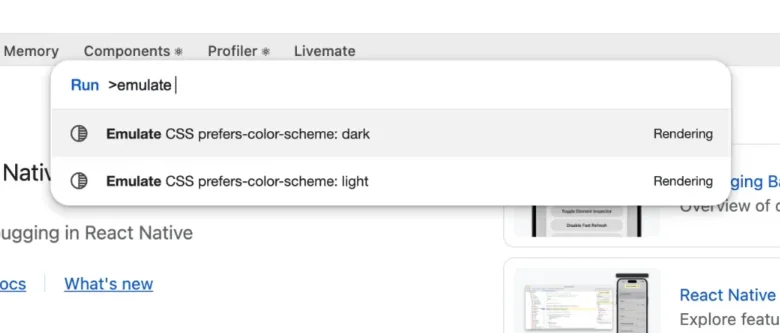
Beyond low-level platform integration, version 0.86 places a strong emphasis on developer productivity and diagnostic tooling. React Native DevTools has received targeted upgrades designed to streamline the day-to-day workflow of mobile engineers, most notably through the introduction of native-grade light and dark mode emulation.

Previously, testing how a React Native application handled dynamic appearance changes often required navigating deep within device settings, toggling system-wide themes, or implementing custom in-app debug menus. Version 0.86 introduces support for the Emulation.setEmulatedMedia protocol directly within DevTools. Developers can now instantly toggle between light and dark visual modes via the DevTools Command Palette—accessible using the familiar cmd + shift + P (macOS) or ctrl + shift + P (Windows/Linux) shortcut.
Mirroring modern web inspection tools, this emulation acts as a temporary state override. The forced appearance mode automatically resets the moment the DevTools session disconnects, ensuring that device-level settings remain pristine. By eliminating context-switching between the emulator and code editor, this feature accelerates UI validation and design system compliance auditing.
Zero Breaking Changes and Upgrade Predictability
One of the most praised aspects of recent React Native releases has been the engineering team’s rigorous adherence to predictable deprecation lifecycles and backward compatibility. Following in the footsteps of version 0.83, React Native 0.86 proudly features zero user-facing breaking changes.
This achievement underscores a multi-year effort by core contributors to refactor internal APIs, adopt the New Architecture (Fabric and TurboModules) incrementally, and enforce strict versioning policies without penalizing application developers. For teams operating on version 0.85, the upgrade path to 0.86 is designed to be frictionless, requiring zero modifications to existing application source code.
To maintain architectural hygiene, however, the release does introduce several internal API deprecations that are scheduled for permanent removal in future major versions. Developers are encouraged to review static analysis warnings during compilation to identify legacy patterns early. Furthermore, the core team continues to refine the JSI (Native Interface), introducing powerful new C++ APIs that enhance interoperability between native modules and the JavaScript runtime, laying the groundwork for even higher-performance cross-platform applications.
Industry Impact and the Upgrade Roadmap
The release of React Native 0.86 arrives at a time when cross-platform mobile frameworks are locked in a fierce competition for enterprise adoption. By prioritizing stability, predictable upgrade cadences, and immediate compliance with the latest OS requirements like Android 15, React Native reinforces its position as a mature, enterprise-ready solution.
Statistical metrics from the development cycle highlight the collaborative scale of version 0.86: the release incorporates over 596 distinct commits contributed by 97 independent developers from around the globe. This decentralized contribution model demonstrates the vibrant health of the community following its transition to the React Foundation.
For engineering teams planning their upgrade schedules, upgrading to version 0.86 is highly recommended to ensure forward compatibility with modern Android environments. Developers managing existing projects can utilize the official React Native Upgrade Helper to inspect diffs and automate migration steps. New projects can be initialized immediately via the command line using the latest community CLI:
npx @react-native-community/cli@latest init MyProject --version latestMeanwhile, ecosystems closely tied to React Native, such as Expo, have announced that version 0.86 will be integrated into their upcoming expo@canary release channels, allowing managed-workflow developers to begin testing the new capabilities within experimental environments. As version 0.86 solidifies its status as the current stable baseline, older versions such as 0.83.x officially transition out of support, emphasizing the importance of regular, incremental maintenance cycles in modern mobile engineering.