Unlocking Retail Intelligence: How Microsoft Fabric and Neo4j Are Revolutionizing AI Copilots with Graph Data

Modern retail enterprises find themselves drowning in data while simultaneously starving for actionable insights. Between fragmented customer profiles, point-of-sale (POS) transactions, fluctuating inventory levels, and dynamic promotional schedules, large-scale merchants generate terabytes of digital signals on a daily basis. Yet, despite this abundance of information, legacy relational architectures routinely keep vital data locked away in isolated operational silos. POS platforms, inventory management systems, and customer relationship management (CRM) applications operate independently, preventing a unified view of the enterprise.
This structural fragmentation creates a severe bottleneck for organizations deploying artificial intelligence agents and Copilots to drive personalization. While AI systems are designed to deliver tailored experiences, they require rich, interconnected business context rather than isolated rows of transactional data. Traditional relational tables are engineered specifically for fast transactional logging, but they predictably collapse under the weight of multi-hop queries. Consequently, these relational architectures conceal nuanced customer habits and obscure the complex, interdependent relationships that exist between products.
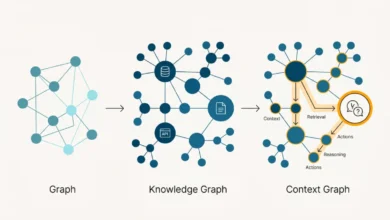
To dismantle these persistent data silos, a new architectural paradigm has emerged. Microsoft Fabric centralizes enterprise data within OneLake utilizing open Delta tables, providing a unified foundation without the operational overhead of complex ETL (Extract, Transform, Load) pipelines or redundant data duplication. Building directly upon this open foundation, Neo4j Graph Intelligence projects these foundational tables into dynamic, connected models that expose meaningful relationships across customers, orders, inventory, and products. Together, this dual-engine architecture delivers multi-hop relationship intelligence, empowering AI agents to access real-time business context and drastically improve recommendation accuracy.
The Hidden Financial Cost of Suboptimal Recommendations
When AI Copilots rely exclusively on basic relational queries or superficial semantic search capabilities, poor recommendations have an immediate and measurable impact on bottom-line profit margins and long-term brand equity. In the fast-paced retail sector, a recommendation engine that fails to capture true customer intent can quickly frustrate shoppers, leading to cart abandonment and a diminished perceived value of the brand.
Market analysts estimate that suboptimal personalization costs global retailers billions of dollars annually in missed cross-selling and up-selling opportunities. When a consumer receives irrelevant product suggestions, the friction in their digital journey increases. This friction often results in lower average order values and reduced customer lifetime value. Furthermore, as consumers increasingly expect hyper-personalized interactions, brands that fail to deliver risk losing market share to more agile competitors equipped with advanced context-aware AI systems.
To overcome these limitations and achieve truly high-converting personalization, AI tools must move beyond simple keyword matching. They require connected intelligence that fundamentally understands how merchandise dynamically relates through shared shopper behaviors, localized purchasing trends, and nuanced product neighborhoods.
The Banana Problem: Why Standard Co-Occurrence Fails Modern Retail
To understand the limitations of traditional recommendation systems, one must examine the well-documented market basket co-occurrence dilemma often referred to in data science as the "banana problem."
Consider a typical grocery shopping scenario: a consumer adds organic spinach, fresh avocado, and specialty peanut butter to their digital cart. A standard SQL-based query examines historical co-purchases across the enterprise database to determine what items are most frequently bought alongside these selections. Because bananas appear in nearly every grocery cart regardless of specific meal planning, standard co-occurrence queries invariably mistake raw item popularity for true customer intent, ultimately drowning out genuine, context-specific preferences.
This phenomenon is the retail equivalent of assuming that every individual who purchases coffee also wants bottled water. While the pairing may be statistically frequent on a macro level, it entirely fails to suggest items that would genuinely complement or complete that specific, unique order.
To unlock true incremental revenue and deliver genuine value, modern AI agents must bypass high-frequency statistical noise. They must be capable of identifying subtle, "long-tail" affinity patterns that accurately reveal what a shopper actually needs next based on their immediate contextual basket.
Surfacing True Intent Through Advanced Node Similarity
Rather than relying on basic counts of direct purchases, Neo4j analyzes complex product neighborhoods using advanced Graph Data Science (GDS) methodologies. Techniques such as Node Similarity—utilizing Jaccard or Cosine Neighborhood algorithms—compare the surrounding context of items. By evaluating products frequently bought with items like cauliflower versus pepper jack cheese, the system isolates genuine affinities regardless of total sales volume.
By evaluating overlapping connections across the underlying graph topology, the system uncovers non-obvious, high-value complements, such as artisanal hot sauces or specialty regional dips, rather than generic, high-volume staples.
| Capability | Standard Relational SQL Agent | Neo4j Graph-Grounded Copilot |
|---|---|---|
| Data Structure | Flat transactional tables | Connected property graphs (:Customer, :Order, :Product, :Aisle) |
| Primary Logic | Direct co-occurrence counts (COUNT, GROUP BY) | Node Similarity & neighborhood overlap analysis |
| Noise Filtering | Over-indexes on high-volume staples (e.g., Bananas) | Filters out volume bias to find true product affinity |
| Unseen Carts | Fails, times out, or returns null for novel item combinations | Traverses multi-hop graph paths to find contextual substitutes & complements |
| Query Latency | Exponential degradation as joins increase | Constant millisecond traversal regardless of graph depth |
Chronology and Evolution of the Integration
The integration of Neo4j Graph Intelligence into Microsoft Fabric represents a significant milestone in the evolution of enterprise data architecture. The collaborative initiative began taking shape as organizations increasingly demanded unified analytics that could seamlessly feed generative AI models without requiring massive data migration projects.
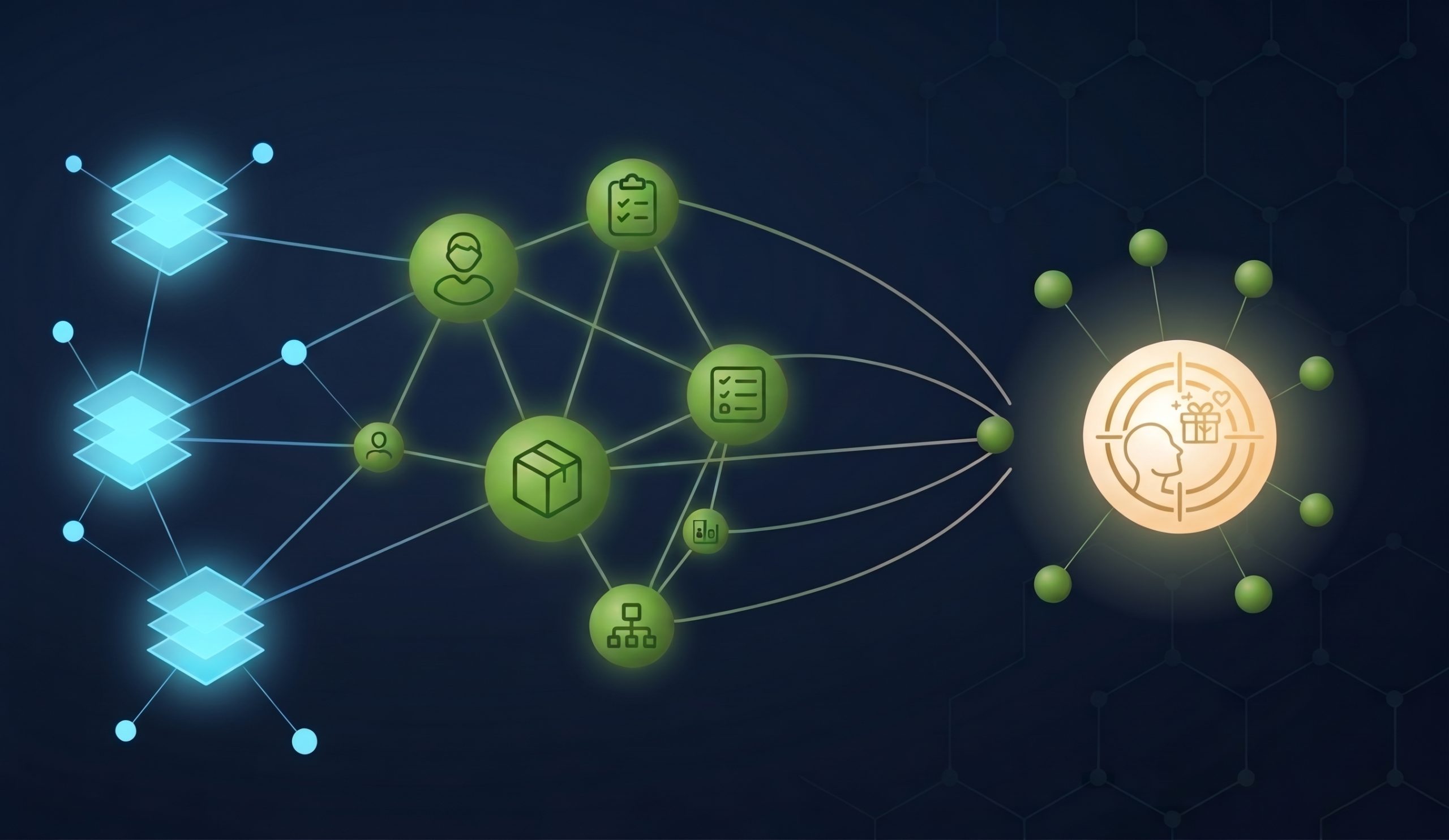
In the initial development phase, engineering teams focused on bridging the gap between Microsoft’s robust lakehouse architecture in OneLake and Neo4j’s industry-leading graph database capabilities. By establishing an open Delta table foundation, developers ensured that data could flow naturally from transactional systems into analytical models.
By mid-2024, beta testing demonstrated that combining Fabric Data Agents with graph-grounded context drastically reduced query latency for complex, multi-hop retail inquiries. Industry analysts noted that this technical synergy eliminated the historical trade-off between maintaining deep relational records and executing rapid graph traversals.
By late 2024 and extending into 2025, the integration achieved general availability within the Fabric Workload Hub and the Azure Marketplace. This commercial rollout enabled enterprise retailers to deploy graph-grounded Copilots directly within their existing security frameworks, setting a new benchmark for enterprise AI deployment.
How Microsoft Fabric and Neo4j Power Contextual AI
The technical synergy between Microsoft Fabric and Neo4j creates a robust, enterprise-grade retrieval and reasoning pipeline that connects legacy relational storage with advanced graph context.
First, enterprise data originating from diverse sources is consolidated within Microsoft Fabric’s OneLake as open Delta tables. This eliminates data duplication and ensures a single source of truth across the organization. Second, Neo4j Graph Intelligence projects these Delta tables into interconnected property graphs, mapping explicit relationships between customers, orders, products, and physical or virtual aisles.
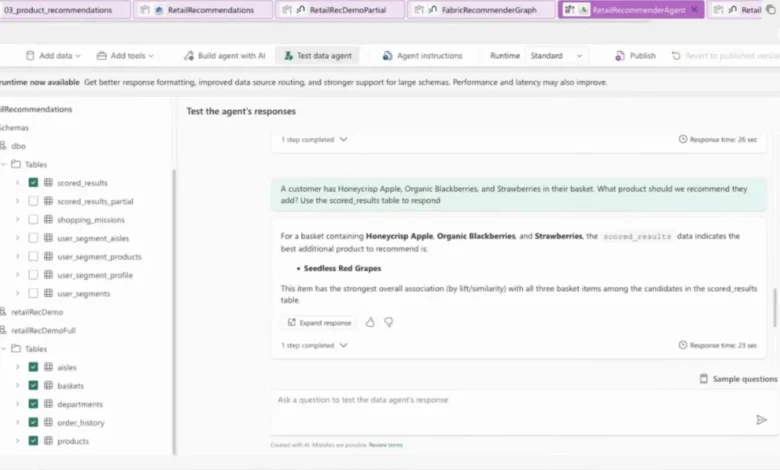
Crucially, Fabric Data Agents make this complex graph intelligence accessible to non-technical business users through natural language processing. Rather than requiring data scientists or business analysts to write complex graph query languages like Neo4j Cypher, Fabric Data Agents automatically translate everyday business questions into optimized Cypher queries behind the scenes. The system subsequently retrieves relationship-rich insights from the graph and presents them within a conversational, user-friendly interface.
Industry Reactions and Expert Perspectives
Enterprise technology leaders have responded enthusiastically to the partnership, emphasizing its potential to streamline AI deployments while maintaining rigorous governance standards. Data architects and retail executives have pointed out that previous attempts to integrate graph databases with enterprise data lakes often resulted in cumbersome custom integrations and heightened security risks.
According to enterprise software analysts, the ability to run graph analytics natively within the Microsoft Fabric ecosystem addresses one of the most persistent hurdles in modern IT: siloed infrastructure. By leveraging existing enterprise controls—including Microsoft Purview governance, native single sign-on (SSO), and stringent tenant-level security boundaries—organizations can adopt advanced graph AI without compromising corporate compliance or data privacy protocols.
Furthermore, retail merchandising executives have highlighted the practical benefits of natural language data querying. Store managers, inventory planners, and marketing teams can now interrogate complex customer datasets using conversational prompts, drastically reducing the time required to generate targeted promotional campaigns or adjust regional inventory allocations.
Broader Business Implications and Future Outlook
The broader implications of graph-grounded AI extend far beyond basic product recommendations. As retailers face tightening margins and shifting consumer behaviors, the ability to derive real-time, context-aware insights from enterprise data will likely become a primary competitive differentiator.
By deploying graph-grounded Copilots within Microsoft Fabric, enterprises can future-proof their data strategies. They no longer need to choose between the transactional stability of relational databases and the analytical depth of graph topologies. Instead, the dual-engine architecture harmonizes both worlds, allowing AI agents to reason over complex business relationships with unprecedented speed and accuracy.
As this technology matures, industry experts predict that graph intelligence will expand into other retail domains, including dynamic supply chain optimization, fraud detection, and hyper-localized pricing strategies. Retailers that successfully adopt these integrated architectures will be uniquely positioned to meet rising consumer expectations while maximizing the return on their enterprise data investments.
Getting Started with Graph-Grounded Copilots
Organizations seeking to transform their retail recommendation engines and inventory management systems can implement these capabilities without overhauling their existing workflows or managing external infrastructure. Neo4j Graph Intelligence is available directly inside the Fabric Workload Hub for native single sign-on and unified workspace management, as well as through the Azure Marketplace.
By mapping OneLake data into sophisticated graph models and executing advanced Graph Data Science workloads, retail teams can quickly empower Fabric Data Agents and Copilot experiences. These tools deliver superior contextual recommendations, elevate cross-sell conversion rates, and provide a clear pathway toward smarter, more responsive retail operations.
Related posts: