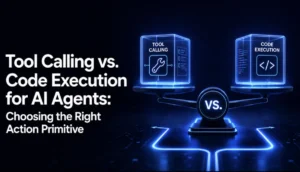
Tool Calling vs. Code Execution for AI Agents Choosing the Right Action Primitive

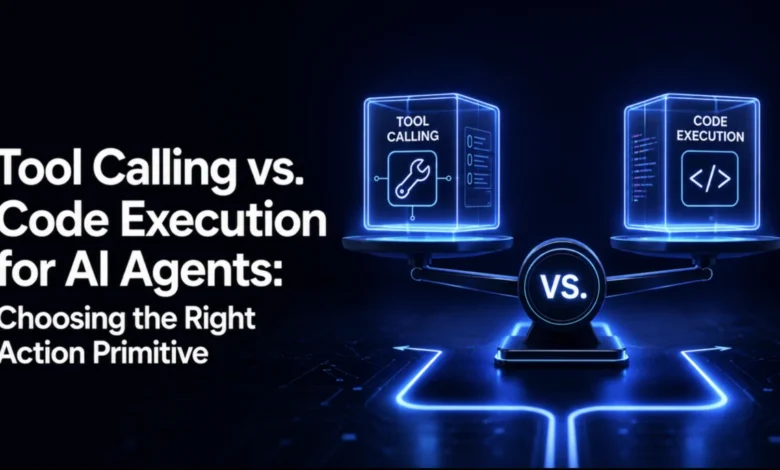
The rapid evolution of autonomous AI agents has shifted the industry’s focus from merely generating text to executing complex, multi-step workflows. At the heart of this transition lies the "action primitive"—the fundamental mechanism that allows a Large Language Model (LLM) to interact with external software, databases, and APIs. As developers scale agentic systems from simple chatbots to sophisticated enterprise automations, they are increasingly forced to choose between two primary architectural paradigms: standard tool calling and programmatic code execution. While both enable an agent to "act" in the real world, they represent fundamentally different approaches to logic, resource management, and cost efficiency.
Understanding the Action Primitive Landscape
An action primitive acts as the bridge between the model’s internal reasoning and the external environment. Historically, tool calling emerged as the industry standard. In this model, the LLM is provided with a manifest of available functions. When the model determines an action is necessary, it pauses its text generation to emit a structured JSON payload describing the function call. The host application intercepts this signal, executes the function in a standard environment, and feeds the result back into the model’s context window.
This process is inherently iterative. If an agent needs to calculate the total budget for twenty departments, it must request the data for each department one by one, wait for the response, and then re-process that data within its context. This leads to a "chatter" effect: the agent spends excessive compute tokens parsing and re-parsing intermediate data that it does not fundamentally need to "read" to reach a conclusion—it simply needs the final arithmetic result.
In contrast, code execution represents a significant shift in architectural philosophy. Instead of acting as a direct caller of APIs, the model is given the ability to write and execute scripts—typically in Python or TypeScript—within a secure, sandboxed environment. Rather than forcing the agent to handle every data point, this approach allows the agent to write a script that performs the aggregation locally and returns only the final summary to the model.
Chronology of the Shift toward Programmatic Control
The transition toward code execution gained significant momentum in late 2025. Following the release of Anthropic’s "Programmatic Tool Calling" features and the broader industry adoption of the Model Context Protocol (MCP), developers began moving away from the "one-turn, one-call" limitation.
In November 2025, technical documentation from leading AI labs began emphasizing "allowed_callers," a security and architectural flag that permits a model to call tools from within its own generated code. This capability was not merely an incremental update; it was a response to the "context bloat" problem. By offloading logic to a sandbox, researchers observed that agents could maintain higher accuracy on complex benchmarks like GAIA, as the model was no longer required to track dozens of intermediate variables in its "working memory" while simultaneously managing the logic of the task.
Supporting Data and Performance Metrics
The economic implications of this transition are substantial. Internal benchmarking conducted by major AI research labs suggests that switching from standard tool calling to code-based orchestration can reduce token consumption by nearly 40% on complex research tasks.
For instance, in a study of a standard document-to-database extraction workflow, an agent using standard tool calling required approximately 43,588 tokens to reach a conclusion. When the same task was offloaded to a code-execution environment, the token usage dropped to 27,297—a reduction of 37%. More importantly, the accuracy of these agents on the GAIA benchmark—a standard for measuring AI agency—improved from 46.5% to 51.2%. This performance gain is attributed to the reduced cognitive load on the LLM; by allowing the sandbox to handle the sorting, filtering, and arithmetic, the model is free to focus on higher-level reasoning and decision-making.
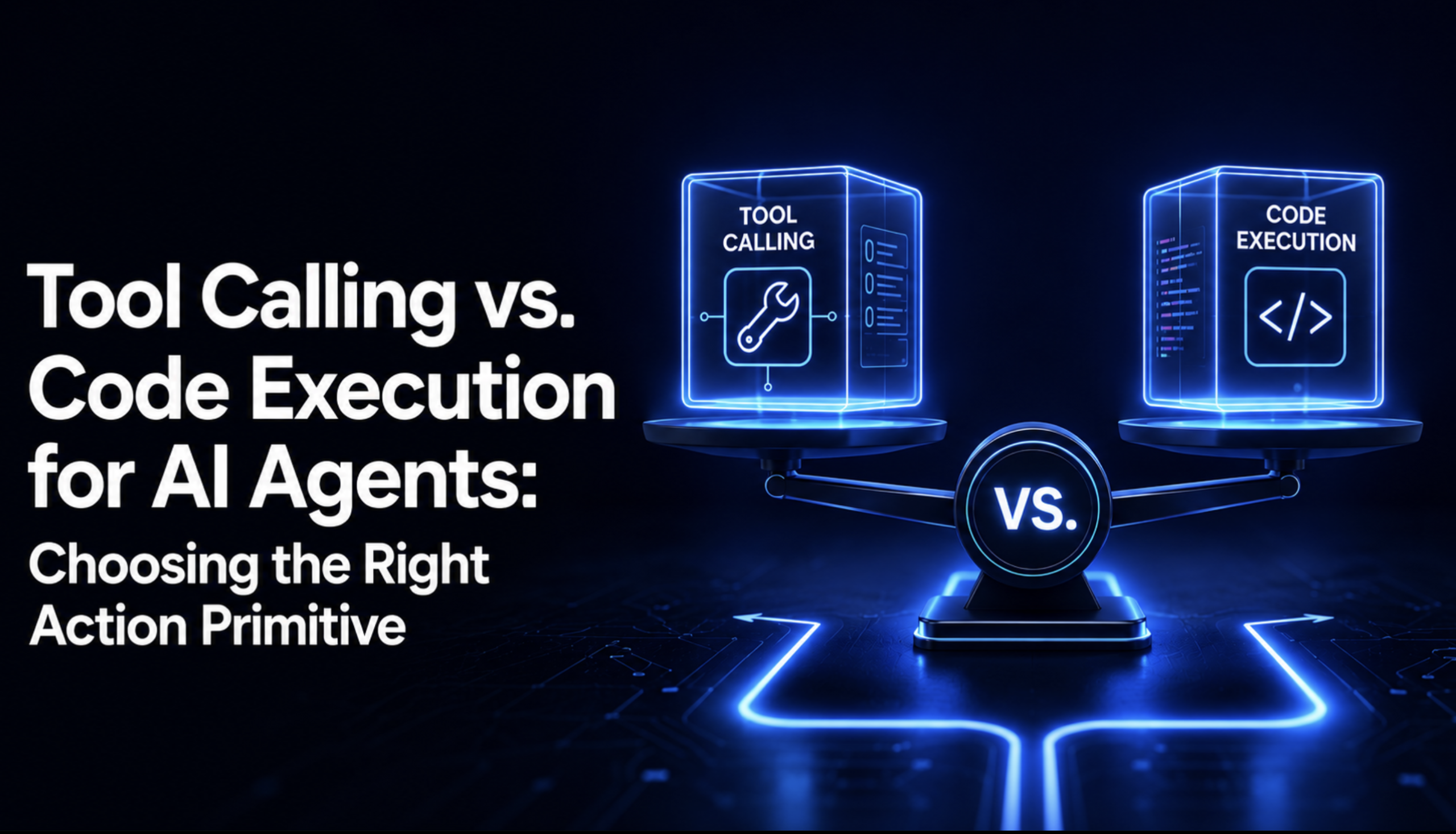
Comparative Analysis of Action Primitives
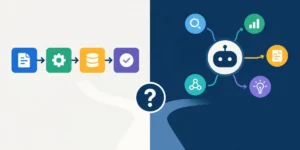
The choice between these two primitives is rarely binary; it is a tactical decision based on the specific requirements of the application.
The Case for Tool Calling
Tool calling remains the superior choice for single-shot, low-latency lookups. When an agent is asked a simple question—such as checking the current weather in a specific city—the overhead of initializing a sandboxed code environment is counterproductive. Furthermore, tool calling offers superior auditability. Because every action is a discrete event logged as a JSON object, developers can reconstruct the agent’s decision-making process with precision. This is critical in industries such as finance or healthcare, where every API interaction must be traceable for compliance and debugging.
The Case for Code Execution
Code execution excels in "fan-out and aggregation" scenarios. When an agent must retrieve data from multiple sources, perform statistical analysis, or process large datasets, the standard tool-calling loop creates a bottleneck. By using code execution, the agent can write a script to parallelize requests (e.g., using asyncio.gather in Python), ensuring that the agent does not waste time waiting for individual API responses before initiating the next step. This is particularly vital when dealing with sensitive data, as PII (Personally Identifiable Information) can be processed within the sandbox and stripped before the result is returned to the model, minimizing the exposure of sensitive data to the LLM’s context.
Infrastructure and Operational Implications
For development teams, the decision also hinges on existing infrastructure. Implementing robust code execution requires a secure, containerized sandbox environment—such as those provided by modern agent frameworks or cloud-native serverless functions. Failure to implement proper sandboxing can expose the host system to code-injection risks or malicious API calls. Consequently, organizations without an established secure execution layer may find the overhead of implementing code execution to be an prohibitive upfront cost.
Conversely, for teams already operating in a containerized, DevOps-heavy environment, the shift is relatively seamless. By leveraging existing CI/CD pipelines to manage the execution sandbox, these organizations can unlock significant cost savings and performance improvements in their agentic workflows.
Broader Impact and Future Outlook
The industry is clearly trending toward a hybrid model. Modern, high-performance agents rarely rely exclusively on one method. Instead, they use a tiered approach: simple, direct tool calls for straightforward queries, and elevated code-execution privileges for complex data processing.
This evolution marks a shift in how developers view AI agents. No longer are they seen as simple text-in, text-out interfaces; they are becoming orchestrators of compute. The ability to distinguish between when an agent should "ask" and when an agent should "do" is emerging as the defining skill for the next generation of AI engineers.
As these tools mature, the focus will likely shift toward standardizing the communication between the model and the sandbox. The goal is to move toward an environment where the agent can dynamically provision its own computational resources, further reducing the latency between a user request and a final, data-backed answer. For now, however, the primary lesson for developers is clear: the architecture you choose dictates the efficiency of your agent. By matching the action primitive to the task at hand—whether it be a single lookup or a massive data aggregation—developers can build systems that are not only more cost-effective but significantly more capable of handling the complexities of real-world operations.