AWS Announces Major Architectural Evolution to Amazon EventBridge With Enhanced Custom Event Buses

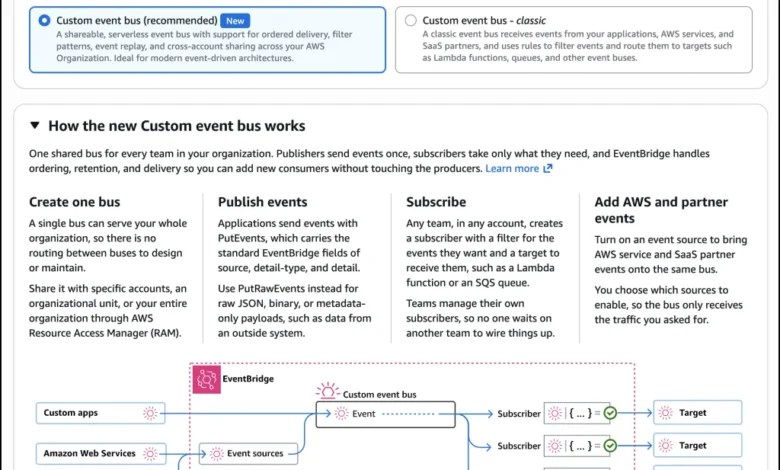
Amazon Web Services (AWS) has officially launched a significant architectural evolution for its serverless routing portfolio with the introduction of enhanced custom event buses in Amazon EventBridge. Designed specifically to alleviate the structural friction inherent in scaling distributed, event-driven systems, the new capability fundamentally rethinks how modern enterprises handle cross-account data flows, event sequencing, content deduplication, and cost allocation. By replacing cumbersome multi-bus workarounds with a single, highly scalable, and centrally shared event backbone, AWS aims to streamline enterprise cloud engineering while preserving the granular isolation demanded by modern microservices architectures.
The Evolution of Event-Driven Topologies and Enterprise Scaling Challenges
To understand the industry significance of this release, it is necessary to examine the historical trajectory of event-driven architectures (EDAs) within large-scale cloud environments. In the early stages of EDA adoption, organizations typically deployed a singular custom event bus housed within a dedicated AWS account. This centralized paradigm functioned reliably when application scopes were narrow and governed by single, cohesive engineering units.
However, as microservices gained ubiquitous enterprise adoption, organizations rapidly pivoted toward multi-account governance models. Following AWS security and operational best practices, companies distributed workloads across hundreds—and in some cases thousands—of distinct AWS accounts, each assigned to specialized development teams.
Routing events across these departmental silos exposed severe architectural limitations in legacy event-bus configurations. To connect isolated accounts, platform engineers were forced to construct intricate webs of cross-account resource policies, rule chains, and bus-to-bus routing pathways. This reactive engineering counteracted the foundational premise of serverless computing: reducing operational overhead. Platform teams routinely lost systemic visibility into publisher-subscriber dependencies, cross-account data routing fees escalated unpredictably due to compounding data transfers, and applications requiring strict event ordering were left with few viable paths forward other than deploying heavy ancillary infrastructure like Amazon Simple Queue Service (SQS) queues or abandoning serverless patterns altogether.
Core Architecture and Technical Innovations of the Enhanced Event Bus

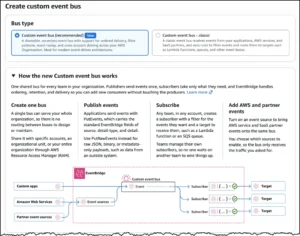
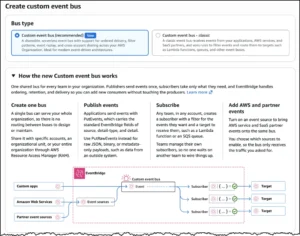
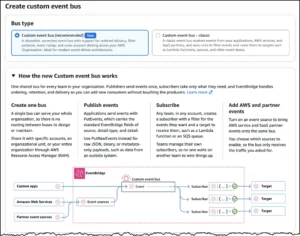
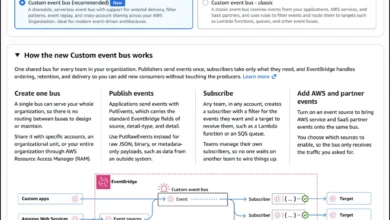
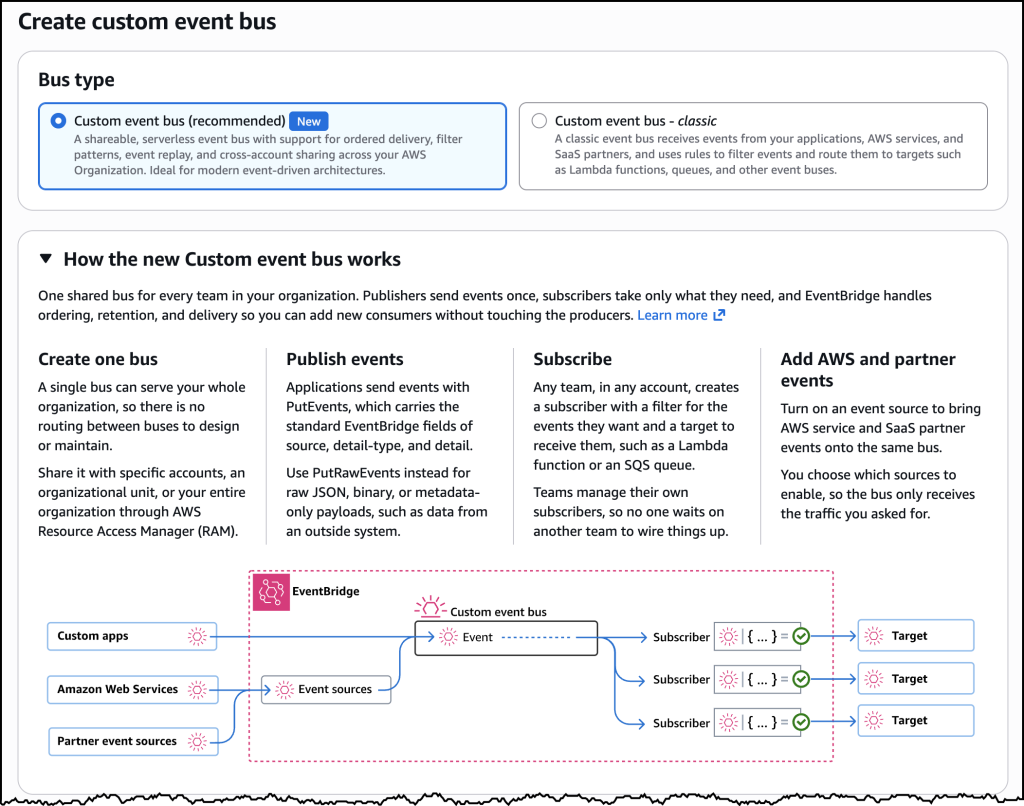
The newly introduced enhanced custom event bus directly addresses these multi-account pain points by providing a native, unified event backbone that spans across an entire AWS Organization. Rather than stitching together disparate resources, platform teams can now provision a single, central event bus and share it securely using native AWS Resource Access Manager (AWS RAM) integrations.
Under this model, publishing applications emit events to the central bus without needing prior knowledge of downstream consumers. Concurrently, subscribers deploy independent Subscriber resources—a unified abstraction that consolidates event filtering, target routing configurations, retry parameters, and dead-letter queue (DLQ) destinations into a single manageable unit. This decoupling empowers individual teams to subscribe to relevant event streams autonomously while enabling platform administrators to retain strict governance, auditability, and visibility across the entire organizational graph.
Crucially, the enhanced bus scales to accommodate up to 10,000 active subscribers by default—a substantial threshold designed to eliminate the artificial segmentation that previously compelled teams to fragment their event flows across multiple discrete buses.
Balancing Asynchronous Flexibility with Strict Event Ordering
A long-standing trade-off in distributed computing has been the friction between high-throughput asynchronous event processing and strict chronological data consistency. While standard event-driven applications thrive on non-blocking, out-of-order execution, specific operational domains—such as financial transactions, inventory ledgering, and real-time logistics tracking—depend heavily on strict chronological integrity. Out-of-sequence telemetry in a fleet-management platform, for instance, can cause downstream routing algorithms to process stale geographical coordinates, resulting in catastrophic operational errors.
The enhanced custom event bus solves this architectural dilemma by supporting hybrid processing paradigms natively on the same bus. Publishers can attach an optional EventGroupId metadata attribute to outbound payloads. EventBridge automatically ensures that events sharing identical group IDs are delivered in exact chronological sequence to consumers configured for ordered delivery, while simultaneously routing those same events to other asynchronous subscribers without sequence constraints.
To operationalize this capability reliably, AWS has introduced synchronous invocation support for destinations such as AWS Lambda. In synchronous mode, EventBridge halts delivery confirmation until the downstream target successfully processes the invocation, effectively removing the historical necessity of interposing SQS queues between the event bus and the compute layer just to guarantee execution order.

Advanced Event Evaluation, Deduplication, and Payload Transformation
Data hygiene and payload adaptation have historically consumed significant development cycles within enterprise integration teams. The enhanced custom event bus introduces robust native capabilities designed to minimize custom boilerplate code:
Content-Based Deduplication: Transient network timeouts, application retries, and partial deployment failures frequently result in duplicate event emissions. The new bus incorporates automated payload hashing that inspects incoming events and collapses identical transmissions arriving within a five-minute window. This provides developers with native exactly-once delivery semantics for sources that lack internal idempotency token generation.
JSONata Transformations: Downstream consumers frequently require specific data schematics that differ from the publisher’s output format. Using integrated JSONata expressions, subscribers can dynamically reshape, extract, filter, or compute new values directly within the subscription rule layer before the payload hits the target application.
Protocol Deserialization: Enterprises operating hybrid messaging standards that utilize Apache Avro or Protocol Buffers can now configure EventBridge to automatically deserialize binary payloads into standard JSON formats. This enables microservices to execute fine-grained filtering and routing across deep payload attributes without requiring custom pre-processing microservices.
Restructuring Cloud Economics with Ingress-Egress Pricing
Beyond technical capabilities, the release restructures the economic model associated with event-driven scale. Legacy multi-bus architectures suffered from compounding financial models where data transit charges accumulated across every hop between cross-account buses.
The enhanced custom event bus transitions to an explicit ingress and egress throughput pricing model. Publishers incur costs exclusively for the volume of data ingested into the central bus, while subscribers pay proportionally for the events delivered to their respective targets. Industry analysts note that this predictable pricing structure heavily favors large-scale enterprise deployments, aligning operational expenditures directly with actual consumption and eliminating hidden multi-hop transit penalties.
Backward Compatibility and Gradual Enterprise Migration
Mindful of the immense installed base of legacy serverless applications running globally, AWS has engineered the enhanced custom event bus as an entirely opt-in, side-by-side resource. Existing event infrastructure will remain fully supported, automatically designated as "Custom event bus – classic" within the management console to distinguish them from the new unified resource type. Organizations retain complete autonomy to migrate workloads incrementally at their own operational pace without requiring risky, wholesale refactoring of existing production pipelines.
Immediate Regional Availability and Deployment Pathways
The enhanced custom event bus is generally available starting today across a broad footprint of global AWS infrastructure. Supported launch regions include US East (N. Virginia, and Ohio), US West (Oregon), Europe (Ireland, Frankfurt, Stockholm, and Spain), and Asia Pacific (Hong Kong, Malaysia, Mumbai, Singapore, Sydney, Thailand, and Tokyo).
Enterprise engineering teams can provision, manage, and configure the new resources immediately using the AWS Management Console, the AWS Command Line Interface (AWS CLI), or automated Infrastructure-as-Code (IaC) APIs. Comprehensive technical documentation and deployment guides are available directly through the official Amazon EventBridge developer portal.
Related posts: