AWS Introduces Enhanced Custom Event Bus for Amazon EventBridge to Simplify Multi-Account Serverless Architectures

Cloud computing architecture has long promised to liberate engineering organizations from the operational overhead of managing physical infrastructure, server fleets, and complex networking topologies. Serverless paradigms, championed by cloud providers like Amazon Web Services (AWS), have significantly accelerated software delivery by allowing developers to focus strictly on writing business logic. However, as organizations scale their adoption of serverless computing, they frequently encounter architectural friction points that reintroduce complexity. A primary challenge has emerged within event-driven architectures built upon Amazon EventBridge, where scaling across multiple AWS accounts forces teams to deploy fragmented, multi-bus topologies plagued by rising costs and diminished visibility.
Addressing these enterprise-scale operational hurdles, AWS has officially announced the launch of an enhanced custom event bus for Amazon EventBridge. Purpose-built to support large-scale organizations operating distributed workloads across multiple teams and accounts, the new offering provides a centralized, organization-wide event backbone. By introducing native ordering guarantees, a streamlined Subscriber resource, and a transparent ingress-and-egress pricing model, the update fundamentally transforms how enterprises handle event routing, delivery mechanics, and cross-account data sharing.
The Evolution of Multi-Account Event Routing Challenges
To understand the strategic significance of the new enhanced custom event bus, one must examine the standard lifecycle of event-driven adoption within modern enterprises. Typically, an organization initiates its serverless journey with a single custom event bus housed inside a solitary AWS account. Under a single-team ownership model, this straightforward architecture operates with high efficiency, low latency, and minimal administrative overhead.
As corporate cloud adoption matures, however, security frameworks, compliance mandates, and organizational scaling principles—collectively endorsed by AWS best practices—dictate the transition toward a multi-account strategy. In this distributed paradigm, individual engineering teams operate within isolated AWS accounts to maintain blast radiuses and enforce granular access control.
To facilitate communication between these isolated accounts, teams historically relied on complex workarounds. They created multiple custom event buses interconnected via cross-account rules or elaborate bus-to-bus configurations. While functional, this architectural pattern inadvertently reintroduces the very operational complexity that serverless frameworks are engineered to eliminate. Platform engineering teams quickly lose comprehensive visibility into which downstream consumers are subscribing to specific upstream events. Furthermore, cross-account and bus-to-bus routing charges compound rapidly, creating unpredictable financial overhead.
Compounding these economic and visibility challenges, teams requiring strict event sequencing—such as those building logistics tracking, financial transaction processing, or inventory management systems—faced severe limitations. Because standard event-driven patterns typically operate asynchronously where message delivery order is not guaranteed, engineers were forced to construct cumbersome workarounds or adopt entirely separate messaging technologies to preserve data integrity.

Core Architectural Innovations of the Enhanced Event Bus
The newly released enhanced custom event bus directly targets these operational bottlenecks through a series of foundational architectural enhancements designed to unify event-driven topologies.
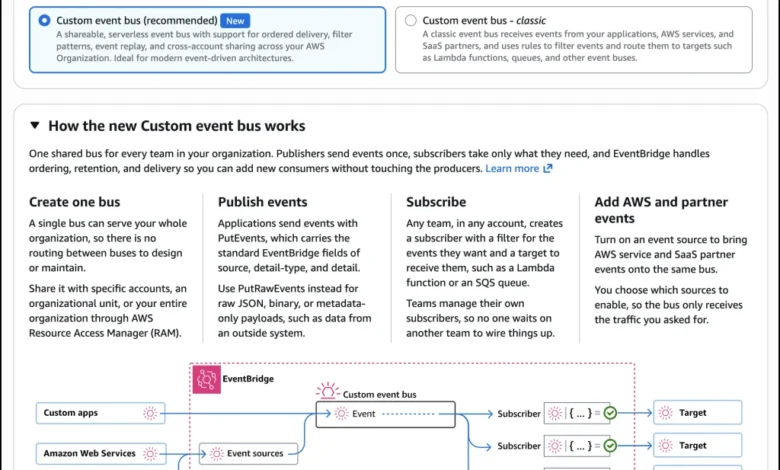
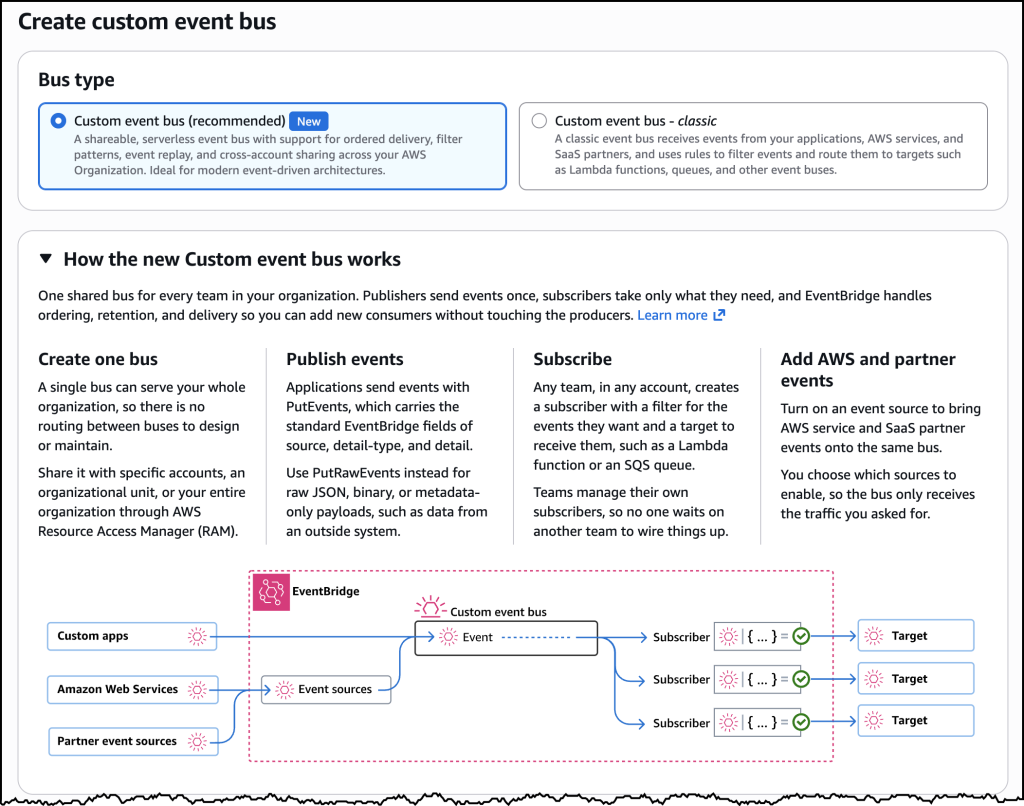
At the center of the solution is organization-wide sharing powered by AWS Resource Access Manager (AWS RAM). Platform engineering teams can now deploy a single, centralized event bus and seamlessly share it across all AWS accounts within an enterprise AWS Organization. This eliminates the necessity of manually configuring intricate cross-account resource policies or managing cascading bus-to-bus routing rules. Application teams can publish and consume events on the shared backbone instantly, operating with autonomy while platform administrators retain rigorous governance and visibility.
To accommodate large enterprise footprints, the enhanced event bus supports a default quota of 10,000 distinct Subscribers per individual bus, with higher thresholds available upon request. This high-density architecture dramatically mitigates the fragmentation historically caused by restrictive subscriber limits.
Balancing Asynchronous Flexibility with Strict Event Ordering
A major technological advancement within the new release is its native support for dual-delivery patterns—allowing both unordered asynchronous consumption and strict event ordering to coexist on the exact same event bus.
While asynchronous, out-of-order event consumption remains an architectural best practice for maximizing system throughput and decoupling microservices, certain industry domains demand absolute sequential processing. For instance, in modern fleet management and logistics applications, real-time vehicle telemetry and driver location updates must be ingested and processed in chronological sequence. If out-of-sequence location events are processed by routing and navigation algorithms, the system risks making critical operational decisions based on stale or contradictory data.
The enhanced custom event bus solves this challenge by enabling publishers to attach an EventGroupId parameter to outgoing event payloads. EventBridge intelligently routes and delivers messages sharing the identical EventGroupId in strict chronological sequence exclusively to subscribers configured for ordered delivery. Meanwhile, other decoupled consumers on the same bus can ingest those identical events asynchronously without performance degradation.

To ensure end-to-end reliability during ordered execution, AWS has integrated synchronous invocation targets for services such as AWS Lambda. Operating in synchronous mode, EventBridge confirms successful downstream processing before officially acknowledging the event. This capability removes the legacy requirement of interposing Amazon Simple Queue Service (Amazon SQS) queues between an event bus and compute functions merely to guarantee sequential processing.
Streamlined Management via the New Subscriber Resource
Simplifying administrative overhead, the updated event bus introduces a unified Subscriber resource. Historically, configuring event filtering, target bindings, custom retry policies, and dead-letter queue (DLQ) destinations required the deployment and maintenance of numerous disparate rules and target resources across multiple management planes.
The new Subscriber resource consolidates these operations into a single manageable entity. Each consumer defines its precise subscription criteria, destination endpoints, and failure-handling parameters within one cohesive resource definition. Additionally, variable start-time capabilities empower engineering teams to rapidly onboard new consumers, execute historical event replays for system recovery, or hydrate new data lakes with minimal friction.
Advanced Event Evaluation, Deduplication, and Transformation
Data hygiene and payload transformation have also received substantial upgrades. Publishers can now activate content-based deduplication directly on the event bus. When network timeouts, transient infrastructure failures, or application retries cause duplicate payloads to be transmitted, EventBridge automatically computes cryptographic hashes of meaningful payload attributes. Matches arriving within a five-minute sliding window are systematically collapsed, achieving true exactly-once delivery semantics for upstream sources incapable of generating native idempotency tokens.
For downstream subscribers requiring customized data formats, the integration of JSONata expressions allows applications to reshape incoming payloads dynamically on the fly. Subscribers can extract specific fields, rename parameters, or compute derived values directly within the routing layer before the payload reaches the target endpoint. Furthermore, for organizations utilizing binary serialization formats such as Apache Avro or Protocol Buffers, EventBridge provides native deserialization capabilities. Subscribers can evaluate fine-grained filter patterns and execute routing logic against the full event payload without executing resource-intensive local deserialization routines.
Financial Restructuring Through a Modernized Pricing Model
Economic scalability is a critical consideration for enterprise cloud architectures. To eliminate the compounding cost penalties associated with legacy multi-bus configurations, AWS has implemented a transparent ingress and egress throughput pricing model for the enhanced custom event bus.
Under this updated financial framework, publishers incur costs based strictly on the volume of events ingested, while subscribers pay for events successfully delivered. This structural shift replaces the complex per-event billing model of the past, significantly improving cost allocation transparency and economic efficiency for organizations scaling event-driven microservices across hundreds of accounts.
Backward Compatibility and Gradual Migration Paths
To protect existing enterprise investments, AWS has designed the enhanced custom event bus as a fully non-breaking addition to the Amazon EventBridge ecosystem. Legacy event buses will continue to operate without disruption, automatically categorized in management consoles as Custom event bus — classic.
Organizations retain the complete autonomy to adopt the new enhanced event bus at their own operational pace. The new resource is fully accessible across the AWS Management Console, the AWS Command Line Interface (AWS CLI), and standard EventBridge programmatic APIs.
Immediate Global Availability
The enhanced custom event bus for Amazon EventBridge is available immediately to customers worldwide. Initial regional availability spans key strategic cloud hubs, including US East (N. Virginia, Ohio), US West (Oregon), Europe (Ireland, Frankfurt, Stockholm, Spain), and Asia Pacific (Hong Kong, Malaysia, Mumbai, Singapore, Sydney, Thailand, Tokyo) Regions.
Industry analysts note that this strategic release underscores AWS’s ongoing commitment to refining serverless infrastructure for large-scale enterprise environments. By directly addressing the structural friction of multi-account governance, event ordering, and cost predictability, Amazon EventBridge reinforces its position as a foundational messaging backbone for modern cloud-native enterprises. Engineering teams seeking to modernize their event-driven topologies can begin deploying the new capabilities immediately through the standard AWS documentation and management console interfaces.