AWS Introduces Enhanced Custom Event Bus for Amazon EventBridge to Streamline Multi-Account Serverless Architectures

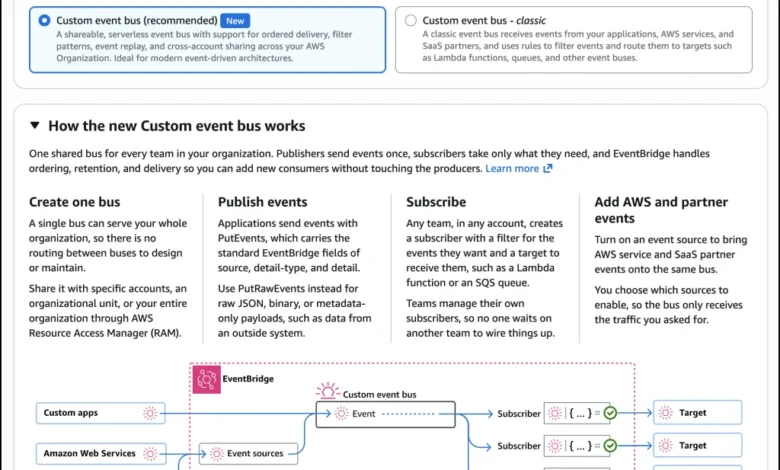
Amazon Web Services (AWS) has officially announced the launch of an enhanced custom event bus for Amazon EventBridge, a major architectural upgrade designed to simplify the deployment and management of event-driven applications across complex, multi-account organizational structures. Traditionally, organizations building serverless applications on AWS begin with a single custom event bus within a solitary account. However, as cloud adoption scales and more teams onboard onto the platform, adhering to AWS multi-account best practices introduces significant operational friction. The newly released enhanced custom event bus aims to eliminate these long-standing architectural bottlenecks by providing a centralized, organization-wide event backbone that supports native resource sharing, strict event ordering, advanced subscription management, and an optimized pricing framework.
Main Facts of the Release
The newly available enhanced custom event bus addresses the core complexities associated with scaling event-driven topologies across distributed enterprise environments. Under previous architectural paradigms, scaling an event-driven framework required teams to deploy multiple custom event buses linked together through intricate cross-account rules or bus-to-bus configurations. This workaround inadvertently reintroduced the operational overhead that serverless computing was originally designed to remove.
Platform engineering teams frequently struggled with a lack of visibility regarding who was subscribing to specific events. Furthermore, compounding routing charges across multiple buses escalated infrastructure costs, while applications demanding strict event ordering were forced to implement cumbersome custom workarounds or migrate to entirely separate message-processing technologies.
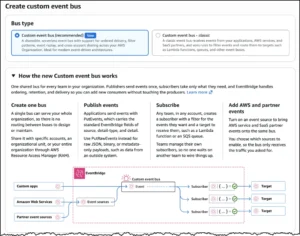
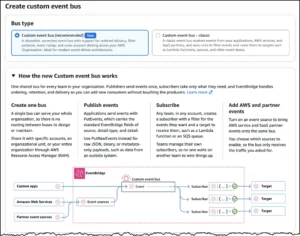
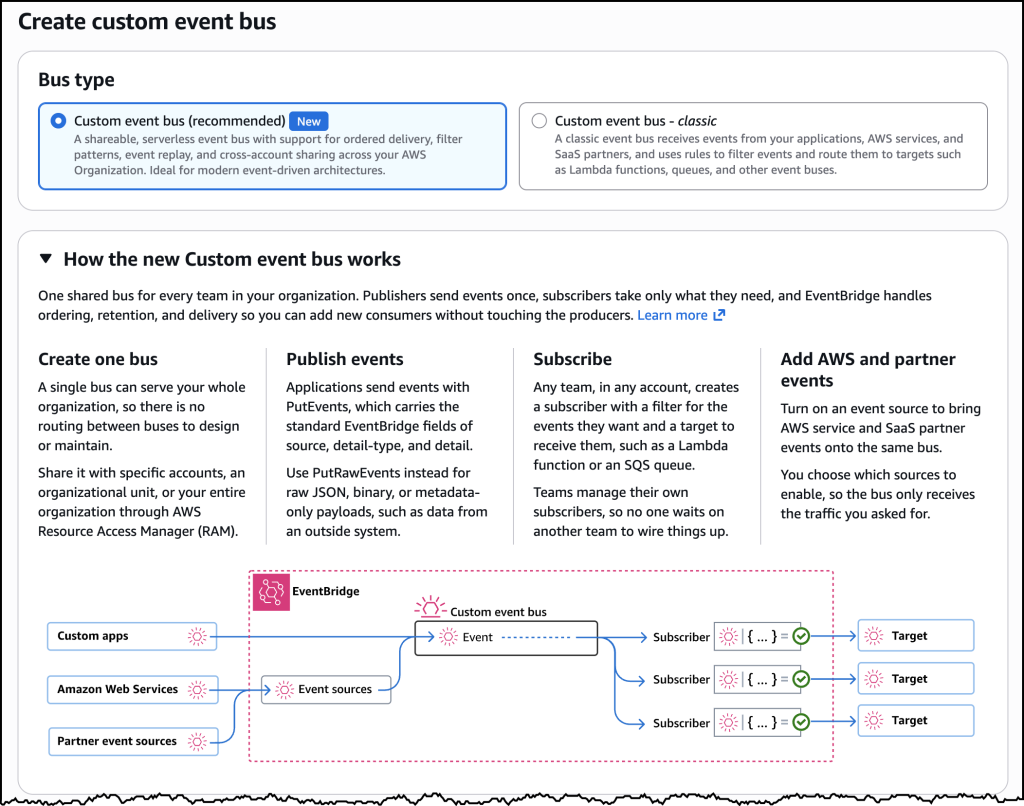
The newly introduced enhanced custom event bus resolves these challenges by allowing platform administrators to deploy a single, centralized event bus that spans all AWS accounts within an entire AWS organization. Key features of this release include:

- Organization-wide resource sharing via AWS Resource Access Manager (AWS RAM), eliminating manual cross-account permission configurations.
- Native event ordering guarantees driven by unique
EventGroupIdparameters, removing the necessity of placing Amazon SQS queues between event buses and AWS Lambda targets for sequential processing. - A streamlined Subscriber resource that consolidates event filtering, target configurations, retry policies, and dead-letter queue destinations into a single manageable entity.
- Content-based deduplication to achieve exactly-once delivery semantics for event sources that cannot natively generate reliable deduplication tokens.
- Payload transformation capabilities using JSONata, alongside native deserialization for Apache Avro and Protocol Buffers events.
- A decoupled ingress and egress throughput pricing model that charges publishers for ingested events and subscribers for delivered events, replacing compounding multi-bus routing fees.
Chronology and Background Context of the Event
The evolution of Amazon EventBridge reflects the broader maturation of serverless computing within enterprise environments. When Amazon EventBridge was originally introduced as an evolution of Amazon CloudWatch Events, it served primarily as a serverless event bus connecting application data from AWS services, SaaS applications, and custom sources. As enterprises increasingly embraced microservices and domain-driven design, event-driven architectures became the preferred pattern for building scalable, loosely coupled systems.
Over the past several years, enterprise adoption of AWS Control Tower and multi-account strategies—mandated for security, compliance, and isolation—created a fundamental architectural tension. While multi-account governance secured cloud environments, it fragmented event routing. Teams had to manually wire cross-account permissions, manage complex resource-based policies, and navigate strict limits on rules and targets per bus.
Recognizing these friction points, AWS engineering teams began developing a native architectural solution that could bridge organizational boundaries without sacrificing governance or performance. The culmination of this development effort is the enhanced custom event bus, which transitions EventBridge from a siloed, account-centric model to a unified, organization-wide fabric. Existing workloads will remain unaffected, as legacy implementations continue to operate seamlessly under the newly designated "Custom event bus – classic" classification, allowing organizations to adopt the new enhanced bus at their own operational pace.
Supporting Data and Architectural Capabilities
The technical specifications of the enhanced custom event bus highlight its readiness for enterprise-grade workloads. Out of the box, the new bus supports a default quota of 10,000 Subscribers per individual event bus, a substantial threshold designed to mitigate the fragmentation that previously forced platform teams to provision multiple auxiliary buses.

Event ordering, a critical requirement for state-sensitive domains such as logistics, financial transaction processing, and supply chain tracking, is handled natively. By incorporating an EventGroupId into the event payload, publishers ensure that related events are delivered sequentially to subscribers configured for ordered processing, while concurrent, non-dependent event streams continue to flow asynchronously without artificial latency. This ordered delivery mechanism pairs with synchronous invocation targets, such as AWS Lambda, which confirm successful processing prior to acknowledging the event upstream.
Data ingestion and transformation have also been modernized. Content-based deduplication utilizes algorithmic payload hashing to identify and discard duplicate event transmissions arriving within a five-minute window, protecting downstream consumers from redundant processing caused by network timeouts or retries. Additionally, the integration of JSONata expression evaluation enables consumers to reshape, extract, or compute new values from event payloads dynamically at the subscription layer, minimizing the need for custom data-transformation proxy layers. For organizations utilizing binary serialization standards, native deserialization of Apache Avro and Protocol Buffers allows fine-grained filtering across the entire event payload without requiring upfront manual decoding by subscribers.
Official Responses and Industry Implications
While formal public commentary from third-party enterprise clients is currently rolling out alongside the regional deployment, early institutional reaction from cloud architects and platform engineers has focused heavily on the economic and operational shifts promised by the new model.
Industry analysts note that the introduction of a decoupled ingress-and-egress pricing structure directly addresses long-standing customer feedback regarding the unpredictable cost scaling of multi-bus topologies. By separating publisher costs from subscriber costs, AWS has aligned cloud expenditure more accurately with actual resource consumption, providing clearer cost-allocation metrics for enterprise financial governance (FinOps) teams.
Furthermore, the integration with AWS RAM significantly reduces the administrative burden on central cloud operations teams. Rather than managing sprawling JSON-based resource policies and brittle cross-account trust relationships, platform administrators can delegate subscription management safely across organizational units (OUs) and specific AWS account boundaries with minimal friction.
Broader Impact and Future Outlook
The launch of the enhanced custom event bus marks a pivotal milestone in the maturation of serverless event-driven architectures. By bridging the gap between stringent multi-account security governance and the fluid, real-time collaboration required by modern software development teams, AWS has effectively redefined how enterprise event backbones are constructed.
As microservices proliferation continues to accelerate across global enterprises, the demand for centralized, highly observable, and scalable event routing will only intensify. The capabilities introduced in this release—ranging from granular subscriber resource management to native sequence ordering and advanced payload transformation—position Amazon EventBridge to capture an even larger share of enterprise mission-critical event processing workloads.
The enhanced custom event bus is currently available across a broad footprint of global AWS Regions, including US East (N. Virginia, Ohio), US West (Oregon), multiple European hubs (Ireland, Frankfurt, Stockholm, Spain), and key Asia-Pacific markets (Hong Kong, Malaysia, Mumbai, Singapore, Sydney, Thailand, Tokyo). Organizations can provision the new resource immediately via the AWS Management Console, the AWS Command Line Interface (AWS CLI), or programmatic EventBridge APIs, signaling a new era of streamlined, organization-wide serverless connectivity.
Related posts: