The dawn of autonomous maritime warfare has arrived as Ukraine scores the first recorded victory in a drone-on-drone naval engagement.

On September 12, a significant shift in modern naval doctrine occurred in the contested waters of the Black Sea. For the first time in recorded military history, two uncrewed surface vessels (USVs) engaged in a direct combat scenario, moving beyond the traditional paradigm of drones targeting stationary ships or infrastructure. The encounter, which resulted in the destruction of a Russian explosive-laden craft by a Ukrainian counterpart, marks a definitive evolution in the Russo-Ukrainian War—a conflict that has become the world’s premier laboratory for the integration of robotics into frontline combat.
The Anatomy of an Unprecedented Engagement
The incident took place under the observation of Ukraine’s Defense Intelligence, which identified a Russian explosive USV operating within the Black Sea theater. The Russian vessel, identified by naval analysts as an "Orcan" class drone, is a platform engineered for lethality. These vessels are typically built with a jet-ski-style water-jet propulsion system, allowing for high-speed maneuverability. Their primary mission profile is a "kamikaze" strike: navigating toward high-value maritime targets or port infrastructure to detonate a substantial explosive payload upon impact.
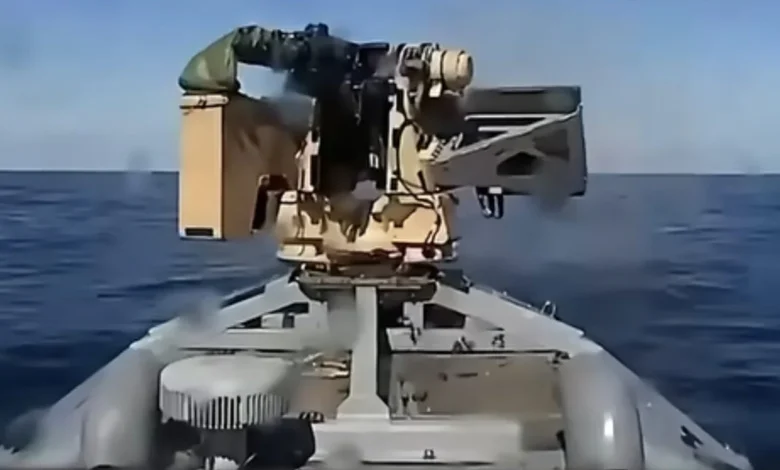
Ukraine’s response was immediate and calculated. Upon detection, intelligence officials vectored a Ukrainian Sargan-3000 USV to intercept the intruder. Unlike the Russian Orcan, which is designed purely for impact, the Sargan-3000 represents a more sophisticated tier of maritime robotics. It is equipped with a remote-controlled weapon station (RCWS) featuring a 12.7 mm heavy machine gun, produced by the Norwegian defense contractor Kongsberg.
Footage released by the Ukrainian Navy captures the clinical precision of the engagement. Operating from a distance of approximately one kilometer, the Ukrainian operator utilized the Sargan-3000’s sensor suite to track the Russian drone. The engagement began with precision fire aimed at disabling the Russian vessel’s communications antenna—a strategic move that effectively blinded the enemy drone before a sustained burst of fire caused the Russian craft to take on water and sink.
The Role of Asymmetric Maritime Warfare
The Black Sea has become the central arena for what military analysts describe as a "drone revolution" in naval warfare. Since the onset of the full-scale invasion in 2022, the Ukrainian Navy—outgunned in traditional capital ships—has successfully leveraged low-cost, high-impact USVs to challenge the Russian Black Sea Fleet’s dominance.
The Russian Orcan drones, often utilized in tandem with aerial assets like the Iranian-designed Geran-2 loitering munitions, represent a multi-domain approach to asymmetric warfare. The Geran drones act as both reconnaissance eyes and communication relays, allowing Russian operators to guide their USVs with greater accuracy against Ukrainian coastal defenses. By integrating air and sea assets, the Russian military has sought to overwhelm Ukrainian air defense systems and maritime patrols simultaneously.
However, the September 12 engagement suggests that the tactical advantage is shifting. By arming their USVs with kinetic weaponry rather than relying solely on explosive payloads, the Ukrainian military has introduced a "hunter-killer" capability to their fleet. This development forces the Russian military to reconsider its reliance on uncrewed maritime platforms, as these vessels can no longer operate in the Black Sea with the assumption that they are safe from interception.
Timeline of the Drone Evolution
The transition from passive observation to active USV-on-USV combat did not occur overnight. It is the culmination of a rapid technological arms race.
- Early 2022: Initial deployment of commercial-grade flying drones for reconnaissance and artillery spotting.
- Late 2022: Introduction of the first generation of Ukrainian "kamikaze" sea drones, which successfully targeted the flagship Admiral Makarov and other Russian vessels in Sevastopol.
- 2023: Russia begins to deploy its own USV programs, including the Orcan platform, to counter Ukrainian maritime activity.
- Mid-2024: Ukraine begins experimenting with arming USVs with anti-air missiles and machine guns, anticipating the need for self-defense and anti-drone capabilities.
- September 12, 2024: The first recorded kinetic engagement between two opposing USVs, resulting in the destruction of the Russian craft.
Strategic Implications for Global Naval Doctrine
The implications of this duel extend far beyond the Black Sea. Navies around the world, including those of the United States, China, and the United Kingdom, have been closely monitoring the conflict to refine their own autonomous systems. The success of the Sargan-3000 confirms a long-held suspicion among defense planners: that future maritime conflicts will be characterized by swarms of autonomous systems where speed, sensor fusion, and remote intervention determine the victor.
"It was inevitable that there would be USV-on-USV combat," noted naval analyst HI Sutton. "We have seen the same in the air and on the ground. When both sides possess a proliferation of uncrewed platforms, the combat space becomes saturated with these systems, making contact inevitable."
For the Russian Black Sea Fleet, the loss of their drone boat signifies a vulnerability in their current doctrine. If their autonomous assets can be hunted down and destroyed at a range of one kilometer, the cost-benefit analysis of deploying these drones changes significantly. It necessitates the development of more heavily armored drones, or the escorting of USVs by other armed platforms, which complicates the logistical footprint of Russian maritime operations.
Technological Hurdles and Future Trends
Despite the Ukrainian success, the engagement highlights several persistent challenges in the field of autonomous naval warfare. Signal latency, the stability of satellite links (often provided by platforms like Starlink), and the difficulty of tracking small, low-profile targets in high-sea states remain significant hurdles.
The Sargan-3000’s success relied on the operator’s ability to stabilize the weapon platform despite the motion of the water. Future iterations of these drones will likely incorporate AI-driven target tracking and fire control systems to compensate for the erratic movement of both the attacker and the target. This integration would theoretically allow a single operator to manage a swarm of USVs, with the AI handling the complexities of aiming and firing during high-speed chases.
Furthermore, the integration of non-kinetic measures—such as electronic warfare (EW) suites designed to jam communication signals between the Russian drone and its controller—will likely become a standard feature of future USV designs. If the operator cannot "see" through the drone’s camera, the vessel effectively becomes a ghost, drifting aimlessly until it runs out of fuel.
Official Responses and Media Coverage
The Ukrainian government has utilized the success of this engagement as a public relations victory, highlighting the technological ingenuity of their forces. By releasing the footage through channels like United24, the government aims to demonstrate that, despite the ongoing resource gap between Russia and Ukraine, technological adaptation remains a viable path to attrition.
Russian officials have remained largely silent on the specific loss of the Orcan drone, following a broader pattern of downplaying losses in the maritime domain. However, the incident has sparked significant debate within Russian military-focused Telegram channels, where analysts have begun calling for "up-arming" Russian maritime drones to include defensive systems capable of engaging incoming threats.
The Future of "Robot-on-Robot" Warfare
As the war enters its next phase, the precedent set on September 12 will likely catalyze a new wave of research and development. Defense contractors are already rushing to provide "counter-drone" solutions for naval vessels, including high-energy lasers, directed-energy weapons, and small-caliber automated cannons.
The battlefield of the future will not only be defined by who has the most drones, but by who has the most effective "drone-killers." The ability of a small, remote-controlled boat to act as an interceptor changes the geometry of naval blockade and coastal defense. It effectively creates a "no-go zone" for uncrewed platforms, forcing commanders to reconsider whether the risk of losing a drone in an encounter is worth the potential intelligence or offensive gain.
Ultimately, the clash between the Sargan-3000 and the Orcan is a microcosm of the modern age. It is a sterile, remote-controlled interaction that carries devastatingly real-world consequences. As technology continues to outpace policy, the world’s navies must grapple with a new reality where the most critical engagements may not involve sailors at all, but rather engineers and operators sitting thousands of miles—or simply miles—away from the front lines, navigating the cold, dark waters of the Black Sea through a screen.
The era of robotic naval combat has moved from the realm of science fiction to a daily reality. The September 12 engagement is likely just the first of many such duels, setting the stage for a future where the seas are contested by fleets of machines, and the human element of war is relegated to the roles of overseer and architect.
Related posts: