Optimizing AI Agent Performance Through Markdown Data Streamlining and Token Efficiency

The rapid proliferation of autonomous AI agents has fundamentally altered how developers interact with web data. While these agents provide unprecedented capabilities in research, automation, and content generation, they bring a hidden operational tax: the massive consumption of context window tokens. As agents engage in recursive loops, multi-step search queries, and intensive file retrieval, the cost of processing raw data formats—particularly bloated JSON structures—has become a significant bottleneck for enterprise-scale AI deployment. A recent shift toward Markdown-based data delivery, championed by industry leaders like SerpApi, represents a critical evolution in how developers manage these overhead costs without sacrificing the intelligence of their agentic systems.
The Token Economy in Agentic Systems
In the current landscape of Large Language Models (LLMs), the context window—the "working memory" of the model—is the most precious resource. When an AI agent initiates a search, the resulting payload often includes thousands of tokens dedicated to metadata, tracking scripts, CSS classes, and deeply nested JSON object structures. These elements are essential for traditional web browsers and software APIs, but they are largely redundant for an LLM tasked with summarizing information or extracting insights.
A standard search query for common information can easily balloon into a payload of 20,000 to 30,000 tokens. This is not merely a financial concern; it is a performance limitation. Every token consumed by metadata is a token that cannot be used for the model’s actual reasoning, instruction following, or long-form output. By consuming massive blocks of noise, agents reach their context limits faster, trigger unnecessary re-queries, and incur latency that degrades the end-user experience.
The Evolution of Data Delivery: From JSON to Markdown
For years, JSON (JavaScript Object Notation) has been the industry standard for API communication. Its rigid structure and type-safety make it ideal for back-end engineering and database interactions. However, the rise of LLMs has created a misalignment between the data format and the consumer. LLMs do not require the strict typing or nested array structures that a typical application back-end demands; they prioritize semantic coherence.
The introduction of Markdown-formatted search outputs serves as a bridge between structured data and natural language processing. By stripping away non-essential schema elements—such as internal tracking links, redundant metadata fields, and excessive structural brackets—Markdown allows the LLM to process the same informational content with a drastically smaller footprint.
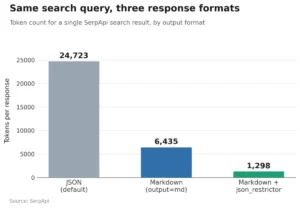
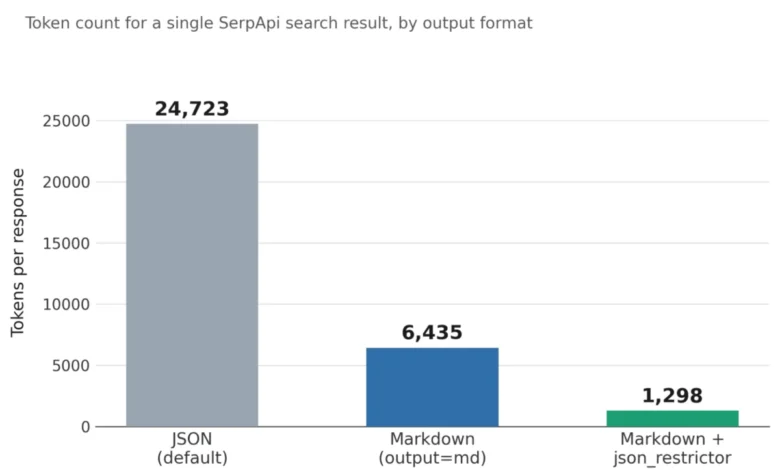
In comparative benchmarks, the shift is stark. A search query for "coffee" that yielded 24,723 tokens in standard JSON format was reduced to 6,435 tokens when processed through a Markdown-optimized stream. This represents a 74% reduction in token usage. For advanced applications, applying further field-specific filtering can drive this number down to approximately 1,298 tokens. This efficiency gain allows developers to fit more search results into a single context window, effectively increasing the "reasoning capacity" of the agent by nearly 20-fold in some configurations.
Chronology of the Token Bottleneck
The current crisis of token efficiency is the result of a three-year acceleration in agentic research.
- 2021–2022: Developers primarily used LLMs for single-turn tasks. Token costs were significant but manageable, as most interaction occurred via web interfaces or simple API calls that did not require deep web context.
- 2023: The emergence of "Agentic Workflows"—where models autonomously browse the web and perform multi-step research—led to a surge in token usage. Organizations began reporting that 70% of their API costs were tied to "input tokens" (the data being sent to the model) rather than "output tokens."
- Early 2024: Industry focus shifted toward "Context Optimization." Companies began experimenting with aggressive pruning, RAG (Retrieval-Augmented Generation) optimization, and custom prompt engineering to reduce input bloat.
- Late 2024–Present: The formalization of Markdown-based API outputs has emerged as a standardized solution, allowing developers to choose between structural precision (JSON) and linguistic efficiency (Markdown).
Comparative Analysis: When to Use Which Format
It is vital to recognize that Markdown is not a universal replacement for JSON. The choice between the two depends entirely on the downstream requirements of the pipeline.
The Case for JSON:
If an AI agent is feeding data into a transactional system, such as a pricing engine, a stock inventory database, or a financial analysis tool, JSON remains the superior choice. Its strict data typing (e.g., distinguishing between a float for price and an integer for review counts) is essential for preventing calculation errors. In these scenarios, the cost of tokens is a necessary investment in data integrity.
The Case for Markdown:
Markdown is optimal for RAG pipelines, summarization tasks, and research agents where the primary goal is synthesis rather than calculation. Because Markdown utilizes tables, headers, and plain text, it mimics the format of the data the LLM was trained on. This allows the model to "understand" the information more naturally, often leading to better extraction results even with fewer tokens.
Strategic Implementation and Technical Integration
SerpApi has pioneered this transition by integrating a "single switch" architecture, allowing developers to request Markdown outputs via simple query parameters or header modifications. This implementation is significant because it shifts the burden of data transformation from the client-side to the server-side.
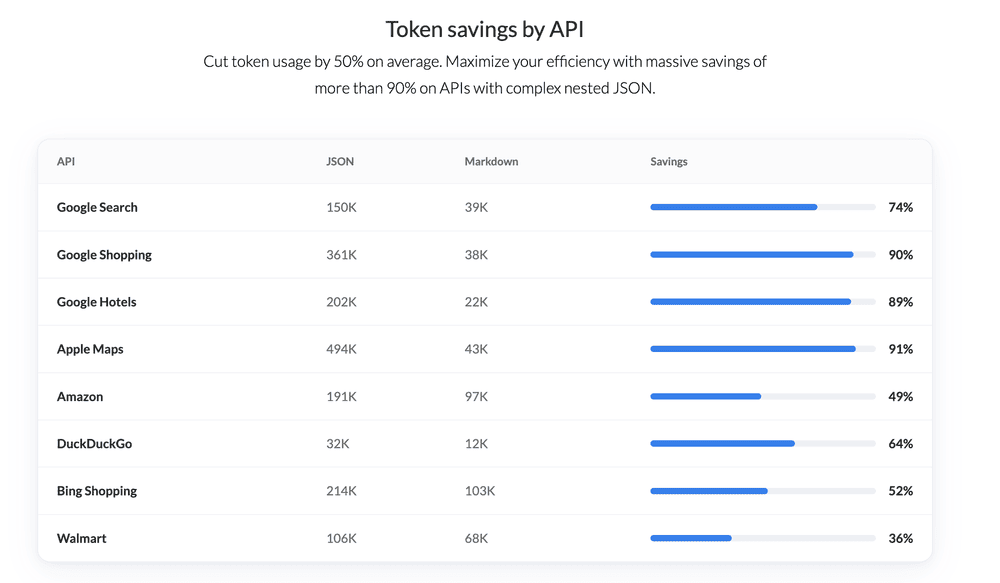
By performing the pruning on the server before the data crosses the network, developers save not only on token costs but also on bandwidth. The implementation allows for the inclusion of YAML frontmatter—which provides necessary context about the search—while discarding tracking noise. Furthermore, the use of json_restrictor tools allows for granular control over the fields returned, effectively allowing developers to build a "custom API" for their specific agent requirements.
Implications for the Future of AI Development
The implications of this shift are profound for both startups and enterprise organizations. As companies move from prototyping to production-grade AI, the cost per query becomes a defining metric of success. If a startup can run an AI agent at 25% of the token cost of its competitors, it gains a substantial competitive advantage in pricing and scalability.
Moreover, the "context window" is no longer just a hardware constraint; it is a management challenge. Developers who treat their data streams as an optimization problem will outperform those who treat them as an immutable input. We are moving toward a future where "Data Shaping"—the intentional design of the information payload to match the cognitive architecture of the LLM—will become a core competency of the software engineering profession.
As we look toward the next generation of models, the demand for efficiency will only grow. While future models may feature larger context windows, the cost of processing that context is unlikely to vanish. Therefore, the adoption of Markdown-optimized API streams, field-level restriction, and intelligent data pruning represents the most pragmatic path toward sustainable, high-performance AI deployment. Developers are encouraged to conduct their own A/B testing—measuring the token delta between raw JSON and optimized Markdown—to determine the specific ROI for their individual workflows. By treating token consumption as an engineering variable rather than a fixed cost, developers can ensure their agentic systems remain both intelligent and economically viable in a rapidly scaling market.