Living with the Ferrari Purosangue: A Deep Dive into the Practicality and Performance of the Maranello Utility

The Ferrari Purosangue represents a watershed moment in the storied history of the Prancing Horse, signaling the manufacturer’s definitive entry into the high-performance utility segment. For decades, the automotive world speculated on whether Ferrari would ever produce an SUV. Following years of internal deliberation and public denials, the Purosangue emerged not as a traditional utility vehicle, but as a "four-door, four-seater" designed to maintain the performance pedigree of a grand tourer while offering the versatility of a daily driver. Priced at a base MSRP of $393,350, the vehicle is a testament to Ferrari’s commitment to internal combustion in an increasingly electrified landscape, even as the company concurrently develops its battery-electric "Luce" platform.
Ergonomics and the Human-Machine Interface
One of the most significant departures in the Purosangue compared to recent Ferrari offerings, such as the 296 GTB, is the approach to driver controls. While the 296 faced criticism for its reliance on capacitive touch surfaces—which many testers found cumbersome during high-speed driving—the Purosangue maintains a more traditional philosophy. The multifunction steering wheel features physical, tactile buttons. This design choice is critical; it allows the driver to manage vehicle functions, including Apple CarPlay integration, without diverting their gaze from the road.
When a driver activates CarPlay, the interface appears directly in the primary instrument cluster, effectively supplanting the digital tachometer. This integration is seamless, though it underscores a broader design philosophy: Ferrari prefers to avoid a traditional central infotainment display. Instead, the cabin is organized around the driver and the front passenger, each receiving their own dedicated display panels. The front-seat passenger has access to a dedicated screen for media consumption and vehicle telemetry, though this screen is polarized to prevent the driver from being distracted by the passenger’s activity.
Despite these successes, certain secondary controls prove more challenging. Climate control and seat settings are managed through a retractable, rotating controller that emerges from the dashboard. This interface requires the user to swipe or tap on a small touchscreen. While intuitive when the vehicle is parked, the small target areas for digital inputs can be difficult to navigate while the vehicle is in motion, representing a rare ergonomic stumble in an otherwise highly engineered cockpit. A similar, though smaller, dial is located between the rear seats to grant passengers control over their own comfort settings.
The Purosangue in Context: Design and Market Positioning
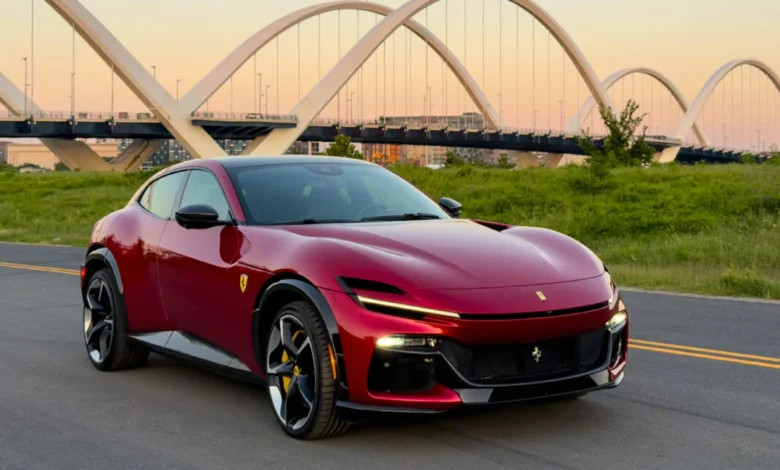
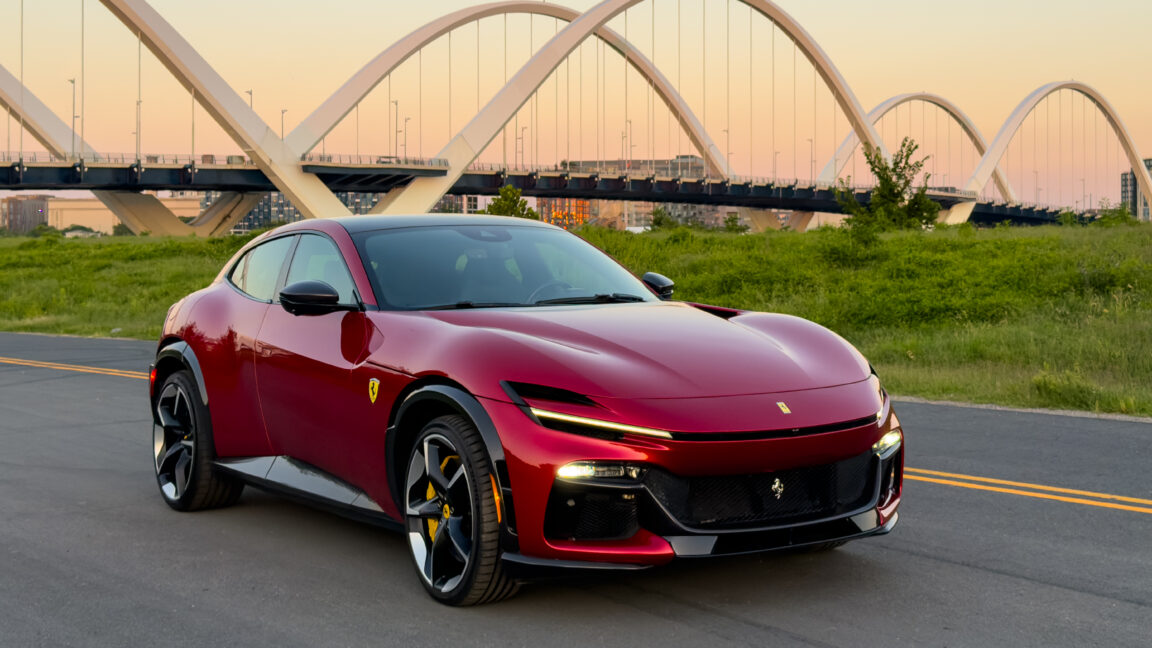
The Purosangue arrived in a distinct shade of Rosso Portofino, a color that highlights the vehicle’s complex bodywork. Unlike the yellow-green metallic variants seen during earlier press events in Rome, the Rosso Portofino finish emphasizes the aerodynamic sculpting required to manage airflow over a high-riding silhouette.
Ferrari’s customization programs, specifically the "Atelier" and "Tailor Made" services, allow for near-infinite levels of personalization. This is a critical aspect of the Purosangue’s value proposition; at a starting price of $393,350, the vehicle is merely a baseline. Our test unit, heavily optioned to showcase the breadth of Ferrari’s material palette, reached a total price of $576,544. This places the Purosangue in a pricing tier significantly above its primary competitors, such as the Aston Martin DBX and the Lamborghini Urus SE.
From a market perspective, Ferrari’s strategy is clear: they are not competing on price, but on exclusivity and brand heritage. By limiting production to roughly 20 percent of their total annual output, Ferrari ensures that the Purosangue remains a rare sight, protecting residual values and maintaining the brand’s luxury cachet.
Engineering the V12 for the Modern Era
At the heart of the Purosangue lies a naturally aspirated 6.5-liter V12 engine, a masterpiece of Italian engineering that stands in stark contrast to the turbocharged or hybrid powerplants becoming standard in the SUV segment. The engine produces 715 horsepower and 528 lb-ft of torque. This powertrain is essential to the Purosangue’s character, providing a linear power delivery and a distinctive acoustic signature that current hybrid or electric alternatives cannot replicate.
However, the reality of daily driving a V12 in the 21st century comes with trade-offs. The fuel efficiency, rated at approximately 12 mpg combined (19.6 L/100 km), reflects the engine’s thirst for high-octane fuel. While this is not unexpected for a high-displacement V12, it marks the Purosangue as a "weekend" daily driver rather than a high-mileage commuter. For those requiring lower emissions and higher efficiency, Ferrari’s upcoming battery-electric projects are expected to fill the gap.
Chronology and Development
The trajectory of the Purosangue can be traced back to the late 2010s, as Ferrari recognized shifting consumer preferences toward high-riding, all-wheel-drive vehicles.
- 2018: Ferrari officially confirms the development of a "utility vehicle" under the code name "Purosangue" (Italian for "thoroughbred").
- 2021: Early engineering mules are spotted undergoing cold-weather testing, confirming the use of a V12 and an all-wheel-drive system.
- September 2022: The official global reveal takes place at the Teatro del Silenzio in Tuscany, confirming a front-mid-engine layout with a transaxle gearbox.
- 2023-2024: Initial customer deliveries commence, with global demand far outstripping the allocated production capacity.
- 2025: The Purosangue cements its status as a core pillar of the Ferrari lineup, with secondary market prices remaining significantly above MSRP.
Implications of the Purosangue
The success of the Purosangue has forced a re-evaluation of the "super-SUV" category. Before its arrival, the market was dominated by vehicles that were essentially modified versions of mass-market luxury platforms. The Purosangue, by contrast, utilizes a unique architecture that incorporates active suspension technology, allowing the car to manage its center of gravity without the need for traditional anti-roll bars.
The inclusion of two rear seats—which are as supportive as the front chairs—and a surprisingly usable cargo area, suggests that Ferrari is successfully targeting a demographic that previously had to look toward brands like Bentley or Rolls-Royce for luxury, or Porsche for performance. The Purosangue effectively combines these two worlds.
Conclusion
The Ferrari Purosangue is a paradox. It is a vehicle that ignores the industry trend toward massive infotainment screens, yet it is arguably one of the most technologically advanced cars on the road today. It is a four-door vehicle that handles with the precision of a mid-engine sports car, and a heavy utility vehicle that manages to feel unmistakably like a Ferrari.
While the fuel economy and the complex interface of the climate control dials are notable drawbacks, they are arguably overshadowed by the experience of the V12 engine and the vehicle’s inherent "specialness." For the owner who values the visceral sensation of high-performance driving but requires the utility of a four-seater, the Purosangue is currently without peer. Whether it will be viewed as a historical anomaly or a long-term blueprint for the future of the brand remains to be seen, but for now, it stands as the most ambitious vehicle to ever roll out of the Maranello factory. The Purosangue is not just a car; it is a statement that even when Ferrari plays by the rules of the utility segment, it does so entirely on its own terms.