Governing the Agentic Enterprise: Mastering the Economics of AI Scaling on Microsoft Foundry


As artificial intelligence transitions from experimental pilot projects into the bedrock of enterprise operations, IT leadership faces a defining challenge: how to govern autonomous systems that possess the capacity to act, scale, and consume resources at speeds far exceeding traditional software architectures. This article serves as the conclusion to the four-part series, The Economics of Agent Optimization, which outlines the methodologies for managing AI as a rigorous, managed investment system within the Microsoft Foundry ecosystem. While earlier installments focused on runtime request management, long-term workflow refinement, and contextual engineering, this final chapter addresses the most critical pillar of sustained AI adoption: continuous financial and operational governance.

The shift toward agentic AI—where autonomous entities connect to disparate data sources, utilize complex toolchains, and make independent decisions—has necessitated a rethink of traditional IT oversight. In a legacy environment, applications are static; they consume predictable amounts of compute and storage. In an agentic environment, consumption is dynamic and often non-linear. A single, seemingly minor logic error in an agent’s instruction set or a runaway feedback loop can lead to exponential increases in token consumption and, by extension, operational costs. Without a robust governance framework, these small inefficiencies aggregate across an entire enterprise estate, potentially jeopardizing the fiscal viability of AI initiatives.
Effective governance in this new paradigm is built upon three core operational pillars: visibility, constraint, and value attribution.

The Evolution of Governance: Moving Beyond Smoke Detectors
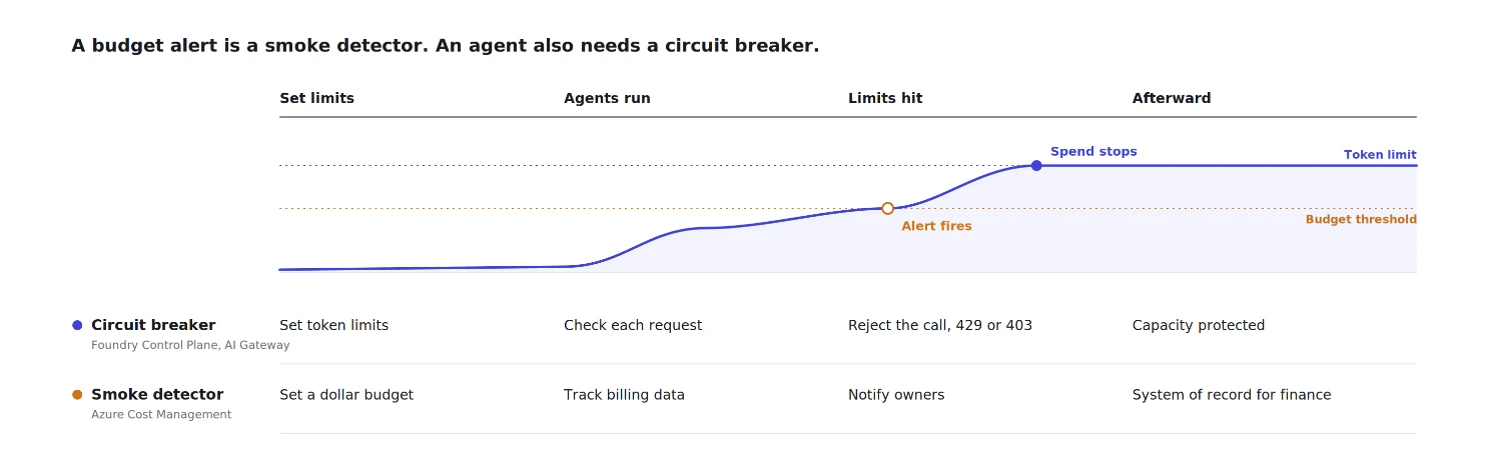
In traditional enterprise software, cost management has largely relied on reactive measures. Organizations set budget thresholds and rely on billing alerts—essentially "smoke detectors"—to notify stakeholders when a project has exceeded its fiscal allocation. However, in the context of high-speed AI agents, a billing alert is often insufficient because it triggers only after the financial damage has already occurred. If an agent enters a recursive loop, it does not pause for a budget review.
To address this, Microsoft Foundry introduces a multi-layered control system. While traditional financial budgets serve as the "system of record" for fiscal reconciliation and long-term planning, Foundry’s governance framework integrates directly into the request path. By utilizing the Azure API Management AI Gateway, organizations can implement "circuit breakers"—real-time enforcement mechanisms that monitor token usage and terminate requests or throttle throughput the moment predefined quotas are breached. This transition from reactive notification to proactive intervention is the cornerstone of modern AI governance.
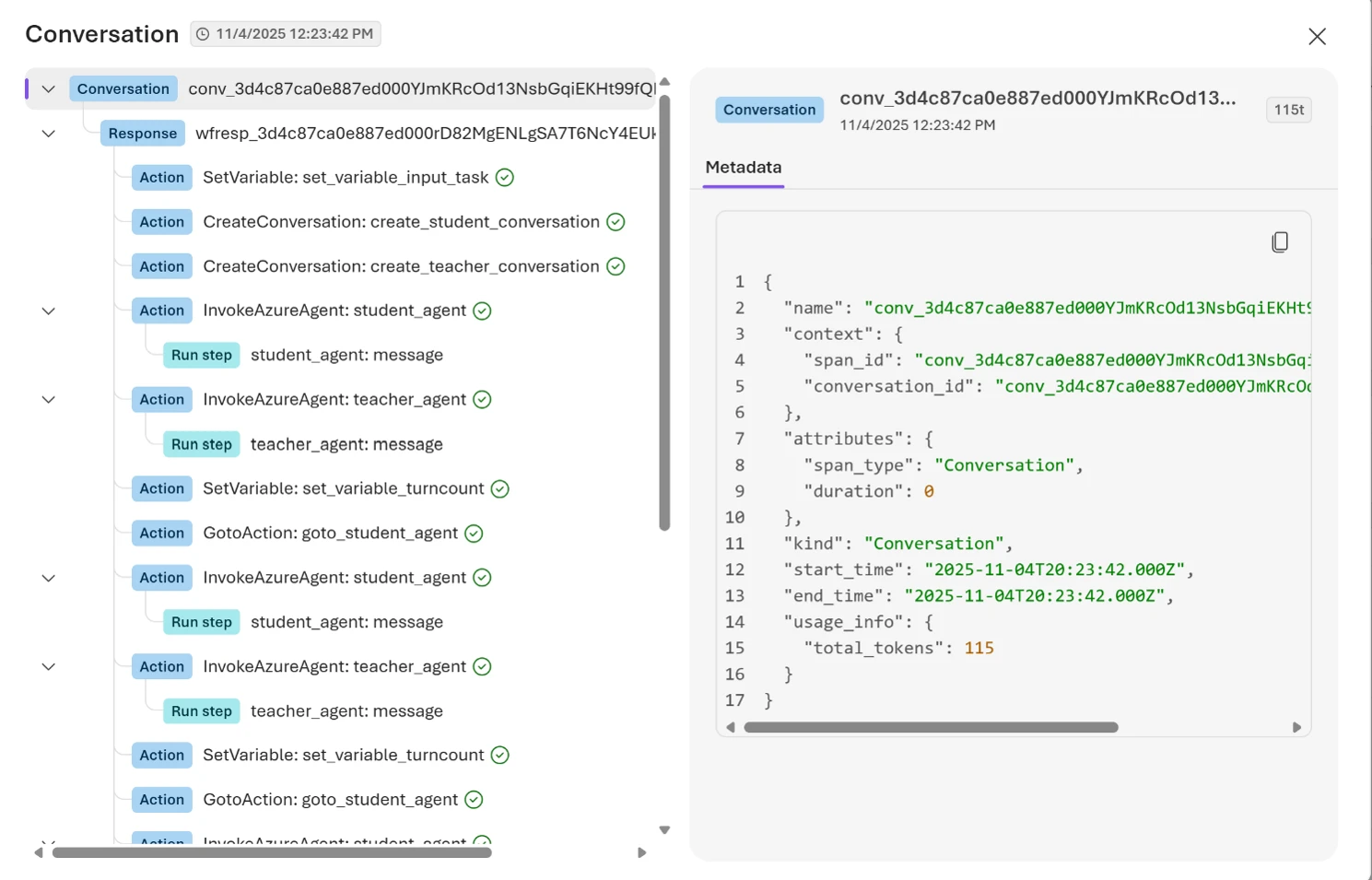
Chronology of an AI Investment Lifecycle
The maturation of an enterprise AI agent follows a predictable lifecycle, and governance must be applied at every stage to ensure cost-efficiency.
- Pilot and Exploration Phase: Initial development focuses on functional efficacy. During this stage, costs are generally low, but observability is vital to establish a baseline of "normal" consumption.
- Integration and Scaling: As agents are granted access to enterprise data and external tools, the complexity of the request path increases. Here, project-level tagging becomes essential for accurate cost attribution.
- Production and Optimization: Once fully operational, agents are subject to strict quota management and ROI analysis. At this stage, organizations must decide whether to scale, re-architect, or retire the agent based on its net business value.
By mapping these phases to the tools within the Foundry ecosystem, IT departments can move away from aggregate cost reporting—which often obscures the source of overruns—toward a granular, metadata-rich model of usage.
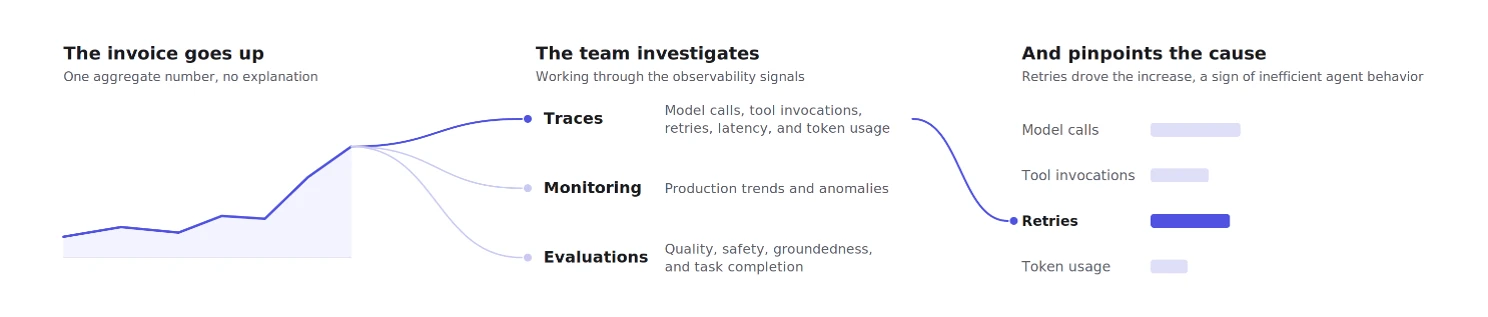
The Technical Framework for Visibility and Control
Visibility is the precursor to control. When costs arrive as a single, opaque figure on an invoice, the context of the business activity is lost. Microsoft Foundry solves this through project-level cost attribution. By automatically associating every project with a unique tag, the platform enables FinOps teams to filter costs by business unit, workload, or department. This is particularly critical for large organizations where multiple teams may share access to underlying model deployments.
Beyond simple attribution, the AI Gateway provides deep telemetry. It can emit metrics on token consumption by specific API keys, users, and even specific backend models. This allows developers to see not just how much an agent spent, but why. For example, if a spike in cost is observed, telemetry can reveal whether it was driven by an increase in legitimate customer demand, an inefficient retry loop, or a shift in the complexity of the prompts being processed.
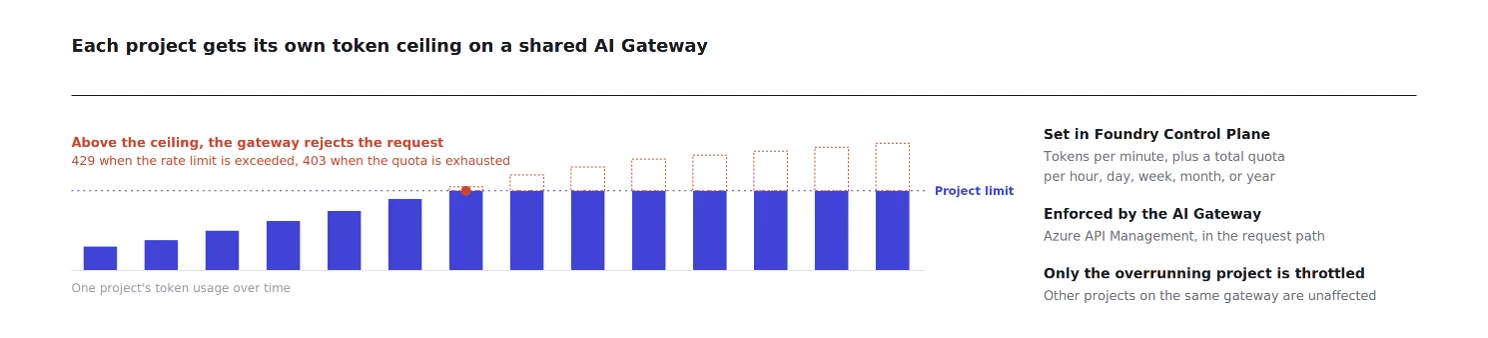
Enforcing Limits at the Request Path
The enforcement of limits within Foundry occurs at three distinct layers:
- Project-Level Quotas: Utilizing the Foundry Control Plane, administrators can set strict token-per-minute rate limits and total quotas. Requests exceeding these thresholds are immediately rejected with a 429 (Too Many Requests) or 403 (Forbidden) response. This prevents any single project from monopolizing shared resources and ensures that budget boundaries are strictly enforced.
- Provider-Agnostic Policy: Through the
llm-token-limitpolicy, organizations can apply uniform governance across different model providers, including OpenAI and Anthropic. This creates a unified "guardrail" that functions regardless of the underlying model architecture, allowing for a consistent compliance posture. - Financial Accountability: Finally, Azure Cost Management remains the primary vehicle for high-level fiscal reporting. By connecting these budgets to Azure Monitor action groups, organizations can trigger automated workflows—such as opening a ticket in an ITSM tool or alerting a manager—when costs hit specific thresholds.
Measuring Value: The ROI of Autonomous Agents
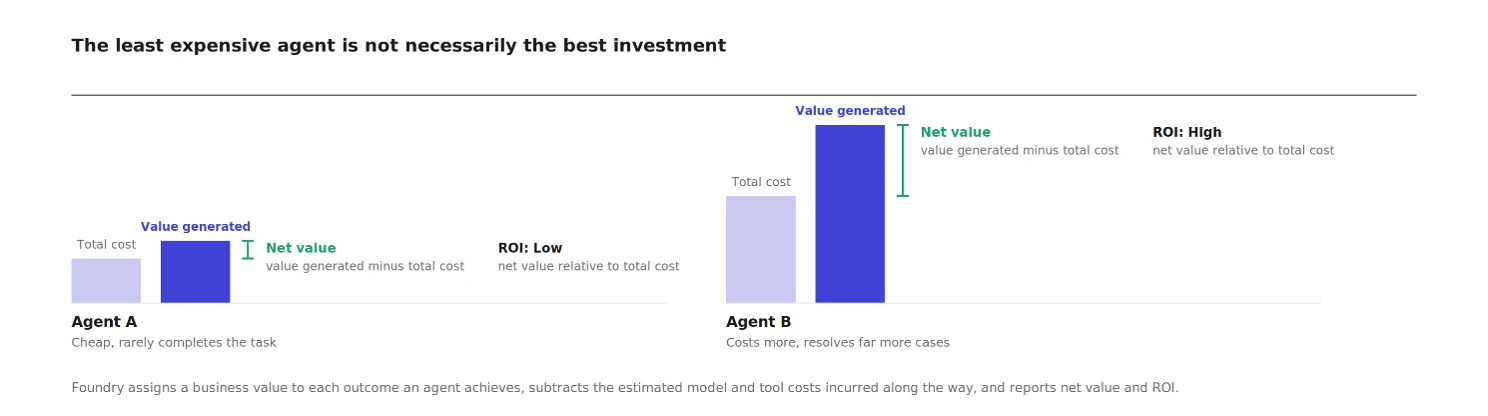
The ultimate metric for any enterprise technology is its return on investment. A common misconception in AI management is that the goal is simply to minimize costs. In reality, the goal is to maximize net value. An agent that incurs a higher cost but successfully resolves 95% of customer support inquiries is vastly superior to a "cheap" agent that requires human intervention for 70% of its tasks.
Microsoft Foundry is currently moving toward a new era of ROI-based governance, currently in private preview. This capability allows teams to define specific business outcomes—such as task completion rates or customer satisfaction scores—and assign a monetary value to these achievements. By comparing the cost of the agent’s operations against the value of the outcomes produced, leadership can make data-driven decisions about the future of their AI portfolio. This moves the conversation from technical performance metrics, such as "tokens per prompt," to strategic business metrics, such as "net value generated per conversation."
Implications for the Future of Enterprise AI
The implication of this structured governance is a shift in how AI is viewed within the corporate hierarchy. By treating AI as a "managed investment system," IT and business units are forced to speak the same language. Developers are provided with the tools to build agents that are inherently efficient, while financial planners are provided with the visibility needed to authorize further investment.
Industry analysts suggest that this trend toward "FinOps for AI" will become the standard for all major enterprises over the next 24 to 36 months. As agents become more autonomous, the risk of "shadow AI" and unmanaged consumption grows. Organizations that implement centralized, policy-driven governance today will be better positioned to capitalize on the productivity gains offered by agentic workflows without suffering the volatility of unmanaged operational costs.
Conclusion: Running AI as a Strategic Asset
Managing AI costs is not a one-time task; it is a continuous cycle of observation, adjustment, and evaluation. It requires the coordination of three different speeds of operation: the immediate response of runtime circuit breakers, the mid-term refinement of workflows through context engineering, and the long-term strategic alignment provided by financial governance.
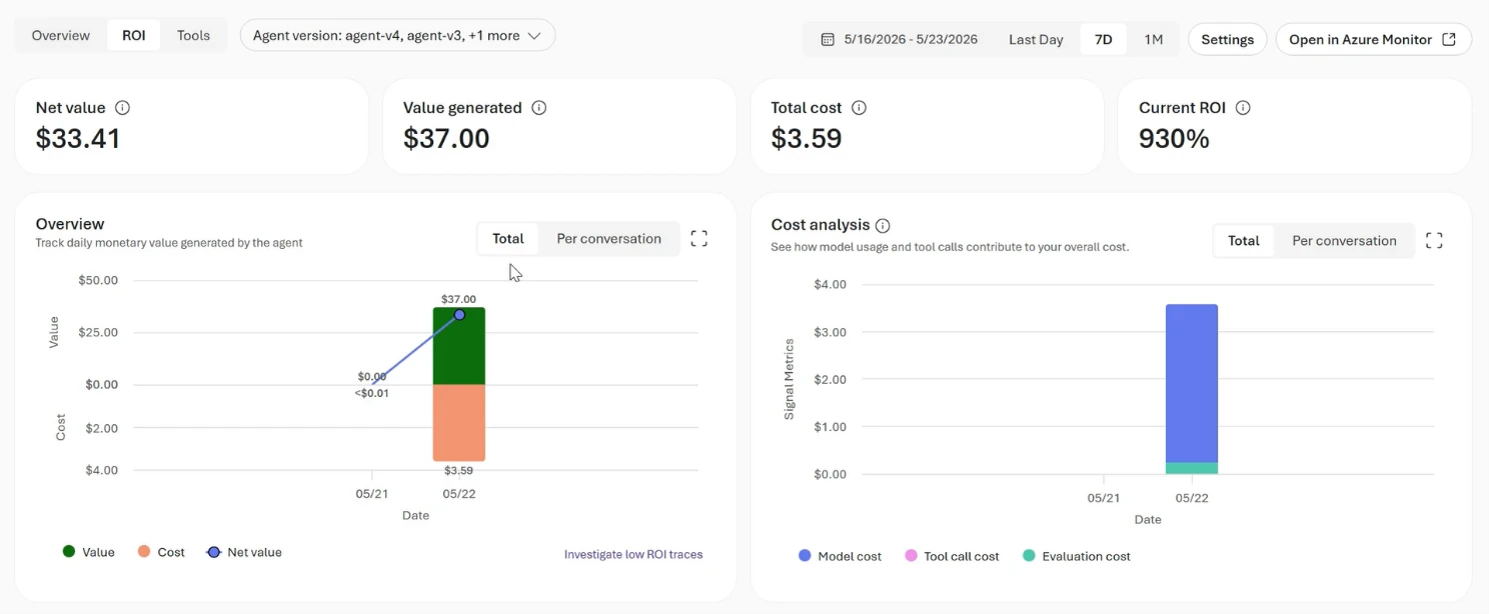
By utilizing the capabilities within Microsoft Foundry—from the observability provided by tracing to the hard limits enforced by the AI Gateway—organizations can ensure that their AI agents remain within predefined operating boundaries. Ultimately, the success of an agentic enterprise depends on its ability to prove that its AI initiatives are not just innovative, but profitable. As organizations continue to scale their AI footprints, the ability to clearly articulate the relationship between tokens, dollars, and business value will become the primary differentiator between those who successfully leverage AI and those who are derailed by the cost of their own ambition.
For organizations currently building out their agentic architectures, the path forward is clear: initiate by making consumption visible, apply request-time limits to protect capacity, and rigorously evaluate the return on every agent deployed. Through this discipline, AI transitions from a speculative expense to a predictable, value-generating asset.