GitHub Copilot Runtime Completes Massive 800,000-Line Rewrite from TypeScript to Rust Powered by AI Agents


The core infrastructure powering the GitHub Copilot ecosystem has undergone a monumental architectural transformation. GitHub announced the successful porting of the Copilot agent runtime—the underlying harness backing the Copilot CLI, mobile and desktop applications, and software development kits (SDKs)—from TypeScript and Node.js to more than 800,000 lines of production-grade Rust.
Executed over a rapid fourteen-and-a-half-week window, the project represents a watershed moment for software engineering. The rewrite was accomplished primarily by a single lead developer supervising an autonomous fleet of AI agents, signaling a profound shift in how large-scale enterprise refactoring and migrations can be conducted. Rather than halting feature development for a multi-year engineering overhaul, the team shipped the Rust implementation incrementally directly into the main repository, completely eliminating the legacy JavaScript runtime stack while achieving orders-of-magnitude performance improvements.
Background and Strategic Imperatives for the Port
Originally engineered in TypeScript on Node.js utilizing the V8 JavaScript engine, the Copilot agent runtime expanded rapidly as AI capabilities matured. However, architectural bottlenecks began to emerge as the runtime was integrated into an increasingly diverse array of products, including Visual Studio Code, Visual Studio, Copilot Code Review, Copilot Cowork, Copilot Studio, and integrations within Microsoft 365 applications like Excel, Word, PowerPoint, and Outlook.

Initially, many of these individual software products implemented custom agent loops before standardizing on the GitHub Copilot SDK. Because the original runtime was tightly coupled with a command-line terminal user interface (TUI), programmatic access required an out-of-process architecture. Consuming applications in languages such as C#, Python, Go, Java, and Rust were forced to spawn the Copilot CLI as a headless subprocess, communicating via a JSON-RPC protocol over pipes or sockets.
This decoupled architecture introduced severe performance trade-offs. Every client instantiation required spinning up an entire Node.js and V8 environment, parsing substantial quantities of JavaScript, generating bytecode, and initializing Just-In-Time (JIT) compilation tiers. Consequently, downstream applications paid a heavy performance tax: a mandatory working set overhead of approximately 100 megabytes per client, increased latency on process hops, restricted throughput for CPU-bound tasks, and complex multi-process monitoring. To eliminate these dependencies and satisfy strict enterprise demands for rapid startup times, low memory consumption, and high server density, engineering leadership targeted Rust as the replacement stack.
Chronology and In-Place Migration Strategy
The migration project commenced in early May 2026. Initial sizing estimates projected a manageable TypeScript codebase of roughly 130,000 lines. However, concurrent feature development throughout the migration cycle meant that approximately 430,000 lines of production TypeScript ultimately flowed through the porting pipeline.
Faced with the choice between a greenfield rewrite in an isolated branch or an in-place incremental migration, the engineering team selected the latter. A "big-bang" cutover approach was dismissed due to the high risk of catastrophic integration failures within a fast-moving repository receiving hundreds of pull requests weekly.
Instead, the migration followed a disciplined, bottom-up trajectory:
- May 2026: Initialization of the Rust workspace, defining lint rules, continuous integration (CI) build pipelines, and establishing core interop patterns using pure-logic primitives devoid of input/output operations or shared state.
- June 2026: Systematic migration of leaf utilities, content exclusion tools, and shell utilities. Temporary interop bridges using the
napiRust crate enabled seamless bidirectional communication between Rust code and remaining TypeScript components. - July 2026: Progressive porting of stateful subsystems, authorization layers, telemetry, plugins, settings persistence, and Model Context Protocol (MCP) integrations.
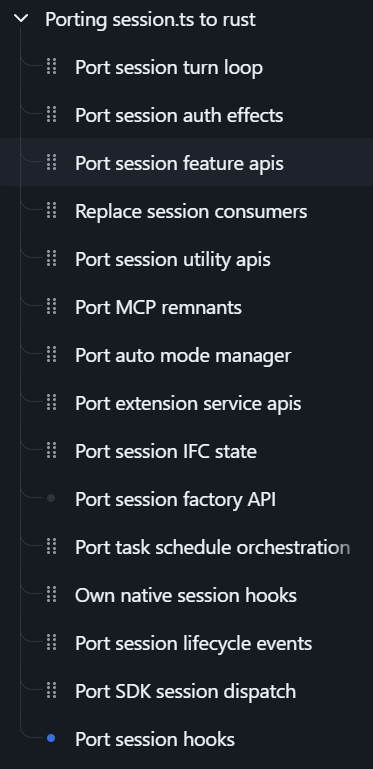
- August 2026: Tackling complex core orchestration layers, notably the expansive
session.tssubsystem spanning roughly 30,000 lines of logic at the center of the application state. - August 21, 2026: The Copilot agent runtime reached 100% production Rust, encompassing 832,378 lines of production code and 468,689 lines of unit tests, while retiring all internal TypeScript and N-API interop seams.
Throughout this 14.5-week window, the repository maintained continuous delivery. The main branch shipped 135 releases—comprising 100 pre-release versions and 35 stable versions—averaging roughly 1.3 public releases per day. This continuous deployment strategy ensured that regressions were surfaced immediately by real-world usage within Microsoft and GitHub, allowing developers to isolate and patch defects within hours.
Quantitative Analysis and Operational Scale
The scale of the migration is captured in comprehensive telemetry compiled from internal pull request logs and structured agent session event logs. Across the entire porting lifecycle, the automated agents and human supervisor processed staggering quantities of data:
- Total Runtime Events Logged: 12,760,995
- Assistant Messages Processed: 1,385,214
- Tool Invocations Recorded: 1,857,409
- Automated Context Compactions: 5,116
- Total Prompt-Cache Hit Rate: 96.22%
Prompt caching proved essential to the economic viability of long-running autonomous agent sessions. By maintaining a stable system prompt, tool definitions, and conversation history prefix, the system achieved a 96.22% cache read rate, reducing token inference costs by an order of magnitude.
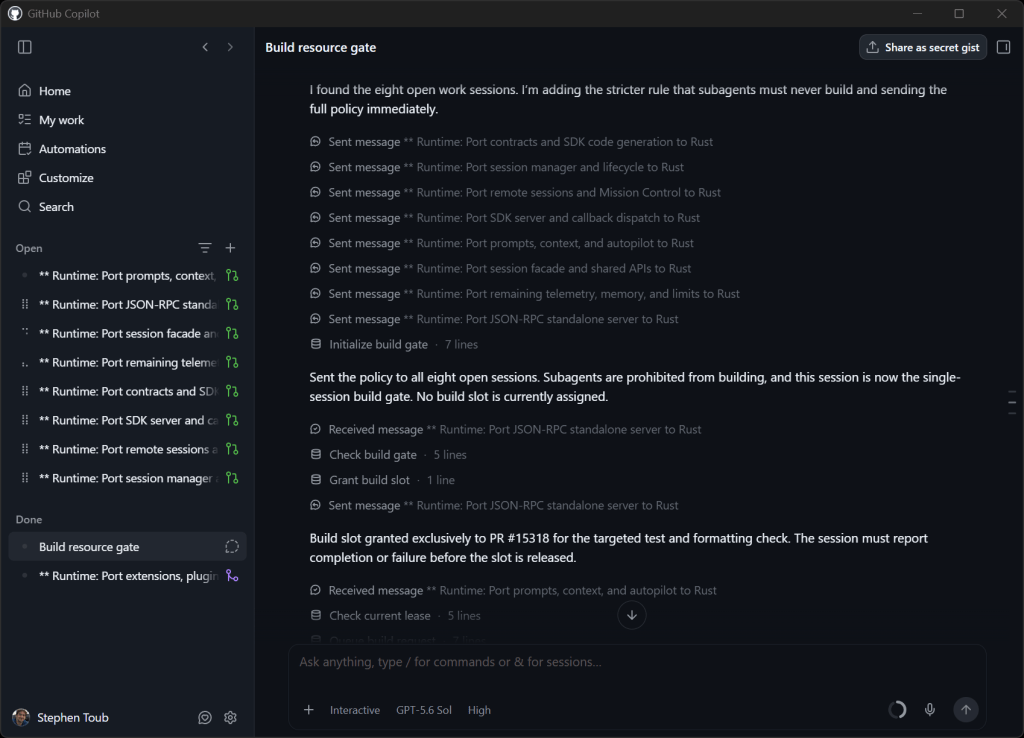
An analysis of human-authored supervisory messages (totaling 2,639 interactions) revealed that 31% of the lead engineer’s time was dedicated to review, testing, and CI oversight; 17.4% involved challenging technical and architectural decisions; and 15% focused on driving task completion. Rather than writing raw syntax, the human engineer operated as a control loop manager—framing boundaries, adjudicating exceptions, and enforcing architectural quality gates.
Architectural Breakthroughs: In-Process and Out-of-Process Hosting
The successful port to Rust unlocked a dual-front-door architecture for the Copilot SDK, which supports six languages: TypeScript, Python, Go, C#, Java, and Rust.
While the traditional out-of-process JSON-RPC server architecture remains available for backward compatibility, the completion of the Rust runtime enables native in-process hosting via a C Application Binary Interface (ABI). Consuming applications can now load the compiled runtime directly into their own memory space as a standard dynamic library (.dll, .so, or .dylib).
Language-specific bindings utilize native interop mechanisms—such as P/Invoke for C#, purego for Go, JNA for Java, cffi for Python, libloading for Rust, and koffi for TypeScript—to instantiate clients directly in-process. This eliminates the inter-process communication overhead, reduces memory footprints, and removes the requirement for client applications to bundle or locate a separate Node.js runtime environment.
Performance Verification and Scalability Gains
Comparative benchmarking conducted via the C# SDK before and after the migration demonstrated dramatic performance enhancements across key operational metrics. By bypassing Node.js startup sequences, JavaScript parsing, and V8 bytecode generation, baseline execution speeds improved exponentially:
- Client, Session, and Single Turn: Completed in 5.25 seconds under the legacy TypeScript architecture, compared to 1.33 seconds for Rust out-of-process, and 292 milliseconds for Rust in-process (an 18-fold acceleration).
- Session Resumption (32-turn history): Improved from 5.64 seconds down to 264 milliseconds in-process (a 21.4-fold acceleration).
- High-Throughput Lifecycles (1,000 single-turn sessions): Throughput increased from 7.55 sessions per second in TypeScript to 120.0 sessions per second using the in-process Rust configuration.
- Resource Consumption: Resident private memory overhead for a ten-client batch dropped from 1,383 MB above baseline down to 126 MB in-process—a 91% reduction in memory overhead. Aggregate CPU utilization during stress tests similarly plummeted from 312 seconds of compute time to approximately 110 seconds.
Industry Implications and Future Outlook
The successful execution of this massive codebase rewrite has sparked widespread discussion across the software engineering community regarding the viability of AI-driven large-scale migrations. Industry analysts note that undertaking an 800,000-line rewrite of core production infrastructure would historically have required a dedicated team of engineers operating over a multi-year timeline, making it economically unfeasible against competing product feature priorities.
By leveraging autonomous agent fleets, structured prompt engineering, automated review loops, and rigorous CI gates, Microsoft and GitHub completed the migration with an attributed token cost of approximately $120,000 alongside a fraction of a single developer’s direct oversight time.
Moving forward, engineering teams plan to leverage Rust’s native memory ownership and concurrency models to further optimize the runtime architecture. With the removal of Node.js constraints, the Copilot agent runtime is now positioned for seamless deployment across cloud services, desktop environments, edge devices, and embedded systems, establishing a highly scalable foundation for the next generation of AI-assisted software development.